Zollner Andreas, Meyer Moritz, Jukic Almina, Adolph Timon, Tilg Herbert
Department of Internal Medicine I, Gastroenterology, Hepatology, Endocrinology & Metabolism, Medical University of Innsbruck, Innsbruck, Austria.
Yale J Biol Med. 2024 Dec 19;97(4):447-462. doi: 10.59249/PMIE8461. eCollection 2024 Dec.
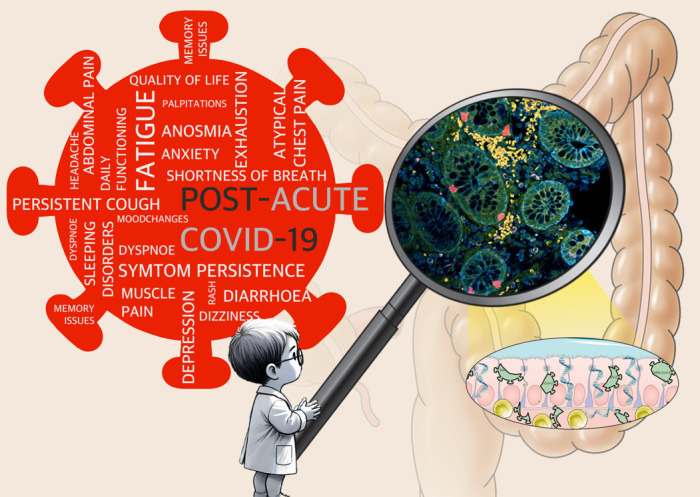
Post-Acute Sequelae of SARS-CoV-2 infection (PASC), commonly known as Long COVID, represents a significant and complex health challenge with a wide range of symptoms affecting multiple organ systems. This review examines the emerging evidence suggesting a critical role of the gut and gut-brain axis in the pathophysiology of Long COVID. It explores how changes in the gut microbiome, disruption of gut barrier integrity, and the persistence of SARS-CoV-2 antigens within the gastrointestinal tract may contribute to the prolonged and varied symptoms seen in Long COVID, including chronic inflammation and neuropsychiatric disturbances. The review also summarizes key insights gained about Long COVID, highlighting its multifactorial nature, which involves immune dysregulation, microvascular damage, and autonomic nervous system dysfunction, with the gut playing a central role in these processes. While progress has been made in understanding these mechanisms, current evidence remains inconclusive. The challenges of establishing causality, standardizing research methodologies, and addressing individual variations in the microbiome are discussed, emphasizing the need for further longitudinal studies and more comprehensive approaches to enhance our understanding of these complex interactions. This review underscores the importance of personalized approaches in developing effective diagnostic and therapeutic strategies for Long COVID, while also acknowledging the significant gaps in our current understanding. Future research should aim to further unravel the complex interplay between the gut and Long COVID, ultimately improving outcomes for those affected by this condition.
2019冠状病毒病感染后急性后遗症(PASC),通常称为长期新冠,是一项重大而复杂的健康挑战,其症状广泛,影响多个器官系统。本综述审视了新出现的证据,这些证据表明肠道及肠-脑轴在长期新冠的病理生理学中起关键作用。它探讨了肠道微生物群的变化、肠道屏障完整性的破坏以及胃肠道内2019冠状病毒病抗原的持续存在如何可能导致长期新冠中出现的持续且多样的症状,包括慢性炎症和神经精神障碍。该综述还总结了关于长期新冠的关键见解,强调了其多因素性质,这涉及免疫失调、微血管损伤和自主神经系统功能障碍,肠道在这些过程中起核心作用。虽然在理解这些机制方面已取得进展,但目前的证据仍无定论。文中讨论了确定因果关系、规范研究方法以及解决微生物群个体差异方面的挑战,强调需要进一步开展纵向研究并采用更全面的方法,以增进我们对这些复杂相互作用的理解。本综述强调了个性化方法在制定长期新冠有效诊断和治疗策略中的重要性,同时也承认我们目前理解中存在的重大差距。未来的研究应旨在进一步揭示肠道与长期新冠之间的复杂相互作用,最终改善受此疾病影响者的预后。