Meherali Salima, Hussain Amber, Rahim Komal Abdul, Idrees Sobia, Bhaumik Soumyadeep, Kennedy Megan, Lassi Zohra S
University of Alberta, Edmonton, AB, Canada.
Edmonton Clinic Health, Faculty of Nursing, University of Alberta,11405 87 Ave NW, Edmonton, Alberta, Canada T6G 1C9.
Ther Adv Reprod Health. 2024 Dec 18;18:26334941241307881. doi: 10.1177/26334941241307881. eCollection 2024 Jan-Dec.
Digital knowledge translation (KT) interventions play a crucial role in advancing adolescent sexual and reproductive health (ASRH). Despite the extensive literature on their effectiveness, there's a lack of synthesized evidence on the efficacy of digital KT tools for adolescent ASRH globally.
This review aimed to systematically identify and map existing empirical evidence on digital KT tools targeting ASRH outcomes and identify research gaps.
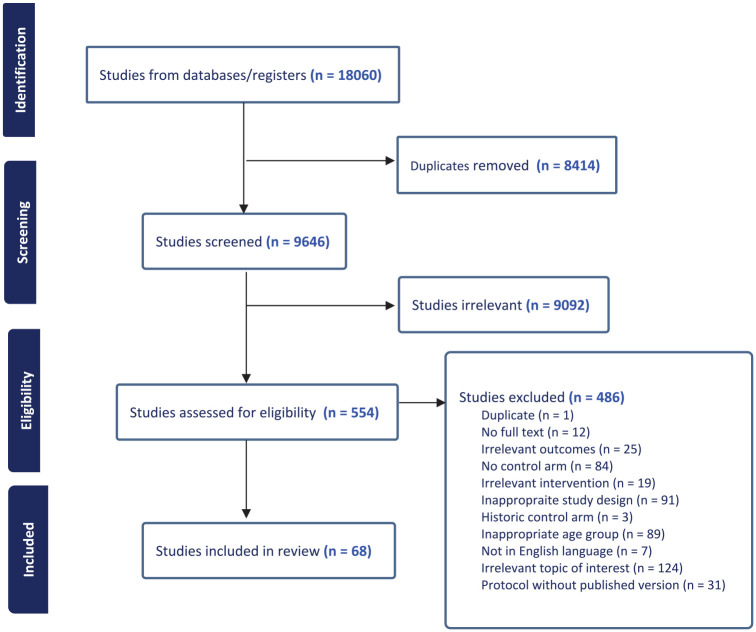
The review employed an evidence gap-map (EGM) approach following 2020 PRISMA reporting guidelines.
A comprehensive literature search was conducted across databases including Medline, EMBASE, Global Health, CINAHL, Scopus, and Cochrane. Covidence software was used for data management. EPPI-Mapper software was used to synthesize findings and develop a graphical EGM.
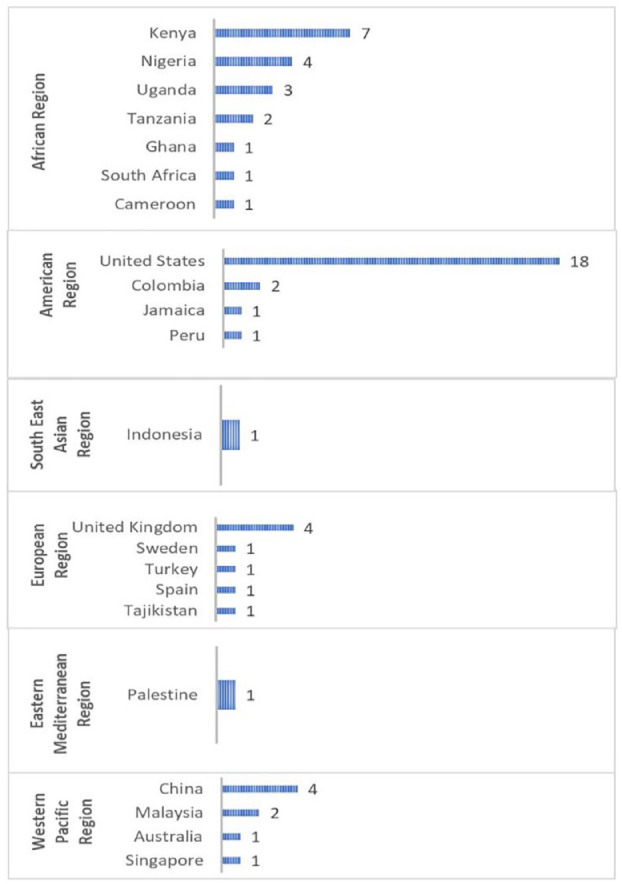
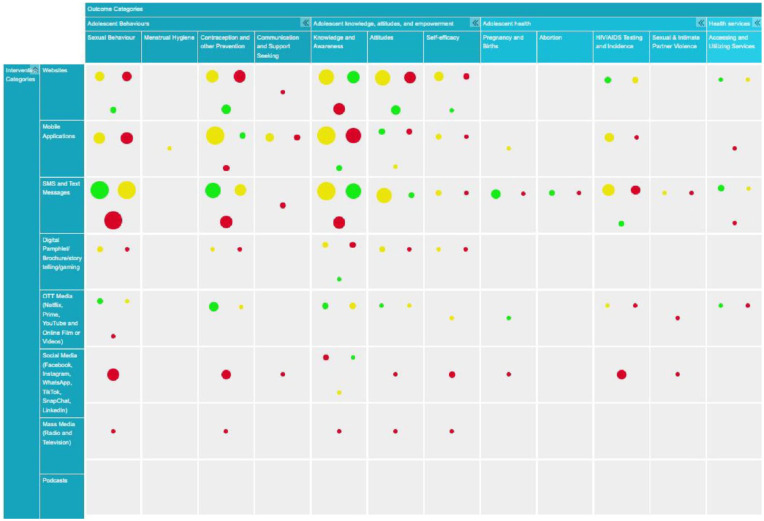
The EGM comprises 68 studies: 59 experimental and 9 systematic reviews, predominantly from African (19 studies) and American regions (22 studies), with limited research from the Eastern Mediterranean and South East Asian regions. It examines digital KT tools' influence on sexual and reproductive health (SRH) outcomes, identifying research gaps. Websites are extensively studied for their impact on adolescent behavior, knowledge, attitude, and self-efficacy, yet research on their effects on ASRH and health services access is limited. Similarly, mobile apps and short message service (SMS)/text messages impact various aspects of SRH outcomes, but research on their effects on health services utilization is insufficient. Interventions like digital pamphlets and gaming lack exploration in health service access. OTT media and social media need further investigation. Mass media, including radio, television, and podcasts, are largely unexplored in adolescent SRH outcomes. Topics such as menstrual hygiene, abortion, and sexual and intimate partner violence also lack research.
The review underscores the dominance of certain KT tool interventions like SMS and websites. Despite advancements, research gaps persist in exploring diverse digital platforms on underrepresented outcomes globally. Future research should expand exploration across digital platforms and broaden the scope of outcome measures.
The protocol is registered with PROSPERO (CRD42022373970).
数字知识转化(KT)干预措施在促进青少年性与生殖健康(ASRH)方面发挥着关键作用。尽管关于其有效性的文献众多,但全球范围内缺乏关于数字KT工具对青少年ASRH有效性的综合证据。
本综述旨在系统地识别和梳理针对ASRH结果的数字KT工具的现有实证证据,并找出研究空白。
本综述遵循2020年PRISMA报告指南采用证据缺口图(EGM)方法。
在包括Medline、EMBASE、全球健康、护理学与健康领域数据库(CINAHL)、Scopus和Cochrane在内的数据库中进行了全面的文献检索。使用Covidence软件进行数据管理。使用EPPI-Mapper软件综合研究结果并绘制图形化的EGM。
该EGM包含68项研究:59项实验研究和9项系统评价,主要来自非洲(19项研究)和美洲地区(22项研究),东地中海和东南亚地区的研究有限。它考察了数字KT工具对性与生殖健康(SRH)结果的影响,识别出研究空白。网站对青少年行为、知识、态度和自我效能的影响得到了广泛研究,但对其对ASRH和医疗服务获取的影响研究有限。同样,移动应用程序和短消息服务(SMS)/短信对SRH结果的各个方面有影响,但对其对医疗服务利用的影响研究不足。数字宣传册和游戏等干预措施在医疗服务获取方面缺乏探索。OTT媒体和社交媒体需要进一步研究。包括广播、电视和播客在内的大众媒体在青少年SRH结果方面基本未被探索。月经卫生、堕胎以及性暴力和亲密伴侣暴力等主题也缺乏研究。
该综述强调了某些KT工具干预措施(如短信和网站)的主导地位。尽管取得了进展,但在全球范围内探索未得到充分研究的结果的各种数字平台方面,研究空白仍然存在。未来的研究应扩大对数字平台的探索,并拓宽结果测量的范围。
该方案已在国际前瞻性系统评价注册库(PROSPERO)注册(注册号:CRD42022373970)。