Gu Lihua, Zhang Pengcheng, Gao Rui, Shu Hao, Wang Pan
Department of Neurology, Tianjin Huanhu Hospital, Tianjin, China.
Academy of Military Medical Sciences, Academy of Military Sciences, Tianjin, China.
Front Aging Neurosci. 2024 Dec 5;16:1465016. doi: 10.3389/fnagi.2024.1465016. eCollection 2024.
Neurofilament light chain (NfL) has recently emerged as a key indicator of neurodegeneration. In this study, our hypothesis is that the levels of blood-derived NfL and its accumulation during the Parkinson's disease (PD) progression could serve as a potential biomarker for predicting subsequent cognitive decline. To investigate this, we conducted a study utilizing a large single-center cohort.
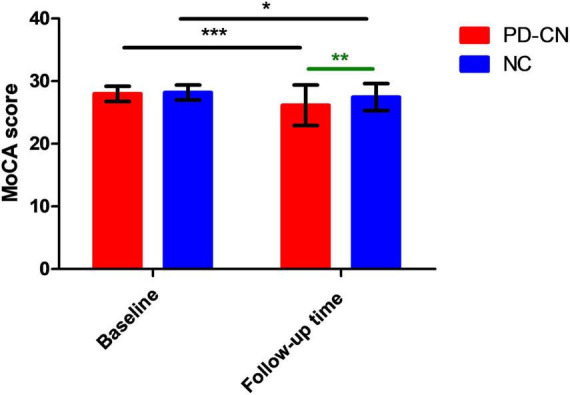
The study included 193 participants, consisting of 106 cognitively normal PD (PD-CN) patients and 87 normal controls (NC) individuals. Serum NfL concentrations were measured. PD patients were followed up for clinical assessment at an average of 2 ± 0.6 years.
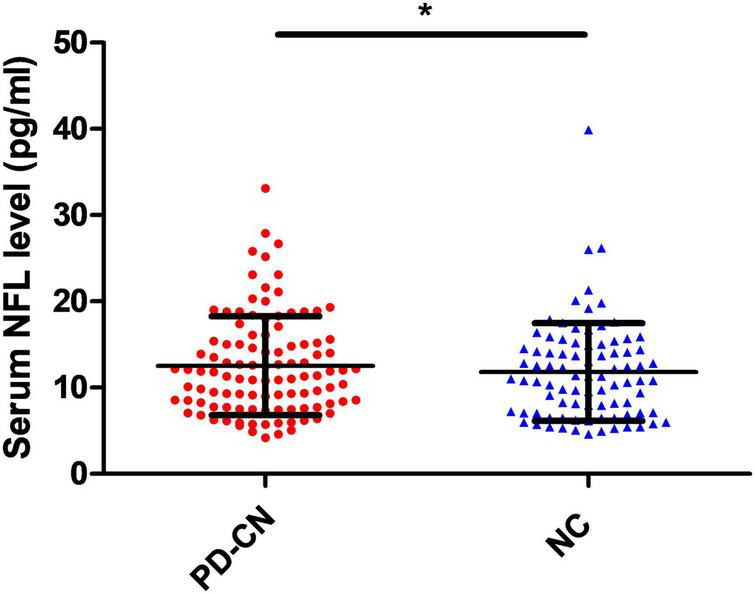
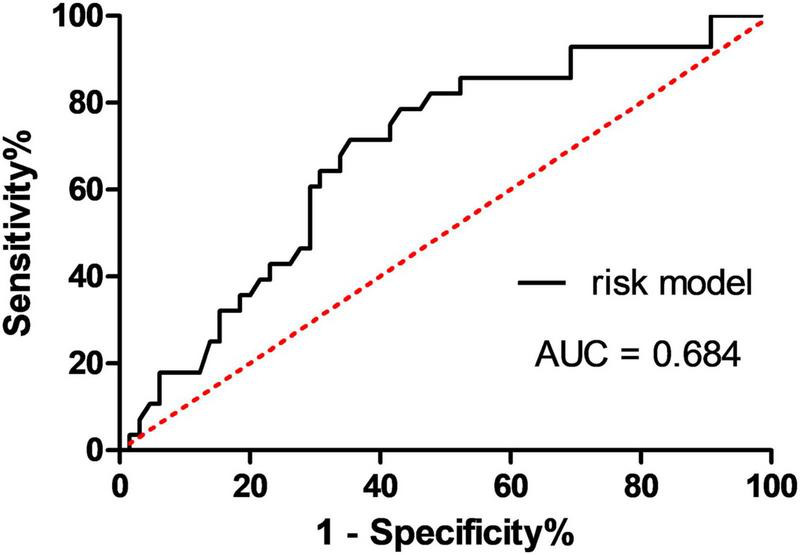
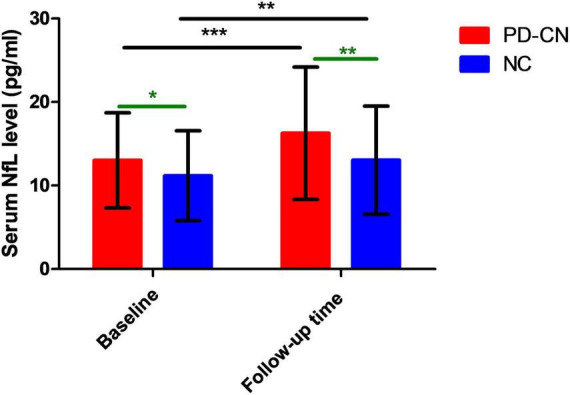
The serum NfL levels were significantly higher in PD-CN patients compared to NC. PD-CN patients and NC at follow-up time exhibited higher serum NfL levels compared to those at baseline. PD patients with high serum NfL levels were found to have a higher likelihood of transitioning from normal cognition to mild cognitive impairment (MCI) or dementia (Hazard ratio (HR) 1.107, 95% confidence intervals (CI) 1.010-1.213, = 0.030). The area under the curve (AUC) for PD-CN conversion to MCI or dementia at follow-up time was determined to be 0.684 (95% CI 0.569-0.799).
In conclusion, our study found that PD patients have significantly higher levels of serum NfL compared to individuals without PD. Furthermore, serum NfL levels increase as PD progresses and can predict cognitive impairment within a 2-year timeframe. Serum NfL may serve as a feasible, non-invasive biomarker of cognitive progression in PD. However, further studies and functional experiments are needed to validate these findings.
神经丝轻链(NfL)最近已成为神经退行性变的关键指标。在本研究中,我们的假设是,帕金森病(PD)进展过程中血液中NfL的水平及其积累可作为预测随后认知衰退的潜在生物标志物。为了对此进行研究,我们利用一个大型单中心队列进行了一项研究。
该研究纳入了193名参与者,包括106名认知正常的PD(PD-CN)患者和87名正常对照(NC)个体。测量了血清NfL浓度。对PD患者进行了平均2±0.6年的临床随访评估。
与NC相比,PD-CN患者的血清NfL水平显著更高。随访时的PD-CN患者和NC的血清NfL水平高于基线时。血清NfL水平高的PD患者从正常认知转变为轻度认知障碍(MCI)或痴呆的可能性更高(风险比(HR)1.107,95%置信区间(CI)1.010 - 1.213,P = 0.030)。随访时PD-CN转变为MCI或痴呆的曲线下面积(AUC)确定为0.684(95%CI 0.569 - 0.799)。
总之,我们的研究发现,与无PD的个体相比,PD患者的血清NfL水平显著更高。此外,血清NfL水平随PD进展而升高,并且可以在2年时间内预测认知障碍。血清NfL可能作为PD认知进展的一种可行的、非侵入性生物标志物。然而,需要进一步的研究和功能实验来验证这些发现。