Chen Zhida, Gao Yunhe, Zhang Pengfei, Liu Yi, Wei Bo, Chen Lin, Xi Hongqing
Department of General Surgery, First Medical Center of Chinese, PLA General Hospital, Haidian District, No.28 Fuxing Road, Beijing, 100853, China.
PLA School of Medicine, Beijing, 100853, China.
Cell Biol Toxicol. 2024 Dec 21;41(1):12. doi: 10.1007/s10565-024-09960-8.
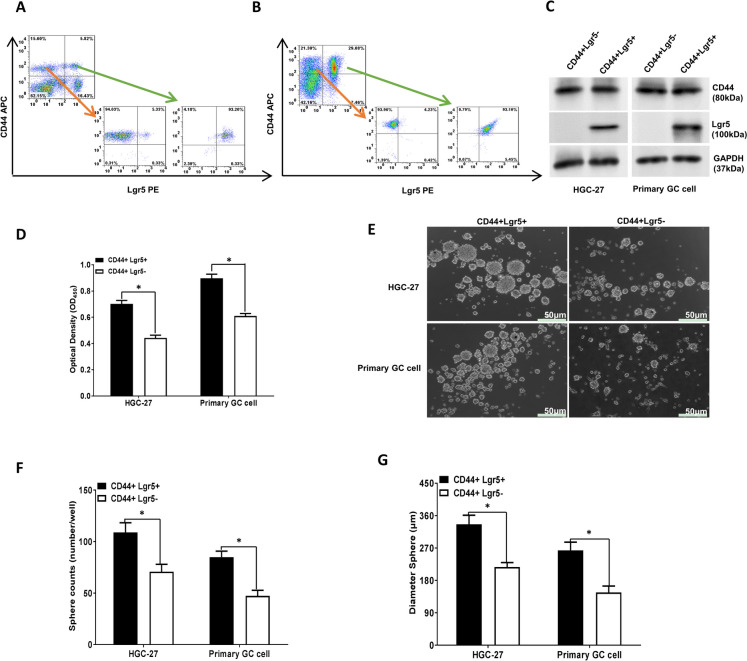
Accumulating evidences have indicated that cancer stem cells (CSCs) can initiate tumor progression and cause recurrence after therapy. However, specific markers of gastric CSCs (GCSCs) from different origins have not been comprehensively revealed. Here, we further detected whether cell populations labelled with CD44 and Lgr5, well-recognized stem markers for gastric cancer (GC), can better emphasize cancer initiation, therapeutic resistance and recurrence. Flow cytometry was utilized to sort the CD44 + Lgr5 + and CD44 + Lgr5- cells from GC cell line HGC-27 and primary GC cells. The influences of CD44 and Lgr5 GCSCs on the malignant behaviors and their potential mechanisms was investigated, respectively. In our study, we reported the identification and validation of CD44 + Lgr5 + cells that presented stronger stemness characteristics, as evidenced by increase of sphere forming ability, elevation of stem cell transcriptional activity. Additionally, CD44 + Lgr5 + double positive cells have lower apoptosis, greater chemotherapy resistance, and higher EMT capacity and LC3 density compared with CD44 + Lgr5- cells. Tumor xenograft experiments also verified the faster carcinogenesis of CD44 + Lgr5 + GCSCs. Furthermore, a series of key proteins in the Wnt, Hedgehog, Notch, and TGF-β pathways were elevated in the CD44 + Lgr5 + double positive subpopulation, except for Notch 1 and Smad 1. In conclusion, the binding of CD44 and Lgr5 can serve as a precise GCSCs marker that initiate malignant progression and chemotherapy resistance in GC by activating Wnt, Hedgehog, Notch, TGF-β pathways. Those evidences raise the needs to target both markers simultaneously as a potential approach for the GC treatment.
越来越多的证据表明,癌症干细胞(CSCs)能够启动肿瘤进展并导致治疗后复发。然而,来自不同来源的胃癌症干细胞(GCSCs)的特异性标志物尚未得到全面揭示。在此,我们进一步检测了用CD44和Lgr5标记的细胞群体,这两种被广泛认可的胃癌(GC)干细胞标志物,是否能更好地突显癌症起始、治疗抗性和复发情况。利用流式细胞术从GC细胞系HGC - 27和原发性GC细胞中筛选出CD44 + Lgr5 +和CD44 + Lgr5-细胞。分别研究了CD44和Lgr5 GCSCs对恶性行为的影响及其潜在机制。在我们的研究中,我们报道了对CD44 + Lgr5 +细胞的鉴定和验证,这些细胞表现出更强的干性特征,如成球能力增强、干细胞转录活性升高。此外,与CD44 + Lgr5-细胞相比,CD44 + Lgr5 +双阳性细胞具有更低的凋亡率、更强的化疗抗性以及更高的上皮-间质转化能力和LC3密度。肿瘤异种移植实验也证实了CD44 + Lgr5 + GCSCs的致癌速度更快。此外,除了Notch 1和Smad 1外,Wnt、Hedgehog、Notch和TGF-β信号通路中的一系列关键蛋白在CD44 + Lgr5 +双阳性亚群中均有升高。总之,CD44和Lgr5的结合可作为一种精确的GCSCs标志物,通过激活Wnt、Hedgehog、Notch、TGF-β信号通路引发GC的恶性进展和化疗抗性。这些证据表明,同时靶向这两种标志物作为GC治疗的潜在方法是有必要的。