Che Chenxi, Yang Peng, Qin Kangxiang, Li Yuntao, Fan Ziwei, Li Wenjun, Gao Shan, Wang Chunlin, Mu Changkao, Wang Huan
School of Marine Science, Ningbo University, Ningbo, Zhejiang, China.
Key Laboratory of Aquacultral Biotechnology Ministry of Education, Ningbo University, Ningbo, Zhejiang, China.
BMC Genomics. 2024 Dec 20;25(1):1232. doi: 10.1186/s12864-024-11138-9.
In recent years, the total production of mud crab Scylla paramamosain has been declining, and the breeding areas are faced with land shortage and shortage of breeding production, which needs to be solved urgently. S. paramamosain can survive and grow in a wide range of salinities is an excellent variety suitable for saline-alkali water aquaculture. As a species with high economic value and strong adaptability to the environment, its cultivation under low salt conditions can not only improve the utilization efficiency of saline-alkali land, but also provide new possibilities for the sustainable development of aquaculture.
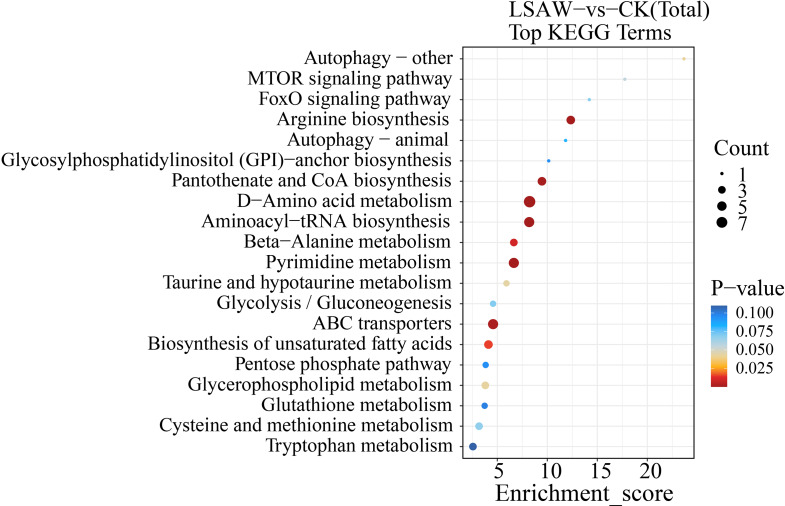
A total of 248 different metabolites were identified by LC/GC-MS in the intestinal tract of S. paramamosain. These different metabolites were mainly concentrated in 'Lipids and lips-like molecules'. Among them, 112 metabolites are upregulated, and among these upregulated metabolites are mainly 'Fatty Acyls' and 'Glycerophospholipids'. The upregulation of these metabolites indicates an increase in lipid storage of S. paramamosain, which may increase the resistance of S. paramamosain to adverse environmental stress. Among them, 136 metabolic differentiates were down-regulated, mainly 'Carboxylic acids and derivatives'. The down-regulation of these organic acids may indicate that organic acids are used as energy sources for the immune response to long-term environmental stress.
Under long-term chloride type low-salt saline-alkali water stress, S. paramamosain will shift to another homeostasis for development.
近年来,拟穴青蟹的总产量一直在下降,养殖区域面临土地短缺和养殖产量不足的问题,亟待解决。拟穴青蟹能在较广盐度范围内生存和生长,是适合盐碱水养殖的优良品种。作为一种经济价值高且对环境适应性强的物种,其在低盐条件下养殖不仅能提高盐碱地的利用效率,还能为水产养殖业的可持续发展提供新的可能性。
通过液相色谱/气相色谱-质谱联用技术在拟穴青蟹肠道中总共鉴定出248种不同的代谢物。这些不同的代谢物主要集中在“脂质和类脂分子”中。其中,112种代谢物上调,在这些上调的代谢物中主要是“脂肪酰基”和“甘油磷脂”。这些代谢物的上调表明拟穴青蟹的脂质储存增加,这可能会增加拟穴青蟹对不利环境胁迫的抵抗力。其中,136种代谢物下调,主要是“羧酸及其衍生物”。这些有机酸的下调可能表明有机酸被用作长期环境胁迫下免疫反应的能量来源。
在长期氯化物型低盐盐碱水胁迫下,拟穴青蟹将转向另一种内稳态进行发育。