• 文献检索
  • 文档翻译
  • 深度研究
  • 学术资讯
  • Suppr Zotero 插件Zotero 插件
  • 邀请有礼
  • 套餐&价格
  • 历史记录
应用&插件
Suppr Zotero 插件Zotero 插件浏览器插件Mac 客户端Windows 客户端微信小程序
定价
高级版会员购买积分包购买API积分包
服务
文献检索文档翻译深度研究API 文档MCP 服务
关于我们
关于 Suppr公司介绍联系我们用户协议隐私条款
关注我们

Suppr 超能文献

核心技术专利:CN118964589B侵权必究
粤ICP备2023148730 号-1Suppr @ 2026

文献检索

告别复杂PubMed语法,用中文像聊天一样搜索,搜遍4000万医学文献。AI智能推荐,让科研检索更轻松。

立即免费搜索

文件翻译

保留排版,准确专业,支持PDF/Word/PPT等文件格式,支持 12+语言互译。

免费翻译文档

深度研究

AI帮你快速写综述,25分钟生成高质量综述,智能提取关键信息,辅助科研写作。

立即免费体验

良性子宫切除术后一年身体疼痛空间分布的变化,重点关注新发和持续性盆腔疼痛的患病率及危险因素——一项前瞻性纵向多中心研究

Changes in spatial bodily pain distribution one year after benign hysterectomy with emphasis on prevalence and risk factors for de novo and persistent pelvic pain- a prospective longitudinal multicenter study.

作者信息

Lukas Peter, Nilsson Lena, Wodlin Ninnie Borendal, Arendt-Nielsen Lars, Kjølhede Preben

机构信息

Department of Obstetrics and Gynecology in Linköping, and Department of Biomedical and Clinical Sciences, Linköping University, Linköping, S-581 85, Sweden.

Department of Anesthesiology and Intensive Care in Linköping, and Department of Biomedical and Clinical Sciences, Linköping University, Linköping, S-581 85, Sweden.

出版信息

BMC Womens Health. 2024 Dec 20;24(1):644. doi: 10.1186/s12905-024-03474-5.

DOI:10.1186/s12905-024-03474-5
PMID:39707275
原文链接:https://pmc.ncbi.nlm.nih.gov/articles/PMC11662711/
Abstract

BACKGROUND

The objectives were to determine the prevalence of de novo and persistent pelvic pain after benign hysterectomy and to assess risk factors.

METHODS

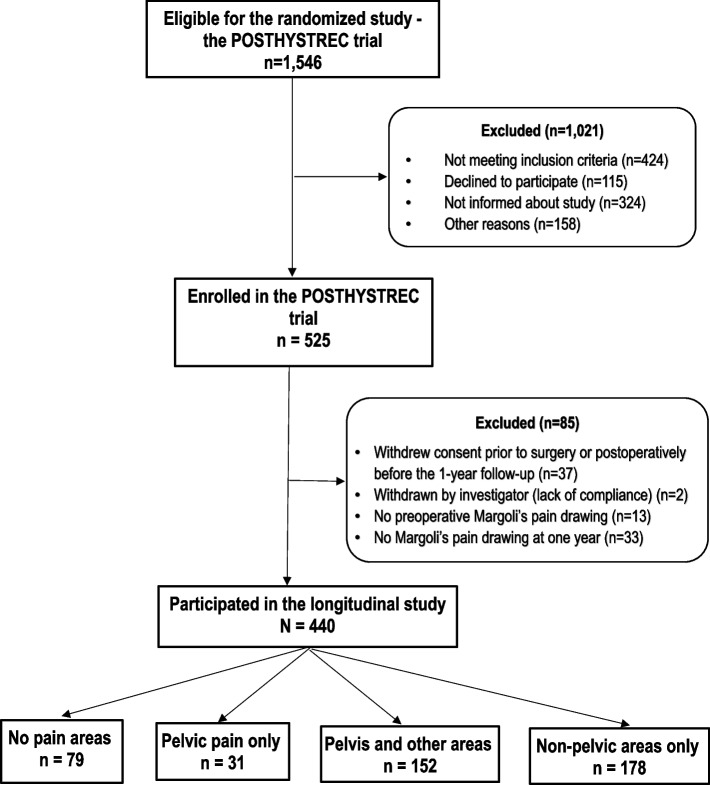
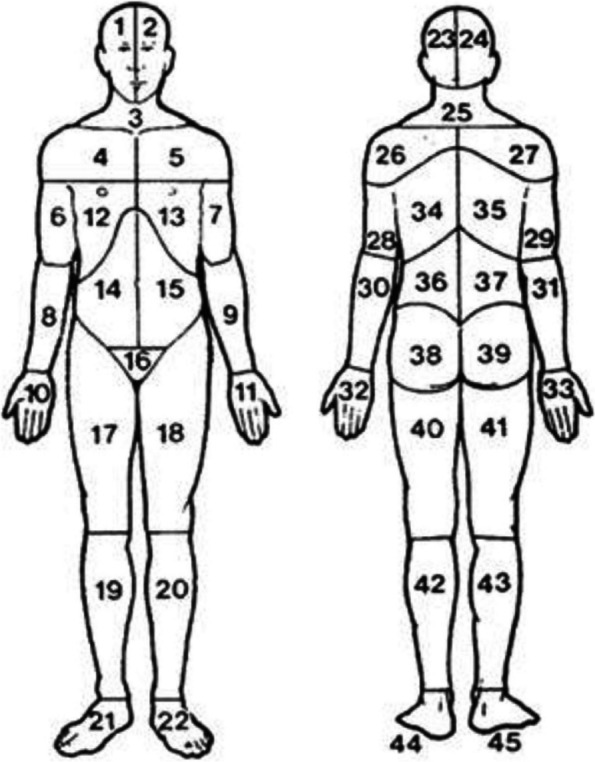
A Swedish prospective multicenter study of 440 women undergoing benign hysterectomy was conducted between October 2011 and March 2017. Measures of pain, the spatial extent of bodily pain, and pain sensitivity were assessed using a self-reporting questionnaire, Margolis's patient pain drawing, and quantitative sensory testing of pain thresholds for pressure, heat, and cold, respectively. Quality of life was evaluated by EQ-5D-3L and SF-36. Psychological distress was assessed by the Hospital Anxiety and Depression Scaleand the Stress-Coping Inventory. Logistic regression models were used to assess risk factors, and the outcome was presented as an adjusted odds ratio (aOR) and 95% confidence interval (CI).

RESULTS

Preoperatively, 18.0% of the women reported no bodily pain, 41.5% had pelvic pain, either as the only location (7.0%) or along with pain in other locations (34.5%), and 40.5% had non-pelvic pain only. Postoperatively, 6.2% developed de novo pelvic pain and 16.4% had persistent pelvic pain. De novo pelvic pain developed exclusively in women who preoperatively had non-pelvic pain only. Risk factors for de novo pelvic pain were a long hospital stay (aOR 1.50 (95%CI) 1.02-2.21)), high preoperative pain intensity (aOR 1.25 (95%CI 1.01-1.62)) and a high number of pain areas (aOR 1.15 (95%CI 1.05-1.27)), along with anxiety (aOR 10.61 (95%CI 1.84-61.03)) and low EQ-5D-3L health index (aOR 0.02 (95%CI 0.00-0.31)). Risk factors for persistent pelvic pain were lower age (aOR 0.89 (95%CI 0.81-0.97)), higher number of pain areas (aOR 1.08 (95%CI 1.02-1.14)), and a higher frequency of preoperative pain (aOR 12.75 (95%CI 2.24-72.66)).

CONCLUSION

Although hysterectomy appeared to be reasonably effective in curing pelvic pain, a non-negligible proportion of women developed de novo pelvic pain or had persistent pelvic pain. De novo pelvic pain seemed to affect only those who preoperatively had widespread bodily pain. Women at risk for de novo and persistent pelvic pain after hysterectomy could be identified preoperatively.

TRIAL REGISTRATIONS

The study was retrospectively registered in ClinicalTrial.gov (NCT01526668) on 01/27//2012.

摘要

背景

目的是确定良性子宫切除术后新发和持续性盆腔疼痛的患病率,并评估风险因素。

方法

2011年10月至2017年3月,在瑞典对440例行良性子宫切除术的女性进行了一项前瞻性多中心研究。分别使用自我报告问卷、马戈利斯患者疼痛绘图以及压力、热和冷痛阈值的定量感觉测试,评估疼痛程度、身体疼痛的空间范围和疼痛敏感性。通过EQ-5D-3L和SF-36评估生活质量。采用医院焦虑抑郁量表和应激应对量表评估心理困扰。使用逻辑回归模型评估风险因素,结果以调整后的优势比(aOR)和95%置信区间(CI)表示。

结果

术前,18.0%的女性报告无身体疼痛,41.5%有盆腔疼痛,其中仅盆腔疼痛(7.0%)或伴有其他部位疼痛(34.5%),40.5%仅有非盆腔疼痛。术后,6.2%出现新发盆腔疼痛,16.4%有持续性盆腔疼痛。新发盆腔疼痛仅发生在术前仅有非盆腔疼痛的女性中。新发盆腔疼痛的风险因素包括住院时间长(aOR 1.50(95%CI)1.02 - 2.21))、术前疼痛强度高(aOR 1.25(95%CI 1.01 - 1.62))和疼痛部位数量多(aOR 1.15(95%CI 1.05 - 1.27)),以及焦虑(aOR 10.61(95%CI 1.84 - 61.03))和EQ-5D-3L健康指数低(aOR 0.02(95%CI 0.00 - 0.31))。持续性盆腔疼痛的风险因素包括年龄较小(aOR 0.89(95%CI 0.81 - 0.97))、疼痛部位数量较多(aOR 1.08(95%CI 1.02 - 1.14))和术前疼痛频率较高(aOR 12.75(95%CI 2.24 - 72.66))。

结论

尽管子宫切除术似乎在治愈盆腔疼痛方面相当有效,但仍有不可忽视比例的女性出现新发盆腔疼痛或持续性盆腔疼痛。新发盆腔疼痛似乎仅影响术前有广泛身体疼痛的女性。子宫切除术后有新发和持续性盆腔疼痛风险的女性可在术前识别。

试验注册

该研究于2012年1月27日在ClinicalTrial.gov(NCT01526668)进行回顾性注册。
https://cdn.ncbi.nlm.nih.gov/pmc/blobs/c5e6/11662711/9f80d00ff938/12905_2024_3474_Fig2_HTML.jpg
https://cdn.ncbi.nlm.nih.gov/pmc/blobs/c5e6/11662711/3f8a10e6ecd6/12905_2024_3474_Fig1_HTML.jpg
https://cdn.ncbi.nlm.nih.gov/pmc/blobs/c5e6/11662711/9f80d00ff938/12905_2024_3474_Fig2_HTML.jpg
https://cdn.ncbi.nlm.nih.gov/pmc/blobs/c5e6/11662711/3f8a10e6ecd6/12905_2024_3474_Fig1_HTML.jpg
https://cdn.ncbi.nlm.nih.gov/pmc/blobs/c5e6/11662711/9f80d00ff938/12905_2024_3474_Fig2_HTML.jpg

相似文献

1
Changes in spatial bodily pain distribution one year after benign hysterectomy with emphasis on prevalence and risk factors for de novo and persistent pelvic pain- a prospective longitudinal multicenter study.良性子宫切除术后一年身体疼痛空间分布的变化,重点关注新发和持续性盆腔疼痛的患病率及危险因素——一项前瞻性纵向多中心研究
BMC Womens Health. 2024 Dec 20;24(1):644. doi: 10.1186/s12905-024-03474-5.
2
Incidence of self-reported pelvic pain and risk factors for pain 1 year after benign hysterectomy: A register study from the Swedish National Quality Registry for Gynecological Surgery.良性子宫切除术后 1 年自述盆腔痛的发生率和疼痛的危险因素:来自瑞典妇科手术国家质量登记研究。
Acta Obstet Gynecol Scand. 2023 Oct;102(10):1359-1370. doi: 10.1111/aogs.14455. Epub 2022 Sep 8.
3
Impact of Pelvic Pain and Endometriosis on Patient-Reported Outcomes and Experiences of Benign Hysterectomy: A Study from the Swedish National Register for Gynecological Surgery.盆腔痛和子宫内膜异位症对良性子宫切除术患者报告结局和体验的影响:来自瑞典妇科手术国家登记处的一项研究。
J Womens Health (Larchmt). 2018 May;27(5):691-698. doi: 10.1089/jwh.2017.6546. Epub 2017 Nov 17.
4
Persistent posthysterectomy pain: A prospective, observational study.子宫切除术后持续性疼痛:一项前瞻性观察研究。
Eur J Anaesthesiol. 2015 Oct;32(10):718-24. doi: 10.1097/EJA.0000000000000318.
5
Risk-factors for continuous long-term use of prescription opioid drugs 3 years after hysterectomy: A nationwide cohort study.子宫切除术后 3 年内持续长期使用处方类阿片类药物的风险因素:一项全国性队列研究。
Acta Obstet Gynecol Scand. 2020 Aug;99(8):1057-1063. doi: 10.1111/aogs.13826. Epub 2020 Mar 6.
6
Preoperative quantitative sensory testing and robot-assisted laparoscopic hysterectomy for endometrial cancer: can chronic postoperative pain be predicted?术前定量感觉测试和机器人辅助腹腔镜子宫内膜癌手术:能否预测慢性术后疼痛?
Scand J Pain. 2020 Oct 25;20(4):693-705. doi: 10.1515/sjpain-2020-0030.
7
A prospective study of risk factors for pain persisting 4 months after hysterectomy.一项关于子宫切除术后疼痛持续4个月的危险因素的前瞻性研究。
Clin J Pain. 2009 May;25(4):263-8. doi: 10.1097/AJP.0b013e31819655ca.
8
Incidence and predictors of persistent pelvic pain following hysterectomy in women with chronic pelvic pain.慢性盆腔痛患者子宫切除术后持续性盆腔痛的发生率及预测因素。
Am J Obstet Gynecol. 2021 Nov;225(5):568.e1-568.e11. doi: 10.1016/j.ajog.2021.08.038. Epub 2021 Aug 28.
9
Quality of life and sexual function after hysterectomy in women with preoperative pain and depression.术前存在疼痛和抑郁症状的女性子宫切除术后的生活质量和性功能
Obstet Gynecol. 2004 Oct;104(4):701-9. doi: 10.1097/01.AOG.0000140684.37428.48.
10
Impact of deep or ovarian endometriosis on pelvic pain and quality of life: prospective cross-sectional ultrasound study.深部或卵巢子宫内膜异位症对盆腔疼痛及生活质量的影响:前瞻性横断面超声研究
Ultrasound Obstet Gynecol. 2025 Mar;65(3):372-383. doi: 10.1002/uog.29150. Epub 2025 Jan 14.

本文引用的文献

1
Association of Central Sensitization Inventory Scores With Pain Outcomes After Endometriosis Surgery.中央敏感化量表评分与子宫内膜异位症手术后疼痛结局的相关性。
JAMA Netw Open. 2023 Feb 1;6(2):e230780. doi: 10.1001/jamanetworkopen.2023.0780.
2
Association Between Experimental Pain Thresholds and Trajectories of Postoperative Recovery Measures After Benign Hysterectomy.良性子宫切除术后实验性疼痛阈值与术后恢复指标轨迹之间的关联
J Pain Res. 2022 Nov 23;15:3657-3674. doi: 10.2147/JPR.S383795. eCollection 2022.
3
Prevalence and Risk Factors of Central Sensitization in Women with Endometriosis.
子宫内膜异位症女性中枢敏化的患病率及危险因素
J Minim Invasive Gynecol. 2023 Jan;30(1):73-80.e1. doi: 10.1016/j.jmig.2022.10.007. Epub 2022 Oct 29.
4
Incidence of self-reported pelvic pain and risk factors for pain 1 year after benign hysterectomy: A register study from the Swedish National Quality Registry for Gynecological Surgery.良性子宫切除术后 1 年自述盆腔痛的发生率和疼痛的危险因素:来自瑞典妇科手术国家质量登记研究。
Acta Obstet Gynecol Scand. 2023 Oct;102(10):1359-1370. doi: 10.1111/aogs.14455. Epub 2022 Sep 8.
5
Incidence and predictors of persistent pelvic pain following hysterectomy in women with chronic pelvic pain.慢性盆腔痛患者子宫切除术后持续性盆腔痛的发生率及预测因素。
Am J Obstet Gynecol. 2021 Nov;225(5):568.e1-568.e11. doi: 10.1016/j.ajog.2021.08.038. Epub 2021 Aug 28.
6
Chronic Pelvic Pain in Women: A Review.女性慢性盆腔痛:综述。
JAMA. 2021 Jun 15;325(23):2381-2391. doi: 10.1001/jama.2021.2631.
7
Perioperative factors associated with persistent postsurgical pain after hysterectomy, cesarean section, prostatectomy, and donor nephrectomy: a systematic review and meta-analysis.与子宫切除术、剖宫产术、前列腺切除术和供肾切除术术后持续性疼痛相关的围手术期因素:系统评价和荟萃分析。
Pain. 2022 Mar 1;163(3):425-435. doi: 10.1097/j.pain.0000000000002361.
8
Predictors of Persistent Postsurgical Pain After Hysterectomy-A Prospective Cohort Study.子宫切除术后持续性手术后疼痛的预测因素:一项前瞻性队列研究。
J Minim Invasive Gynecol. 2021 Dec;28(12):2036-2046.e1. doi: 10.1016/j.jmig.2021.05.017. Epub 2021 May 30.
9
Quantitative Sensory Testing to Predict Postoperative Pain.定量感觉测试预测术后疼痛。
Curr Pain Headache Rep. 2021 Jan 14;25(1):3. doi: 10.1007/s11916-020-00920-5.
10
The Effect of Follow-Up Contact on Recovery After Benign Hysterectomy: A Randomized, Single-Blinded, Four-Arm, Controlled Multicenter Trial.良性子宫切除术后随访对恢复的影响:一项随机、单盲、四臂、对照的多中心试验。
J Womens Health (Larchmt). 2021 Jun;30(6):872-881. doi: 10.1089/jwh.2020.8752. Epub 2020 Nov 24.