Zhao Zhibo, Wang Peng, Li Ziyang, Wei Xingchen, Li Shishuo, Lu Xiaoqing, Dai Shimin, Huang Benzhao, Man Zhentao, Li Wei
Department of Joint Surgery, Shandong Provincial Hospital Affiliated to Shandong University, Jinan, Shandong, 250021, People's Republic of China.
Department of Sports Medicine & Orthopedic Surgery, Second Affiliated Hospital, Zhejiang University School of Medicine, Hangzhou, Zhejiang, 310058, People's Republic of China.
J Nanobiotechnology. 2024 Dec 20;22(1):786. doi: 10.1186/s12951-024-02965-9.
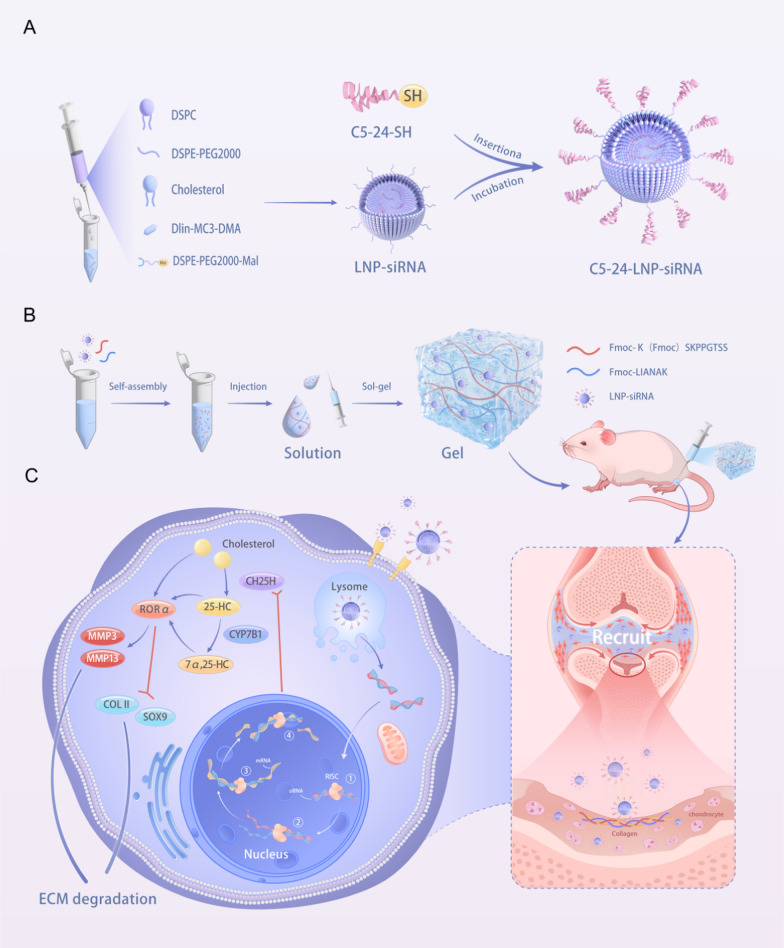
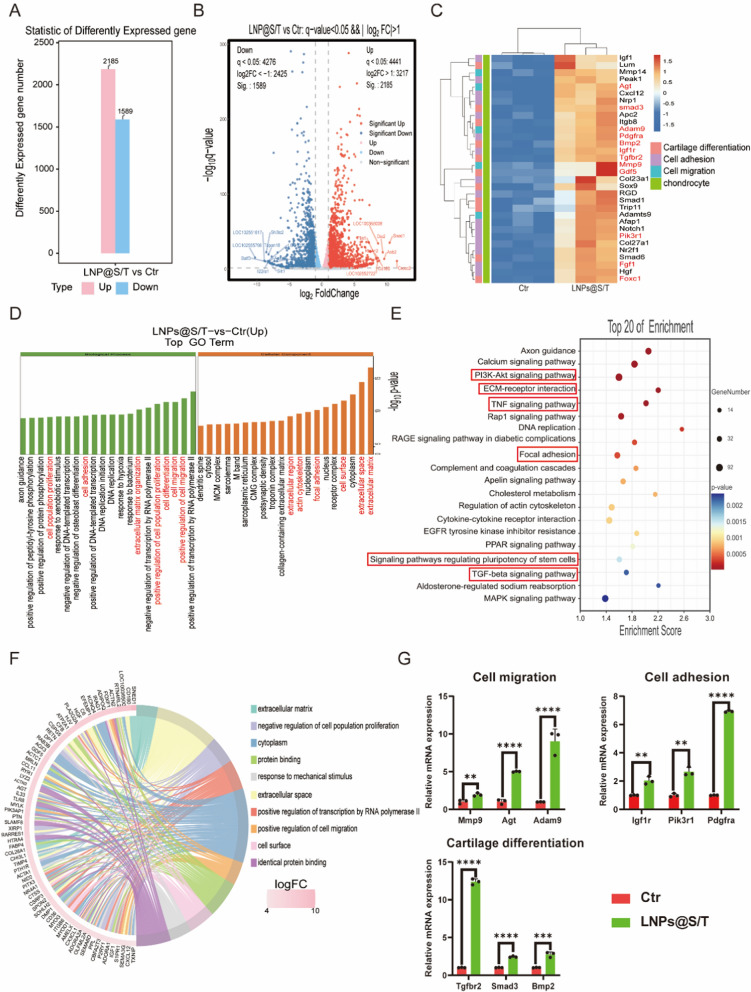
Osteoarthritis (OA) is the most common disease in aging joints and has characteristics of cartilage destruction and inflammation. It is currently considered a metabolic disease, and the CH25H-CYP7B1-RORα axis of cholesterol metabolism in chondrocytes plays a crucial catabolic regulatory role in its pathogenesis. Targeting of this axis in chondrocytes may provide a therapeutic approach for OA treatment. Here, in this study, we propose to use a combination of stem cell-recruiting hydrogels and lipid nanoparticles (LNPs) that modulate cholesterol metabolism to jointly promote a regenerative microenvironment. Specifically, we first developed an injectable, bioactive hydrogel composed of self-assembling peptide nanofibers that recruits endogenous synovial stem cells (SMSCs) and promotes their chondrogenic differentiation. At the same time, LNPs that regulate cholesterol metabolism are incorporated into the hydrogel and slowly released, thereby improving the inflammatory environment of OA. Enhancements were noted in the inflammatory conditions associated with OA, alongside the successful attraction of mesenchymal stem cells (MSCs) from the synovial membrane. These cells were then observed to differentiate into chondrocytes, contributing to effective cartilage restoration and chondrocyte regeneration, thereby offering a promising approach for OA treatment. In summary, this approach provides a feasible siRNA-based therapeutic option, offering a potential nonsurgical solution for treatment of OA.
骨关节炎(OA)是衰老关节中最常见的疾病,具有软骨破坏和炎症的特征。目前它被认为是一种代谢性疾病,软骨细胞中胆固醇代谢的CH25H - CYP7B1 - RORα轴在其发病机制中起着关键的分解代谢调节作用。针对软骨细胞中的这一轴可能为OA治疗提供一种治疗方法。在此项研究中,我们提议使用招募干细胞的水凝胶和调节胆固醇代谢的脂质纳米颗粒(LNP)的组合来共同促进再生微环境。具体而言,我们首先开发了一种由自组装肽纳米纤维组成的可注射生物活性水凝胶,它能招募内源性滑膜干细胞(SMSC)并促进其软骨形成分化。同时,将调节胆固醇代谢的LNP掺入水凝胶并缓慢释放,从而改善OA的炎症环境。在与OA相关的炎症条件下观察到有改善,同时成功吸引了来自滑膜的间充质干细胞(MSC)。然后观察到这些细胞分化为软骨细胞,有助于有效修复软骨和再生软骨细胞,从而为OA治疗提供了一种有前景的方法。总之,这种方法提供了一种基于小干扰RNA(siRNA)的可行治疗选择,为OA治疗提供了一种潜在的非手术解决方案。