Shi Jiantao, Chen Qing, Lai Jianheng, Zhu Jieying, Zhang Ran, Mazid Md Abdul, Li Dongwei, Su Huanxing, Qin Dajiang
State Key Laboratory of Quality Research in Chinese Medicine, Institute of Chinese Medical Sciences, University of Macau, Macao, China.
Key Laboratory of Biological Targeting Diagnosis, Therapy and Rehabilitation of Guangdong Higher Education Institutes, The Fifth Affiliated Hospital of Guangzhou Medical University, Guangzhou, China.
Cell Biosci. 2024 Dec 20;14(1):149. doi: 10.1186/s13578-024-01303-8.
c-Jun is a key regulator of gene expression. Through the formation of homo- or heterodimers, c-JUN binds to DNA and regulates gene transcription. While c-Jun plays a crucial role in embryonic development, its impact on nervous system development in higher mammals, especially for some deep structures, for example, thalamus in diencephalon, remains unclear.
To investigate the influence of c-JUN on early nervous system development, c-Jun knockout (KO) mice and c-JUN KO H1 embryonic stem cells (ESCs)-derived neural progenitor cells (NPCs), cerebral organoids (COs), and thalamus organoids (ThOs) models were used. We detected the dysplasia via histological examination and immunofluorescence staining, omics analysis, and loss/gain of function analysis.
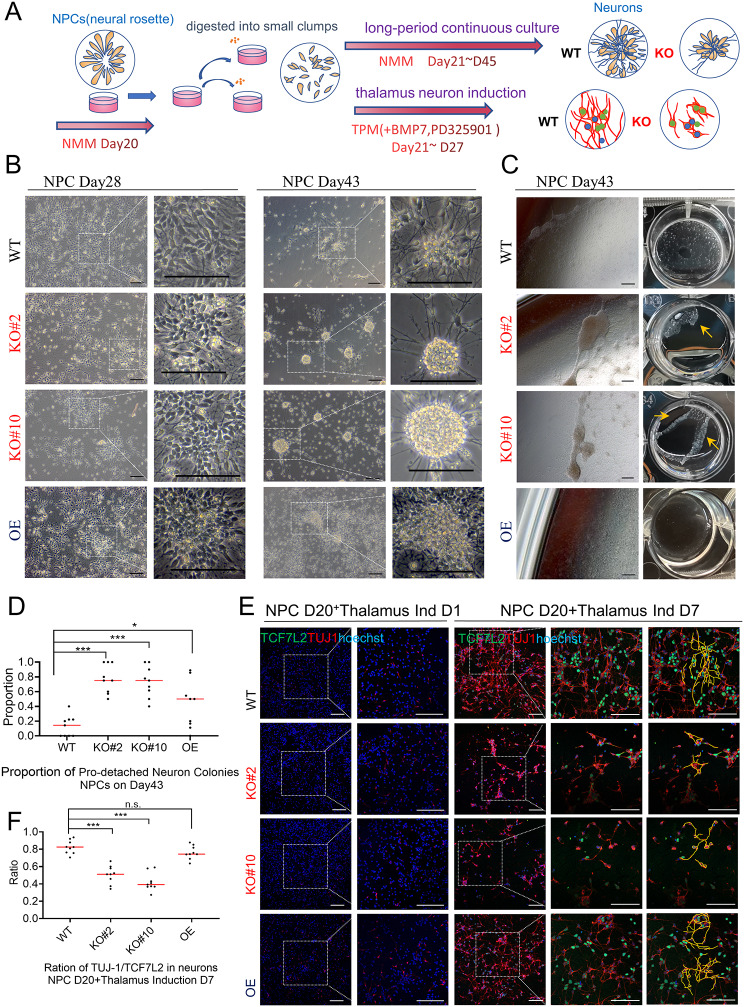
At embryonic day 14.5, c-Jun knockout (KO) mice exhibited sparseness of fibers in the brain ventricular parenchyma and malformation of the thalamus in the diencephalon. The absence of c-JUN accelerated the induction of NPCs but impaired the extension of fibers in human neuronal cultures. COs lacking c-JUN displayed a robust PAX6/NESTIN exterior layer but lacked a fibers-connected core. Moreover, the subcortex-like areas exhibited defective thalamus characteristics with transcription factor 7 like 2-positive cells. Notably, in guided ThOs, c-JUN KO led to inadequate thalamus patterning with sparse internal nerve fibers. Chromatin accessibility analysis confirmed a less accessible chromatin state in genes related to the thalamus. Overexpression of c-JUN rescued these defects. RNA-seq identified 18 significantly down-regulated genes including RSPO2, WNT8B, MXRA5, HSPG2 and PLAGL1 while 24 genes including MSX1, CYP1B1, LMX1B, NQO1 and COL2A1 were significantly up-regulated.
Our findings from in vivo and in vitro experiments indicate that c-JUN depletion impedes the extension of nerve fibers and renders the thalamus susceptible to dysplasia during early mouse embryonic development and human ThO patterning. Our work provides evidence for the first time that c-JUN is a key transcription regulator that play important roles in the thalamus/diencephalon development.
c-Jun是基因表达的关键调节因子。通过形成同二聚体或异二聚体,c-JUN与DNA结合并调节基因转录。虽然c-Jun在胚胎发育中起关键作用,但其对高等哺乳动物神经系统发育的影响,尤其是对一些深部结构,如间脑中的丘脑,仍不清楚。
为了研究c-JUN对早期神经系统发育的影响,使用了c-Jun基因敲除(KO)小鼠以及由c-JUN基因敲除的H1胚胎干细胞(ESC)衍生的神经祖细胞(NPC)、脑类器官(CO)和丘脑类器官(ThO)模型。我们通过组织学检查、免疫荧光染色、组学分析以及功能丧失/获得分析来检测发育异常情况。
在胚胎第14.5天,c-Jun基因敲除(KO)小鼠的脑室实质中纤维稀疏,间脑中的丘脑畸形。c-JUN的缺失加速了NPC的诱导,但损害了人类神经元培养物中纤维的延伸。缺乏c-JUN的CO显示出强大的PAX6/NESTIN外层,但缺乏纤维连接的核心。此外,皮质下样区域表现出具有转录因子7样2阳性细胞的有缺陷的丘脑特征。值得注意的是,在引导性ThO中,c-JUN基因敲除导致丘脑模式形成不足,内部神经纤维稀疏。染色质可及性分析证实与丘脑相关的基因中染色质状态的可及性较低。c-JUN的过表达挽救了这些缺陷。RNA测序确定了18个显著下调的基因,包括RSPO2、WNT8B、MXRA5、HSPG2和PLAGL1,而24个基因,包括MSX1、CYP1B1、LMX1B、NQO1和COL2A1显著上调。
我们在体内和体外实验中的发现表明,在小鼠早期胚胎发育和人类ThO模式形成过程中,c-JUN的缺失会阻碍神经纤维的延伸,并使丘脑易发生发育异常。我们的工作首次提供了证据,证明c-JUN是在丘脑/间脑发育中起重要作用的关键转录调节因子。