Stringer Dominic, Payne Mollie, Carter Ben, Emsley Richard
Department of Biostatistics and Health Informatics, Institute of Psychiatry, Psychology and Neuroscience, Kings College London, London, UK.
BMC Med Res Methodol. 2024 Dec 21;24(1):317. doi: 10.1186/s12874-024-02451-8.
The choice of a single primary outcome in randomised trials can be difficult, especially in mental health where interventions may be complex and target several outcomes simultaneously. We carried out a systematic review to assess the quality of the analysis and reporting of multiple outcomes in mental health RCTs, comparing approaches with current CONSORT and other regulatory guidance.
The review included all late-stage mental health trials published between 1st January 2019 to 31st December 2020 in 9 leading medical and mental health journals. Pilot and feasibility trials, non-randomised trials, and early phase trials were excluded. The total number of primary, secondary and other outcomes was recorded, as was any strategy used to incorporate multiple primary outcomes in the primary analysis.
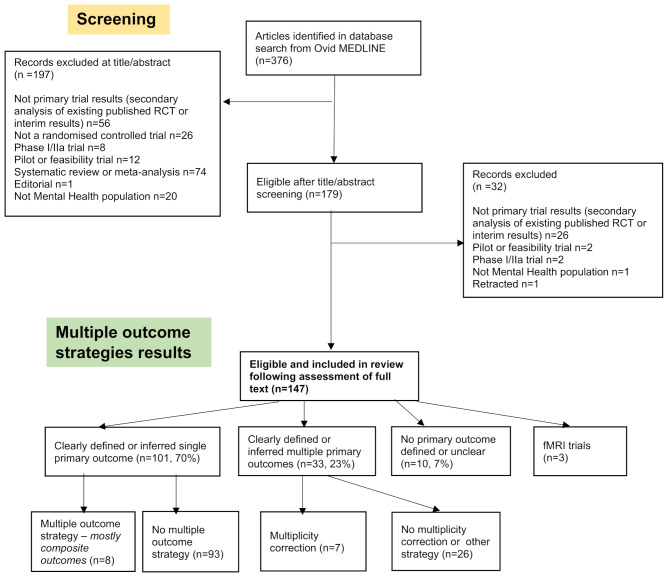
There were 147 included mental health trials. Most trials (101/147) followed CONSORT guidance by specifying a single primary outcome with other outcomes defined as secondary and analysed in separate statistical analyses, although a minority (10/147) did not specify any outcomes as primary. Where multiple primary outcomes were specified (33/147), most (26/33) did not correct for multiplicity, contradicting regulatory guidance. The median number of clinical outcomes reported across studies was 8 (IQR 5-11 ).
Most trials are correctly following CONSORT guidance. However, there was little consideration given to multiplicity or correlation between outcomes even where multiple primary outcomes were stated. Trials should correct for multiplicity when multiple primary outcomes are specified or describe some other strategy to address the multiplicity. Overall, very few mental health trials are taking advantage of multiple outcome strategies in the primary analysis, especially more complex strategies such as multivariate modelling. More work is required to show these exist, aid interpretation, increase efficiency and are easily implemented.
Our systematic review protocol was registered with the International Prospective Register of Systematic Reviews (PROSPERO) on 11th January 2023 (CRD42023382274).
在随机试验中选择单一主要结局可能很困难,尤其是在心理健康领域,干预措施可能很复杂且同时针对多个结局。我们进行了一项系统评价,以评估心理健康随机对照试验中多个结局的分析和报告质量,并将其方法与当前的CONSORT及其他监管指南进行比较。
该评价纳入了2019年1月1日至2020年12月31日期间在9种主要医学和心理健康期刊上发表的所有后期心理健康试验。试点和可行性试验、非随机试验以及早期试验被排除在外。记录了主要、次要和其他结局的总数,以及在主要分析中纳入多个主要结局所使用的任何策略。
共纳入147项心理健康试验。大多数试验(101/147)遵循CONSORT指南,指定单一主要结局,将其他结局定义为次要结局并在单独的统计分析中进行分析,尽管少数试验(10/147)未指定任何结局为主要结局。在指定多个主要结局的试验中(33/147),大多数试验(26/33)未对多重性进行校正,这与监管指南相悖。各研究报告的临床结局中位数为8(四分位间距5-11)。
大多数试验正确遵循了CONSORT指南。然而,即使声明了多个主要结局,也很少考虑结局之间的多重性或相关性。当指定多个主要结局时,试验应校正多重性,或描述其他解决多重性的策略。总体而言,很少有心理健康试验在主要分析中利用多个结局策略,尤其是更复杂的策略,如多变量建模。需要开展更多工作来证明这些策略的存在、辅助解释、提高效率并易于实施。
我们的系统评价方案于2023年1月11日在国际前瞻性系统评价注册库(PROSPERO)注册(CRD42023382274)。