Bharati Rohit, Shmeit Yamen Homaidan, Šedivá Jana Hanzal, Cong Tomáš Thanh Nguyen, Kundu Jiban Kumar, Severová Lucie, Svoboda Roman, Fernández-Cusimamani Eloy
Department of Economic Theories, Faculty of Economics and Management, Czech University of Life Sciences Prague, Kamýcká 129, Prague 6, 165 00, Czech Republic.
Department of Crop Sciences and Agroforestry, The Faculty of Tropical AgriSciences, Czech University of Life Sciences Prague, Kamýcká 129, Prague 6, Suchdol, 165 00, Czech Republic.
BMC Plant Biol. 2024 Dec 21;24(1):1227. doi: 10.1186/s12870-024-05973-x.
Celosia argentea is a widely recognized plant for its ornamental qualities and therapeutic uses in traditional medicine. As demand for such multipurpose plants grows, enhancing its phenotypic and physiological traits could further expand its commercial potential. Polyploidization, particularly through chemical treatments like oryzalin, offers a method to induce genetic variation and potentially improve desirable traits in plants.
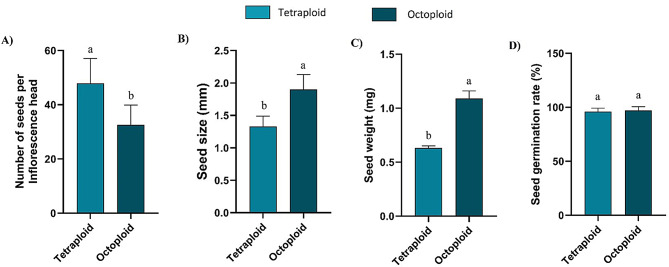
Tetraploid (2n = 4×= 36) nodal segments of C. argentea were treated with oryzalin under in vitro conditions, resulting in successful induction of octoploidy (2n = 8×= 72). Flow cytometry and chromosome counting confirmed polyploidization, with the highest induction rate achieved using 40 µM oryzalin for 24 h. Comparative analyses between octoploid and tetraploid plants revealed significant differences in morphological traits, including increased stem and leaf thickness, larger leaf area, inflorescence characteristics and more compact growth in the octoploids. Additionally, octoploids exhibited enhanced chlorophyll content and altered photosynthetic characteristics, along with notable changes in stomatal size and density. Ploidy stability was maintained across generations, ensuring the heritability of the induced traits.
In vitro polyploidization in C. argentea led to significant phenotypic and physiological improvements, demonstrating its potential for application in ornamental horticulture and plant breeding. This research contributes to the understanding of the impact of in vitro polyploidization on plant development, offering insights for the commercial cultivation and enhancement of C. argentea.
Not applicable.
鸡冠花因其观赏价值和在传统医学中的治疗用途而广为人知。随着对这类多用途植物需求的增长,增强其表型和生理特性可进一步扩大其商业潜力。多倍体化,特别是通过如氨磺乐灵等化学处理,提供了一种诱导植物遗传变异并潜在改善其优良性状的方法。
在体外条件下,用氨磺乐灵处理鸡冠花的四倍体(2n = 4x = 36)节段,成功诱导出八倍体(2n = 8x = 72)。流式细胞术和染色体计数证实了多倍体化,使用40 µM氨磺乐灵处理24小时诱导率最高。八倍体和四倍体植株的比较分析显示,形态特征存在显著差异,包括八倍体的茎和叶厚度增加、叶面积增大、花序特征以及生长更紧凑。此外,八倍体表现出叶绿素含量增加和光合特性改变,气孔大小和密度也有显著变化。多倍体在各代中保持稳定性,确保了诱导性状的遗传性。
鸡冠花的体外多倍体化导致了显著的表型和生理改善,证明了其在观赏园艺和植物育种中的应用潜力。本研究有助于理解体外多倍体化对植物发育的影响,为鸡冠花的商业栽培和改良提供了见解。
不适用。