Dube Kopano R, de Beer Shani T, Powis Kathleen M, McCaul Michael, Slogrove Amy L
Department of Paediatrics & Child Health, Faculty of Medicine and Health Sciences, Stellenbosch University, Cape Town, South Africa.
Centre for Infectious Disease Epidemiology and Research, Faculty of Health Sciences, University of Cape Town, Cape Town, South Africa.
BMC Pregnancy Childbirth. 2024 Dec 21;24(1):844. doi: 10.1186/s12884-024-06939-5.
Adverse birth outcomes (preterm birth, low birth weight, small for gestational age, and stillbirth) seem to persist in infants born to people with HIV, even in the context of maternal antiretroviral therapy. However, findings have been disparate, inconclusive, and difficult to compare directly across settings, partly owing to variable outcome definitions. We aimed to collate, compare, and map existing adverse birth outcome definitions to inform a harmonized approach to universally measure these outcomes in studies including pregnant people with HIV.
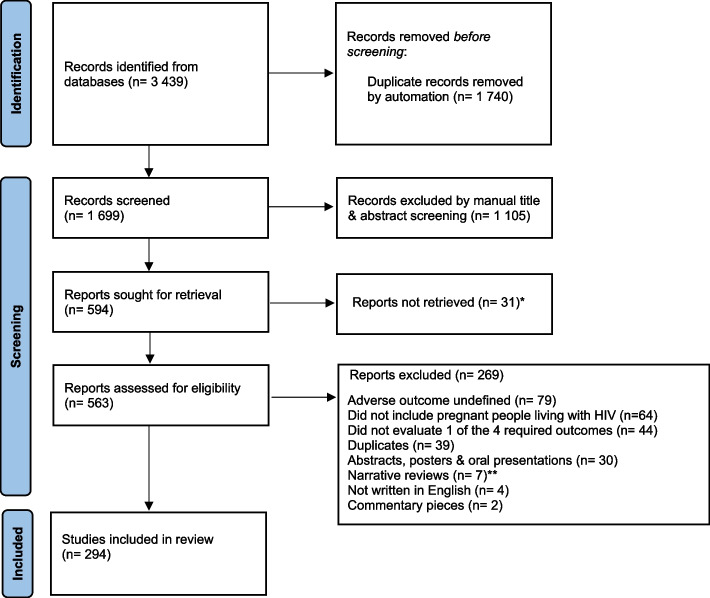
We conducted a scoping review of studies that reported adverse birth outcomes associated with maternal HIV and antiretroviral use in pregnancy, specifically those that included definitions of 'preterm birth', 'low birth weight', 'small for gestational age', and 'stillbirth'. Five databases were searched from 01 January 2011 to 15 August 2022. Title, abstract and full-text screening was conducted independently in duplicate. A comparative quantitative analysis was conducted to compare study characteristics by period of study (< 2013; 2013-2015; > 2016) and country income group. A qualitative content analysis was conducted to compare and map deviations from the WHO definitions as a reference.
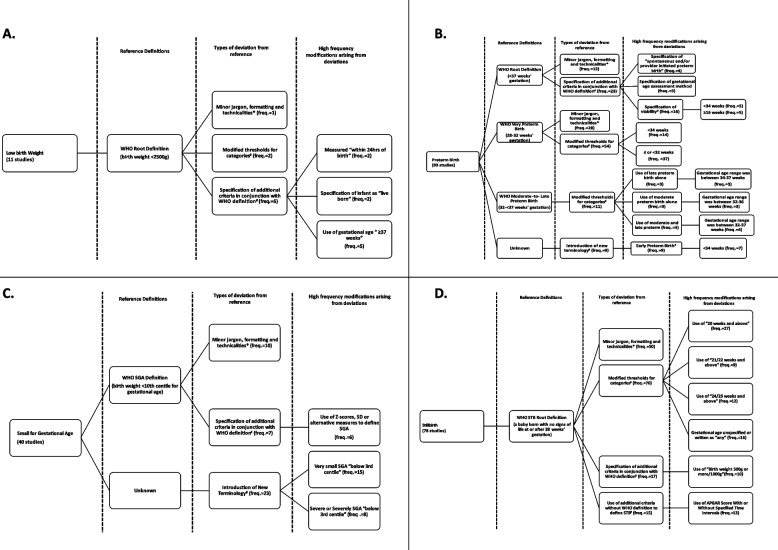
Of the 294 articles that included at least one adverse birth outcome, 214 (73%) studies started before 2013, 268 (91%) were published as primary research articles, and 137 (47%) were conducted in Eastern and Southern Africa. Among the 283 studies included in the country income group analysis, 178 (63%) were conducted in low- and middle-income countries. Studies reporting low birth weight, preterm birth, small for gestational age and stillbirth deviated from the WHO definitions in n = 11/169 (7%), n = 93/246 (39%), n = 40/112 (36%) and n = 85/108 (79%) instances, respectively. The variations included the use of different thresholds and the addition of new terminology.
The current WHO definitions are valuable tools for population-level monitoring; however, through consensus, these definitions need to be optimized for research data collection, analysis, and presentation. In conjunction with good reporting, variation in adverse birth outcome definitions can be decreased to facilitate comparability of studies as well as pooling of data for enhanced evidence synthesis.
即使在孕产妇接受抗逆转录病毒治疗的情况下,感染艾滋病毒者所生婴儿的不良出生结局(早产、低出生体重、小于胎龄儿和死产)似乎仍会持续存在。然而,研究结果存在差异、尚无定论,且在不同环境下难以直接比较,部分原因是结局定义存在差异。我们旨在整理、比较和梳理现有的不良出生结局定义,为在包括感染艾滋病毒的孕妇在内的研究中统一测量这些结局提供一种协调一致的方法。
我们对报告了与孕产妇艾滋病毒感染及孕期使用抗逆转录病毒药物相关的不良出生结局的研究进行了范围综述,特别是那些包含“早产”“低出生体重”“小于胎龄儿”和“死产”定义的研究。检索了五个数据库,时间范围为2011年1月1日至2022年8月15日。标题、摘要和全文筛选由两人独立进行。进行了一项比较定量分析,以按研究时期(<2013年;2013 - 2015年;>2016年)和国家收入组比较研究特征。进行了定性内容分析,以比较和梳理与作为参考的世界卫生组织定义的偏差。
在294篇包含至少一种不良出生结局的文章中,214项(73%)研究在2013年之前开始,268项(91%)作为原始研究文章发表,137项(47%)在东非和南非进行。在纳入国家收入组分析的283项研究中,178项(63%)在低收入和中等收入国家进行。报告低出生体重、早产、小于胎龄儿和死产的研究分别在n = 11/169(7%)、n = 93/246(39%)、n = 40/112(36%)和n = 85/108(79%)的情况下与世界卫生组织的定义存在偏差。这些差异包括使用不同的阈值以及添加新术语。
当前世界卫生组织的定义是进行人群水平监测的宝贵工具;然而,需要通过共识对这些定义进行优化,以用于研究数据的收集、分析和呈现。结合良好的报告,不良出生结局定义的差异可以减少,以促进研究的可比性以及数据汇总以加强证据综合。