Kabula Bilali, Mlacha Yeromin P, Serbantez Naomi, Nhiga Samwel L, Mkude Sigsbert, Kiware Samson, Michael James S, Mero Victor, Ballard Sarah-Blythe, Chan Adeline, Abbasi Said, Mwalimu Charles D, Govella Nicodem J
Amani Medical Research Centre, National Institute for Medical Research, Muheza, Tanzania.
Environmental Health and Ecological Science Department, Ifakara Health Institute, Mikocheni, Dar es Salaam, Tanzania.
Malar J. 2024 Dec 21;23(1):395. doi: 10.1186/s12936-024-05211-7.
Effective vector control interventions, notably insecticide-treated nets (ITNs) and indoor residual spraying (IRS) are indispensable for malaria control in Tanzania and elsewhere. However, the emergence of widespread insecticide resistance threatens the efficacy of these interventions. Monitoring of insecticide resistance is, therefore, critical for the selection and assessment of the programmatic impact of insecticide-based interventions.
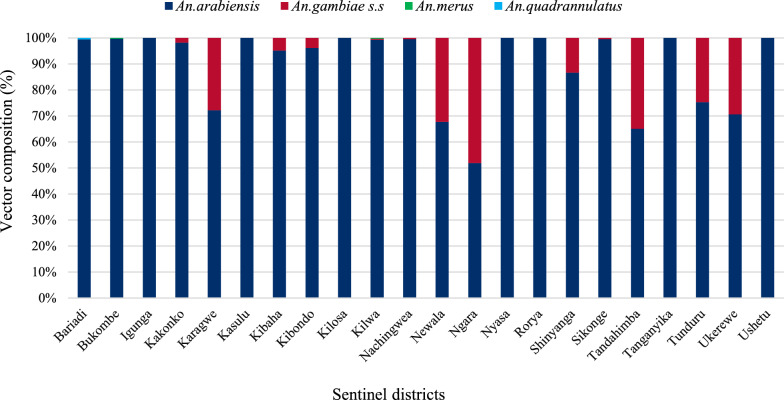
The study was conducted country-wide across 22 sentinel districts of Tanzania between May and July 2023 using standard World Health Organization susceptibility test with 1×, 5×, and 10× of deltamethrin, permethrin, and alpha-cypermethrin and discriminating concentrations of 0.25% pirimiphos-methyl. Synergist assays were conducted to explore the underlying mechanisms of the observed phenotypic pyrethroid-resistant mosquitoes. Three- to five-day-old wild adult females in the first filiar generation of Anopheles gambiae sensu lato (s.l.) were used for the susceptibility bioassays.
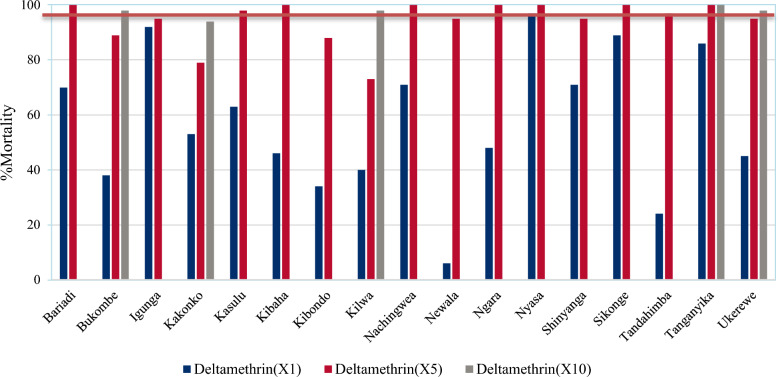
Anopheles gambiae s.l. were resistant to all pyrethroids at the discriminating dose in most sentinel districts except in Rorya, which remains fully susceptible, and Ushetu, which remains susceptible to deltamethrin but not permethrin. In 5 sites (Bukombe, Ukerewe, Kilwa, Kibondo, and Kakonko), the An. gambiae s.l. species exhibited strong resistance to pyrethroids surviving the 10 X concentrations (mortality rate < 98%). However, they remained fully susceptible to pirimiphos-methyl in almost all the sites except in Kibondo and Shinyanga. Likewise, there was full restoration to susceptibility to pyrethroid following pre-exposure of An. gambiae s.l. to piperonyl-butoxide (PBO) in 13 out of 16 sites. The 3 sites that exhibited partial restoration include Kakonko, Tandahimba, and Newala.
The evidence of widespread pyrethroid resistance of the major malaria vector justifies the decision made by the Tanzania National Malaria Control Programme to transition to PBO-based ITNs. Without this switch, the gains achieved in malaria control could be compromised. Equally important, the lack of full restoration to susceptibility observed in three sentinel districts upon pre-exposure to PBO merits close monitoring, as there could be other underlying resistance mechanisms besides oxidase metabolic resistance.
有效的病媒控制干预措施,特别是经杀虫剂处理的蚊帐(ITNs)和室内滞留喷洒(IRS),对于坦桑尼亚及其他地区的疟疾控制至关重要。然而,广泛出现的杀虫剂抗性威胁着这些干预措施的效果。因此,监测杀虫剂抗性对于基于杀虫剂的干预措施的方案选择和效果评估至关重要。
2023年5月至7月期间,在坦桑尼亚全国22个哨点地区开展了这项研究,采用世界卫生组织标准药敏试验,使用1倍、5倍和10倍浓度的溴氰菊酯、氯菊酯和高效氯氰菊酯,以及0.25%甲基嘧啶磷的鉴别浓度。进行增效剂试验以探究观察到的拟除虫菊酯抗性蚊子的潜在机制。冈比亚按蚊复合组(Anopheles gambiae sensu lato,s.l.)第一代3至5日龄野生成年雌性用于药敏生物测定。
除罗里亚(仍完全敏感)和乌舍图(对溴氰菊酯仍敏感,但对氯菊酯不敏感)外,在大多数哨点地区,冈比亚按蚊复合组在鉴别剂量下对所有拟除虫菊酯均有抗性。在5个地点(布孔贝、乌克雷韦、基尔瓦、基邦多和卡孔科),冈比亚按蚊复合组对拟除虫菊酯表现出强抗性,在10倍浓度下仍存活(死亡率<98%)。然而,除基邦多和希尼安加外,它们在几乎所有地点对甲基嘧啶磷仍完全敏感。同样,在16个地点中的13个,冈比亚按蚊复合组预先接触胡椒基丁醚(PBO)后,对拟除虫菊酯的敏感性完全恢复。表现出部分恢复的3个地点包括卡孔科、坦达希姆巴和纽瓦拉。
主要疟疾媒介对拟除虫菊酯广泛抗性的证据证明了坦桑尼亚国家疟疾控制计划决定转向基于PBO的ITNs是合理的。不进行这种转换,疟疾控制所取得的成果可能会受到损害。同样重要的是,在3个哨点地区预先接触PBO后未观察到敏感性完全恢复,值得密切监测,因为除了氧化酶代谢抗性外,可能还有其他潜在的抗性机制。