Daryanani Andres E, Abbasi Muhannad A, Gomez Ardila Maria F, Tellez-Garcia Eduardo, Garzon-Dangond Juan M, Lin Yi, Paludo Jonas, Herrmann Joerg, Ansell Stephen M, Rosenthal Allison C, Villarraga Hector R
Department of Cardiovascular Medicine, Mayo Clinic, 200 1 St SW, Rochester, MN, 55905, USA.
Division of Hematology, Department of Internal Medicine, Mayo Clinic, Rochester, MN, USA.
Cardiooncology. 2024 Dec 21;10(1):91. doi: 10.1186/s40959-024-00290-6.
CD19 CAR T-cell therapy is a novel anti-cancer treatment that has produced remarkable responses in relapsed or refractory B-cell hematological malignancies. Cytokine Release Syndrome (CRS) is a dysregulated immune response that frequently occurs after CAR T-cell infusion. It can cause cardiac dysfunction and circulatory collapse negatively impacting outcomes and survival. To endure the insults of CRS, patients are typically screened for adequate cardiac reserve before treatment. The relationship between baseline cardiac function by echocardiography and the development of moderate to severe presentations of CRS is unclear.
This study aimed to identify baseline echocardiographic variables that can predict the development of hemodynamically significant CRS (CRS ≥ 2), evaluate their behavior at follow-up, and investigate the incidence of cancer therapy-related cardiac dysfunction (CTRCD). An observational retrospective cohort study of patients treated with CD19 CAR T-cell therapy with a baseline echocardiogram was performed. Demographic, clinical and echocardiographic variables were abstracted from the electronic health record. Patients were grouped and compared by the occurrence of CRS < 2 and ≥ 2. Adjusted logistic regression analysis was used to evaluate the association between echocardiographic variables and the development of CRS ≥ 2.
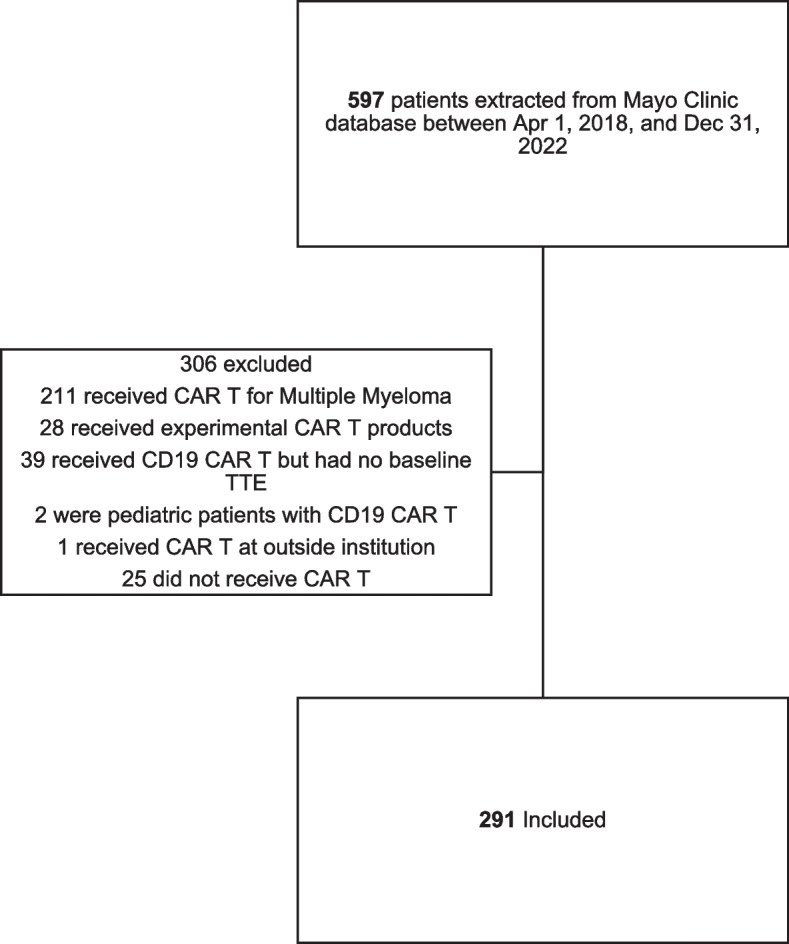
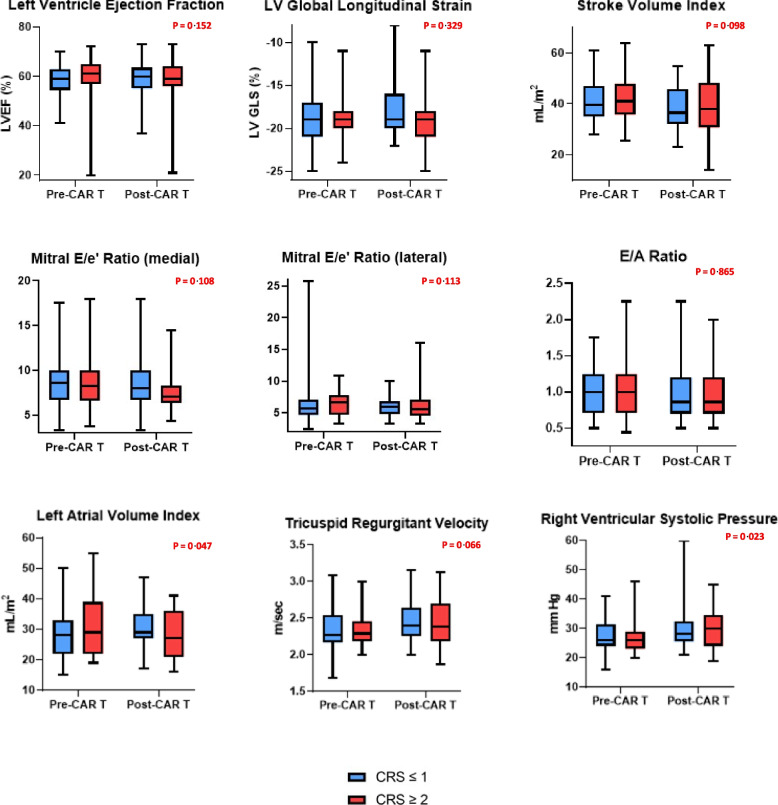
291 patients were included in the study. Median age was 60 (IQR: 51, 67 years), 73% were male, and 71% had diffuse large B-cell lymphoma. Logistic regression analysis did not reveal any significant baseline echocardiographic predictors of CRS ≥ 2, including left ventricular ejection fraction and global longitudinal strain. Systolic and diastolic echocardiographic variables remained within normal limits at follow-up overall and in both CRS groups. The incidence of CTRCD was 4.5% and occurred mostly in the setting of CRS ≥ 2.
No specific echocardiographic variables predicted the development of CRS ≥ 2, and therefore the mechanism leading to hemodynamic decompensation and producing worsening hypoxia and hypotension could be multifactorial and not directly cardiac mediated.
CD19嵌合抗原受体T细胞(CAR T)疗法是一种新型抗癌治疗方法,已在复发或难治性B细胞血液系统恶性肿瘤中产生显著疗效。细胞因子释放综合征(CRS)是一种失调的免疫反应,常在CAR T细胞输注后频繁发生。它可导致心脏功能障碍和循环衰竭,对治疗结果和生存产生负面影响。为了耐受CRS的损害,患者通常在治疗前接受充分心脏储备的筛查。超声心动图评估的基线心脏功能与中度至重度CRS表现的发生之间的关系尚不清楚。
本研究旨在确定可预测血流动力学显著CRS(CRS≥2)发生的基线超声心动图变量,评估其在随访中的变化情况,并调查癌症治疗相关心脏功能障碍(CTRCD)的发生率。对接受CD19 CAR T细胞治疗且有基线超声心动图检查的患者进行了一项观察性回顾性队列研究。从电子健康记录中提取人口统计学、临床和超声心动图变量。根据CRS<2和≥2的发生情况对患者进行分组和比较。采用校正逻辑回归分析评估超声心动图变量与CRS≥2发生之间的关联。
291例患者纳入本研究。中位年龄为60岁(四分位间距:51,67岁),73%为男性,71%患有弥漫性大B细胞淋巴瘤。逻辑回归分析未发现任何CRS≥2的显著基线超声心动图预测因素,包括左心室射血分数和整体纵向应变。总体随访时以及两个CRS组中,超声心动图的收缩期和舒张期变量均保持在正常范围内。CTRCD的发生率为4.5%,主要发生在CRS≥2的情况下。
没有特定的超声心动图变量可预测CRS≥2的发生,因此导致血流动力学失代偿并导致缺氧和低血压加重的机制可能是多因素的,并非直接由心脏介导。