Turvey Alexandra K, Cavalcanti André R O
Department of Biology, Pomona College, Claremont, California, USA.
Health Sciences and Technology Program, Harvard Medical School, Boston, Massachusetts, USA.
IUBMB Life. 2025 Jan;77(1):e2932. doi: 10.1002/iub.2932.
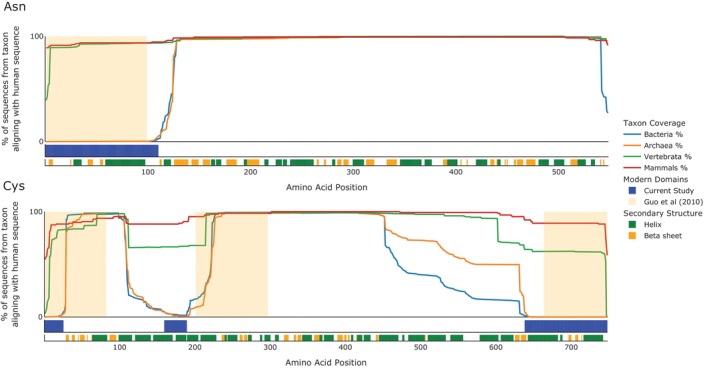
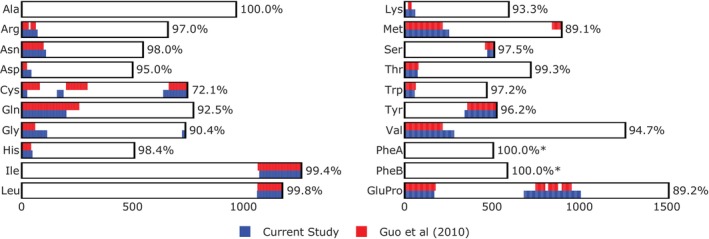
All life depends on accurate and efficient protein synthesis. The aminoacyl-tRNA synthetases (aaRSs) are a family of proteins that play an essential role in protein translation, as they catalyze the esterification reaction that charges a transfer RNA (tRNA) with its cognate amino acid. However, new domains added to the aaRSs over the course of evolution in eukaryotes confer novel functions unrelated to protein translation. To date, damaging variants that affect aaRS-encoding genes have been linked to over 50 human diseases. In this study, we leverage the evolutionary history of the aaRS proteins to better understand the distribution of disease-causing missense variants in human cytosolic aaRSs. We hypothesized that disease-causing missense variants in human aaRSs were more likely to be located in the ancient domains of the aaRS, essential for the aminoacylation reaction, rather than in the evolutionarily more recent domains found in eukaryotes. We determined the locations of the modern and ancient domains in each aaRS protein found in humans. We then statistically assessed the positional conservation across each domain and examined the distribution of pathogenic and benign/unknown missense human genetic variants across these domains. We establish that pathogenic missense variants in the human aaRS proteins are enriched in the evolutionarily ancient domains while benign/unknown missense variants are enriched in the modern domains. In addition to defining the evolutionary history of human aaRS proteins through domain identification, we anticipate that this work will improve the ability to diagnose patients affected by damaging genetic variants in the aaRS protein family.
所有生命都依赖于准确且高效的蛋白质合成。氨酰 - tRNA合成酶(aaRSs)是一类在蛋白质翻译中起关键作用的蛋白质家族,因为它们催化将转运RNA(tRNA)与其对应的氨基酸进行酯化反应。然而,在真核生物进化过程中添加到aaRSs上的新结构域赋予了与蛋白质翻译无关的新功能。迄今为止,影响aaRS编码基因的有害变异已与50多种人类疾病相关联。在本研究中,我们利用aaRS蛋白质的进化历史来更好地了解人类胞质aaRSs中致病错义变异的分布情况。我们假设人类aaRSs中的致病错义变异更有可能位于aaRS的古老结构域中,这些结构域对于氨酰化反应至关重要,而不是位于真核生物中进化上较新的结构域。我们确定了人类中发现的每种aaRS蛋白质中现代和古老结构域的位置。然后,我们对每个结构域的位置保守性进行了统计评估,并检查了致病和良性/未知错义人类遗传变异在这些结构域中的分布情况。我们证实,人类aaRS蛋白质中的致病错义变异在进化上的古老结构域中富集,而良性/未知错义变异在现代结构域中富集。除了通过结构域鉴定来定义人类aaRS蛋白质的进化历史外,我们预计这项工作将提高诊断受aaRS蛋白质家族中有害遗传变异影响的患者的能力。