Segura Patricia, Pagani Marco, Bishop Somer L, Thomson Phoebe, Colcombe Stanley, Xu Ting, Factor Zekiel Z, Hector Emily C, Kim So Hyun, Lombardo Michael V, Gozzi Alessandro, Castellanos Xavier F, Lord Catherine, Milham Michael P, Martino Adriana Di
Child Mind Institute, New York, NY, USA.
Department of Medical Physiology and Biophysics, University of Seville, Seville, Spain.
medRxiv. 2024 Dec 11:2024.12.09.24318621. doi: 10.1101/2024.12.09.24318621.
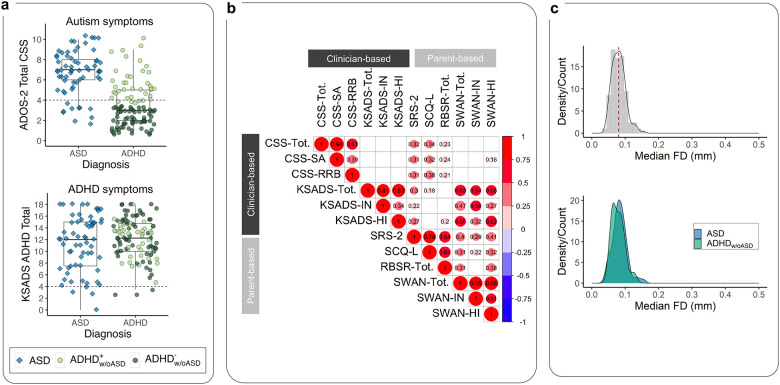
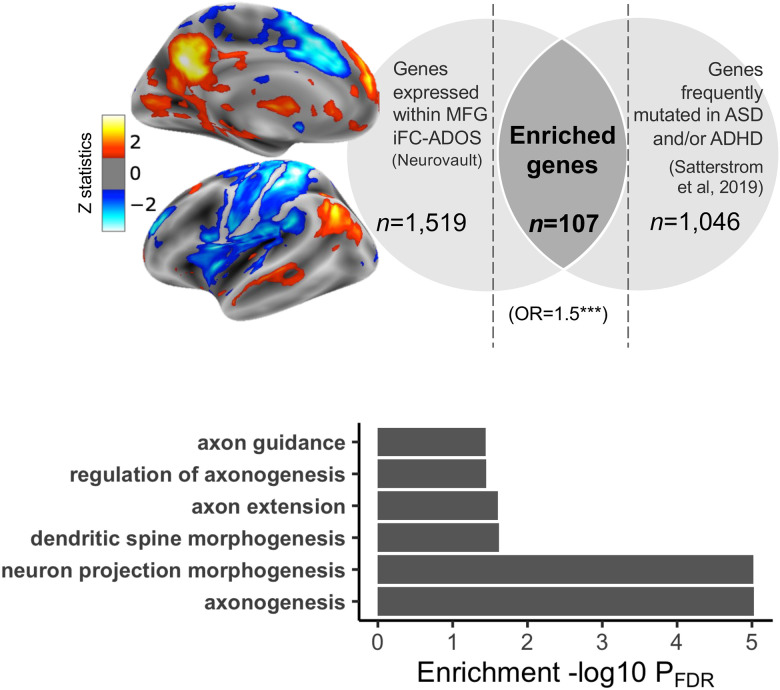
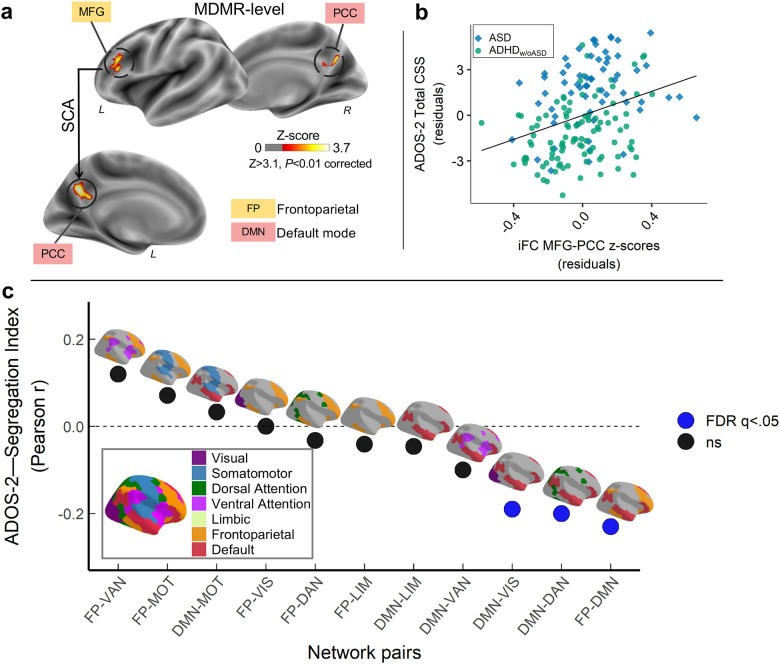
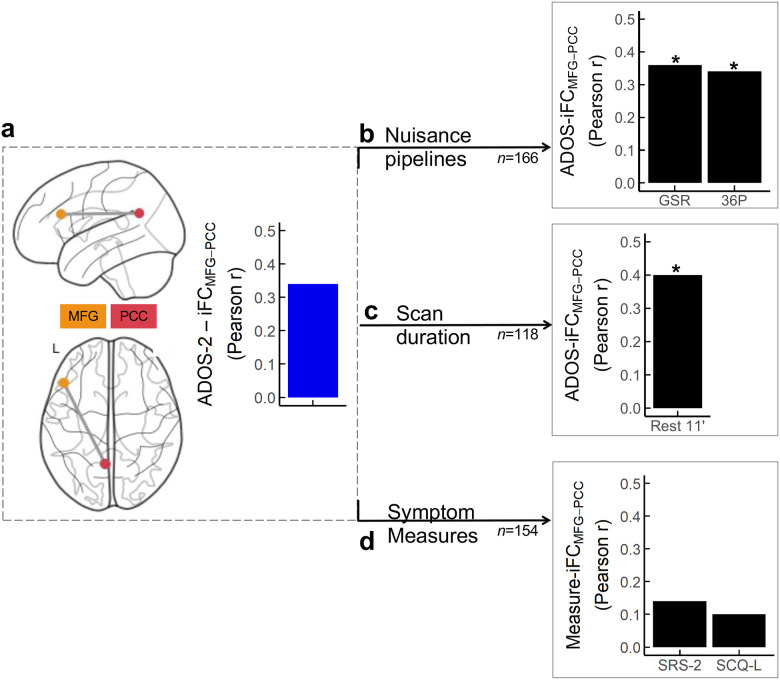
Clinical, neuroimaging and genomics evidence have increasingly underscored a degree of overlap between autism and attention-deficit/hyperactivity disorder (ADHD). This study explores the specific contribution of their core symptoms to shared biology in a sample of N=166 verbal children (6-12 years) with rigorously-established primary diagnoses of either autism or ADHD (without autism). We investigated the associations between inter-individual differences in clinician-based dimensional measures of autism and ADHD symptoms and whole-brain low motion intrinsic functional connectivity (iFC). Additionally, we explored their linked gene expression patterns . Whole-brain multivariate distance matrix regression revealed a transdiagnostic association between autism severity and iFC of two nodes: the middle frontal gyrus of the frontoparietal network and posterior cingulate cortex of the default mode network. Across children, the greater the iFC between these nodes, the more severe the autism symptoms, even after controlling for ADHD symptoms. Results from segregation analyses were consistent with primary findings, underscoring the significance of internetwork iFC interactions for autism symptom severity across diagnoses. No statistically significant brain-behavior relationships were observed for ADHD symptoms. Genetic enrichment analyses of the iFC maps associated with autism symptoms implicated genes known to: have greater rate of variance in autism and ADHD, and be involved in neuron projection, suggesting shared genetic mechanisms for this specific brain-clinical phenotype. Overall, these findings underscore the relevance of transdiagnostic dimensional approaches in linking clinically-defined phenomena to shared presentations at the macroscale circuit- and genomic-levels among children with diagnoses of autism and ADHD.
临床、神经影像学和基因组学证据越来越多地强调了自闭症与注意力缺陷多动障碍(ADHD)之间存在一定程度的重叠。本研究在一个由166名6至12岁的语言儿童组成的样本中,探讨了自闭症和ADHD(无自闭症)这两种疾病的核心症状对共同生物学特征的具体贡献,这些儿童均有经过严格确立的原发性诊断。我们调查了基于临床医生的自闭症和ADHD症状维度测量中个体间差异与全脑低运动固有功能连接性(iFC)之间的关联。此外,我们还探索了它们相关的基因表达模式。全脑多变量距离矩阵回归揭示了自闭症严重程度与两个脑区节点的iFC之间的跨诊断关联:额顶叶网络的额中回和默认模式网络的后扣带回皮质。在所有儿童中,即使在控制了ADHD症状之后,这些节点之间的iFC越强,自闭症症状就越严重。分离分析的结果与主要发现一致,强调了网络间iFC相互作用对跨诊断自闭症症状严重程度的重要性。未观察到ADHD症状与脑行为之间有统计学显著关系。对与自闭症症状相关的iFC图谱进行的基因富集分析表明,涉及的基因具有以下特点:在自闭症和ADHD中具有更高的变异率,并且参与神经元投射,这表明这种特定的脑-临床表型存在共同的遗传机制。总体而言,这些发现强调了跨诊断维度方法在将临床定义的现象与自闭症和ADHD诊断儿童在宏观尺度回路和基因组水平上的共同表现联系起来方面的相关性。