Turner Institute for Brain and Mental Health, School of Psychological Sciences, Monash University, 18 Innovation Walk, Melbourne, VIC, 3800, Australia.
Department of Paediatrics, Monash University, Melbourne, VIC, 3800, Australia.
Mol Autism. 2021 Aug 5;12(1):55. doi: 10.1186/s13229-021-00457-3.
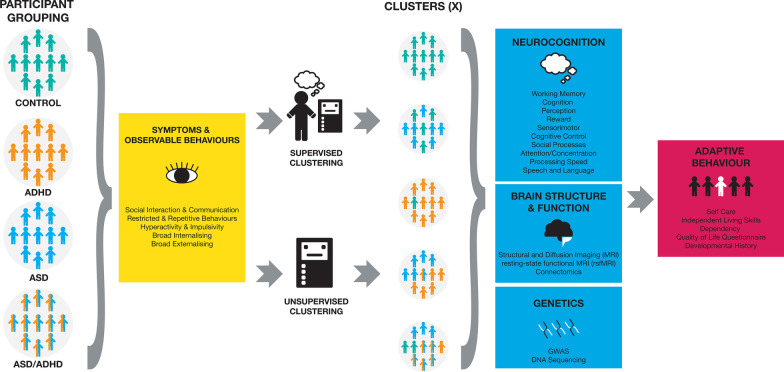
ASD and ADHD are prevalent neurodevelopmental disorders that frequently co-occur and have strong evidence for a degree of shared genetic aetiology. Behavioural and neurocognitive heterogeneity in ASD and ADHD has hampered attempts to map the underlying genetics and neurobiology, predict intervention response, and improve diagnostic accuracy. Moving away from categorical conceptualisations of psychopathology to a dimensional approach is anticipated to facilitate discovery of data-driven clusters and enhance our understanding of the neurobiological and genetic aetiology of these conditions. The Monash Autism-ADHD genetics and neurodevelopment (MAGNET) project is one of the first large-scale, family-based studies to take a truly transdiagnostic approach to ASD and ADHD. Using a comprehensive phenotyping protocol capturing dimensional traits central to ASD and ADHD, the MAGNET project aims to identify data-driven clusters across ADHD-ASD spectra using deep phenotyping of symptoms and behaviours; investigate the degree of familiality for different dimensional ASD-ADHD phenotypes and clusters; and map the neurocognitive, brain imaging, and genetic correlates of these data-driven symptom-based clusters.
The MAGNET project will recruit 1,200 families with children who are either typically developing, or who display elevated ASD, ADHD, or ASD-ADHD traits, in addition to affected and unaffected biological siblings of probands, and parents. All children will be comprehensively phenotyped for behavioural symptoms, comorbidities, neurocognitive and neuroimaging traits and genetics.
The MAGNET project will be the first large-scale family study to take a transdiagnostic approach to ASD-ADHD, utilising deep phenotyping across behavioural, neurocognitive, brain imaging and genetic measures.
ASD 和 ADHD 是常见的神经发育障碍,它们经常同时发生,并且有很强的证据表明它们具有一定程度的共同遗传病因。ASD 和 ADHD 中的行为和神经认知异质性阻碍了对潜在遗传学和神经生物学的研究,也阻碍了对干预反应的预测和诊断准确性的提高。从病理性的分类概念转向维度方法,预计将有助于发现基于数据的聚类,并增强我们对这些疾病的神经生物学和遗传病因的理解。莫纳什自闭症-ADHD 遗传学和神经发育(MAGNET)项目是第一个采用真正跨诊断方法研究 ASD 和 ADHD 的大型家庭研究之一。该项目采用全面的表型谱分析方案,对 ASD 和 ADHD 的核心维度特征进行了捕捉,旨在通过对症状和行为的深度表型分析,在 ADHD-ASD 谱系中识别基于数据的聚类;研究不同维度的 ASD-ADHD 表型和聚类的家族相似性程度;并对这些基于症状的聚类的神经认知、脑成像和遗传相关性进行研究。
MAGNET 项目将招募 1200 个家庭,这些家庭的孩子要么是典型的发育儿童,要么是表现出 ASD、ADHD 或 ASD-ADHD 特征的儿童,此外还有患儿的受影响和未受影响的兄弟姐妹,以及父母。所有儿童将接受全面的行为症状、共病、神经认知和神经影像学特征和遗传学特征的表型分析。
MAGNET 项目将是第一个采用跨诊断方法研究 ASD-ADHD 的大型家庭研究,该项目将利用行为、神经认知、脑成像和遗传等多方面的深度表型分析方法。