Ko Jonathan, Krug Katja, Förster Christian, Jähnig Tanja, Bischoff Martina, Becker Christine, Schwill Simon
Heidelberg University Hospital, Department of General Medicine and Health Services Research, Heidelberg, Germany.
University Hospital Tübingen, Institute for General Medicine and Interprofessional Care, Tübingen, Germany.
GMS J Med Educ. 2024 Nov 15;41(5):Doc51. doi: 10.3205/zma001706. eCollection 2024.
To aid the shortage of general practitioners (GPs) in Germany, since 2011 medical specialists from other fields may switch specialisation by undergoing a slim-lined training programme (lateral entry) into general practice (GP). Available published qualitative and quantitative data on lateral entrants (LEs) is scarce. Aim of the study was an explorative analysis of LEs in the competence centre for postgraduate medical education Baden-Wuerttemberg (KWBW).
In 2016, a multicentric cohort study was initiated including all GP trainees entering the KWBW. Data from 2016 to 2022 was included (T0). A follow-up with graduates from the KWBW was performed once in 2023 (T1). Surveys at T0 and T1 were self-developed, piloted, and included questions on social demography, education, qualification, current training, working environment and professional plans. Dataset was analysed exploratively.
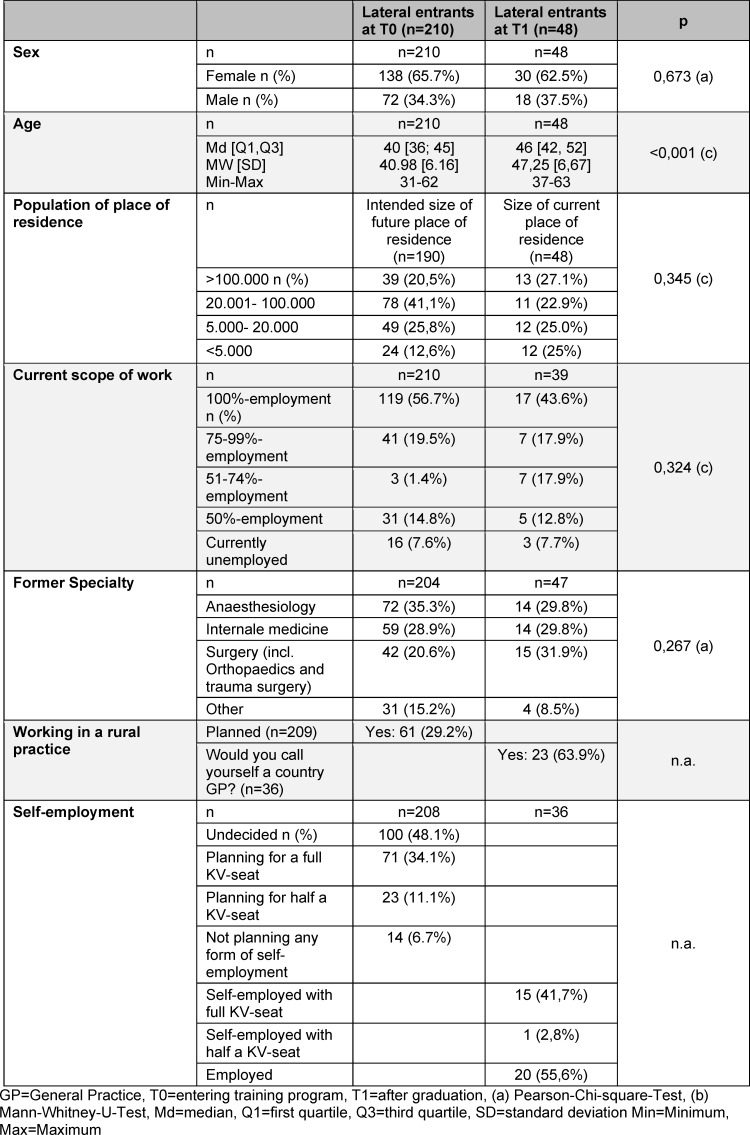
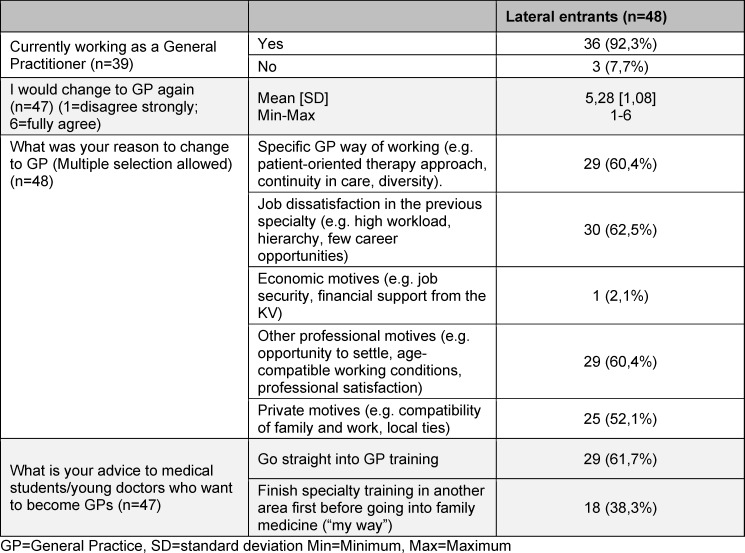
At T0, 884 GP trainees participated (response 95.2%). 23.8% of participants were LEs (N=210). Most LEs were specialists from anaesthesiology (34.8%), internal medicine (28.5%) and surgery (20.6%). LEs had been working in their previous specialty for a median of 3 years before starting GP-training. At T0, LEs were seven years older than their colleagues (p<0,001). The proportion of men among LEs was higher (34.3% vs 25.1%, p=0,009). LEs were more decisive to open their own GP practice (p=0,009). At T1, 48 LEs participated of which 92% were practising GPs (N=36). 64,5% considered themselves rural GPs and work in communities <20.000 people (N=36). LEs mainly choose GP because of its specific way of working, job dissatisfaction and personal motives such as opportunity to start a practice. Most LEs strongly agreed that they would switch to GP again.
LEs are a relevant party among GP trainees. Many LEs become self-employed and contribute essentially to providing primary care. Lateral entry attracts specialists, also from rural areas, seeking for professional satisfaction. This is why LEs should follow their new path within a regional competence centre providing GP specific courses, mentoring and a professional network.
LEs graduating from KWBW have become an important pillar of primary care in Baden-Wuerttemberg.
为缓解德国全科医生短缺的状况,自2011年起,其他领域的医学专家可通过参加精简培训计划(横向进入)转而从事全科医疗工作。关于横向进入者(LEs)的现有定性和定量数据稀缺。本研究的目的是对巴登-符腾堡州研究生医学教育能力中心(KWBW)的横向进入者进行探索性分析。
2016年启动了一项多中心队列研究,纳入所有进入KWBW的全科医生培训学员。纳入了2016年至2022年的数据(T0)。2023年对KWBW的毕业生进行了一次随访(T1)。T0和T1时的调查问卷是自行设计并经过预试验的,包括社会人口统计学、教育、资质、当前培训、工作环境和职业规划等方面的问题。对数据集进行了探索性分析。
在T0时,884名全科医生培训学员参与调查(应答率95.2%)。23.8%的参与者是横向进入者(N = 210)。大多数横向进入者是麻醉科(34.8%)、内科(28.5%)和外科(20.6%)的专家。横向进入者在开始全科医生培训前,在其先前专业领域工作的中位数为3年。在T0时,横向进入者比他们的同事年长7岁(p<0.001)。横向进入者中的男性比例更高(34.3%对25.1%,p = 0.009)。横向进入者更有决心开办自己的全科诊所(p = 0.009)。在T1时,48名横向进入者参与调查,其中92%是执业全科医生(N = 36)。64.5%认为自己是农村全科医生,在人口不足2万的社区工作(N = 36)。横向进入者主要因为其特定的工作方式、工作不满意以及个人动机(如开办诊所的机会)而选择全科医疗。大多数横向进入者强烈同意他们会再次选择成为全科医生。
横向进入者是全科医生培训学员中的一个重要群体。许多横向进入者成为个体经营者,对提供初级医疗服务做出了重要贡献。横向进入吸引了包括农村地区在内的专家,他们寻求职业满足感。这就是为什么横向进入者应该在一个提供全科医疗特定课程、指导和专业网络的区域能力中心内走他们的新道路。
从KWBW毕业的横向进入者已成为巴登-符腾堡州初级医疗服务的重要支柱。