
全科医学专科培训:基于社会立法的支持发展——数据驱动的介绍
Specialist training in general practice: Developments in social-legislation-based support - a data-driven introduction.
作者信息
Rass Simon, Weber Charlotte, Gibis Bernhard
机构信息
Kassenärztliche Bundesvereinigung, Dezernat Sicherstellung und Versorgungsstruktur, Abteilung Sicherstellung, Berlin, Germany.
出版信息
GMS J Med Educ. 2024 Nov 15;41(5):Doc52. doi: 10.3205/zma001707. eCollection 2024.
AIMS
Comprehensive provision of general healthcare (i.e. primary care) within the populace is contingent on there being enough general practitioners (GPs) in proximity to patients. It is no longer the case that vacated allocated positions for primary-care physicians are being filled in all regions. Support for specialist training in general medical practice is one of the measures intended to ensure provision of GP services. This analytical project aims to make a data-driven contribution to gauging the impact of such support on primary care in Germany, while also delivering pointers for further research.
METHODS
On the basis of routinely collected data, the history of such support was examined in detail for all practice-based, statutory health insurance (SHI)-accredited GPs during the period 2016-2022. In the analysis, GPs were broken down by whether they took up full-time or part-time roles, self-employed or salaried roles, and roles in a practice or in an ambulatory healthcare centre (MVZ).
RESULTS
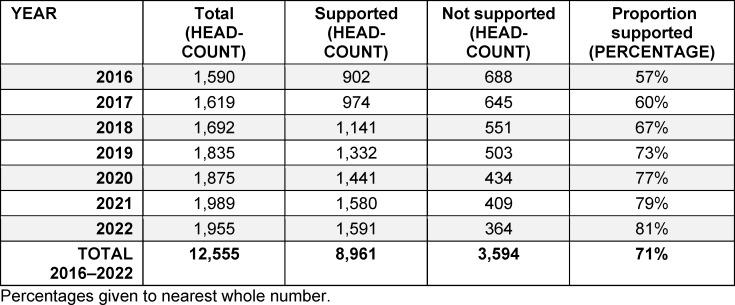
During the period under review, the proportion of those who have both recently commenced work as SHI-accredited GPs and had previously used support for their specialist training, increased from 57% to 81%. The total number of new GPs (headcount) rose from 1,590 to 1,955. Results indicate that those who had availed themselves of this support take up self-employed and full-time roles more often than those who had not.
CONCLUSIONS
Both take-up of support for specialist training, and the number of new GPs, increased markedly during the period under review. The data does not indicate any causal links. However, these results could form a jumping-off point for further research (in general) into support for specialist training, and (in particular) into how this may impact these individuals' subsequent work roles.
目的
民众能否获得全面的常规医疗保健服务(即初级保健),取决于附近是否有足够的全科医生(GP)。并非所有地区的初级保健医生空缺职位都能得到填补。支持全科医学专业培训是确保提供全科医生服务的措施之一。本分析项目旨在以数据为依据,评估此类支持对德国初级保健的影响,同时为进一步研究提供指导。
方法
基于常规收集的数据,详细考察了2016年至2022年期间所有基于执业机构、获得法定医疗保险(SHI)认可的全科医生获得此类支持的历史情况。在分析中,全科医生按全职或兼职、个体经营或受薪、在执业机构或门诊医疗中心(MVZ)工作进行分类。
结果
在审查期间,近期开始工作且此前接受过专业培训支持的SHI认可的全科医生比例从57%增至81%。新全科医生总数(人数)从1590人增至1955人。结果表明,获得此类支持的人比未获得支持的人更常从事个体经营和全职工作。
结论
在审查期间,接受专业培训支持的人数和新全科医生数量均显著增加。数据未表明存在任何因果关系。然而,这些结果可能成为进一步研究(总体而言)专业培训支持,以及(具体而言)其如何影响这些人后续工作角色的起点。



 Zotero 插件