Ovestad Irene T, Dalen Ingvild, Soreng Kristiane, Akbari Saleha, Lapin Morten, Janssen Emiel Am, Austdal Marie, Munk Ane Cecilie, Gudlaugsson Einar
Department of Pathology, Stavanger University Hospital, Stavanger, Norway.
Section of Biostatistics, Department of Research, Stavanger University Hospital, Stavanger, Norway.
Front Immunol. 2024 Dec 6;15:1507193. doi: 10.3389/fimmu.2024.1507193. eCollection 2024.
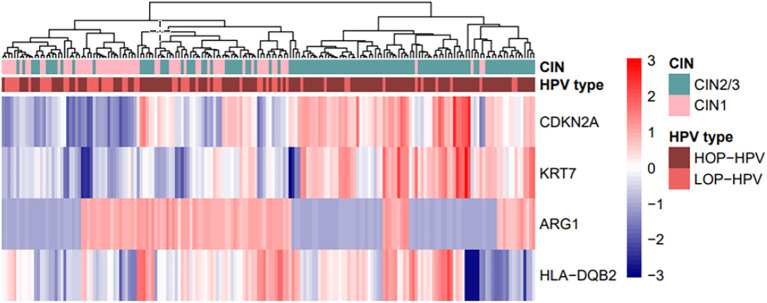
Human papilloma virus (HPV) infections vary in their oncogenic potential, and whether an infection progresses to cervical intraepithelial neoplasia (CIN) also depends on the immune response. Therefore, the aim of the present study was to explore biomarkers related to the immune system and cell proliferation, in combination with HPV classified as having high (HOP) or low oncogenic potential (LOP), that can possibly guide a more accurate identification of women following cervical cancer screening programmes in need for immediate follow-up with a biopsy. A next-generation sequencing transcriptomic immune profile analysis applied to 28 persistent CIN3 lesions and 14 normal biopsies identified four genes, the immune markers and and the tumour markers and , as possible markers for differentiating between CIN3 and normal tissue. To validate these findings, analysis of the relative gene expression of these markers by use of reverse transcriptase real-time quantitative polymerase chain reaction was performed in an independent cohort of 264 (82 normal, 64 CIN1, and 118 CIN2/CIN3) biopsies, and the data were combined with information on the HOP- or LOP-HPV identified in the biopsies. Statistical analysis was performed with receiver operating characteristic curves, reporting area under the curve (AUC) with 95% confidence intervals (CIs), and logistic regression. Statistically significantly higher median expression levels of ( < 0.001) and ( = 0.045) and significantly lower expression of ( = 0.012) were found in biopsies with HOP-HPV infections, with no difference detected for ( = 0.82). Models using expression levels of (AUC, 0.91; 95% CI, 0.86-0.95), (0.86, 0.81-0.91), or (0.78, 0.70-0.85) together with HOP/LOP-HPV class were significantly better than HPV class alone (0.72, 0.66-0.79) in discriminating CIN2/3 versus CIN1 ( < 0.001, < 0.001, and = 0.014, respectively).
人乳头瘤病毒(HPV)感染的致癌潜力各不相同,感染是否会进展为宫颈上皮内瘤变(CIN)也取决于免疫反应。因此,本研究的目的是探索与免疫系统和细胞增殖相关的生物标志物,并结合致癌潜力高(HOP)或低(LOP)的HPV,以指导在宫颈癌筛查项目中更准确地识别需要立即进行活检随访的女性。对28例持续性CIN3病变和14例正常活检组织进行的下一代测序转录组免疫谱分析确定了四个基因,即免疫标志物 和 以及肿瘤标志物 和 ,作为区分CIN3和正常组织的可能标志物。为了验证这些发现,在一个由264例(82例正常、64例CIN1和118例CIN2/CIN3)活检组织组成的独立队列中,使用逆转录酶实时定量聚合酶链反应分析了这些标志物的相对基因表达,并将数据与活检组织中鉴定出的HOP-HPV或LOP-HPV信息相结合。采用受试者工作特征曲线进行统计分析,报告曲线下面积(AUC)及95%置信区间(CI),并进行逻辑回归分析。在HOP-HPV感染的活检组织中,发现 ( < 0.001)和 ( = 0.045)的中位表达水平在统计学上显著更高,而 ( = 0.012)的表达显著更低, ( = 0.82)未检测到差异。使用 (AUC,0.91;95%CI,0.86 - 0.95)、 (0.86,0.81 - 0.91)或 (0.78,0.70 - 0.85)的表达水平以及HOP/LOP-HPV类别构建的模型在区分CIN2/3与CIN1方面明显优于单独的HPV类别(0.72,0.66 - 0.79)(分别为 < 0.001、 < 0.001和 = 0.014)。