Qiu Yue, Cady Chelsea, Rosario Bedda L, Orebaugh Steven
Department of Anesthesiology and Perioperative Medicine, University of Pittsburgh Medical Center, Pittsburgh, PA, USA.
Department of Epidemiology, University of Pittsburgh, Pittsburgh, PA, USA.
Local Reg Anesth. 2024 Dec 17;17:107-115. doi: 10.2147/LRA.S495105. eCollection 2024.
The C4 dermatome anesthesia holds significance for arthroscopic shoulder surgery. However, the reliability of achieving C4 dermatome anesthesia with the current low-dose ultrasound-guided interscalene block (ISB) and supraclavicular block (SCB) remains uncertain. This prospective, single-center study examined the effects of ultrasound-guided interscalene block (ISB) and supraclavicular block (SCB) on the C4 sensory dermatome in patients undergoing shoulder, hand, or wrist surgery.
Patients undergoing outpatient shoulder, hand, or wrist surgeries received ultrasound-guided ISB (for shoulder surgeries) with 12-15 mL of 0.5% bupivacaine or ultrasound-guided SCB (for hand and wrist surgeries) with 20-24 mL of 0.5% bupivacaine. The primary objective of the study was to investigate the sensory effect on the C4 dermatome after ISB and SCB. The secondary outcomes included the sensory effect on the C5 dermatome after performing ISB and SCB, pain scores upon arrival at the post-anesthesia care unit (PACU), and the incidence of adverse effects.
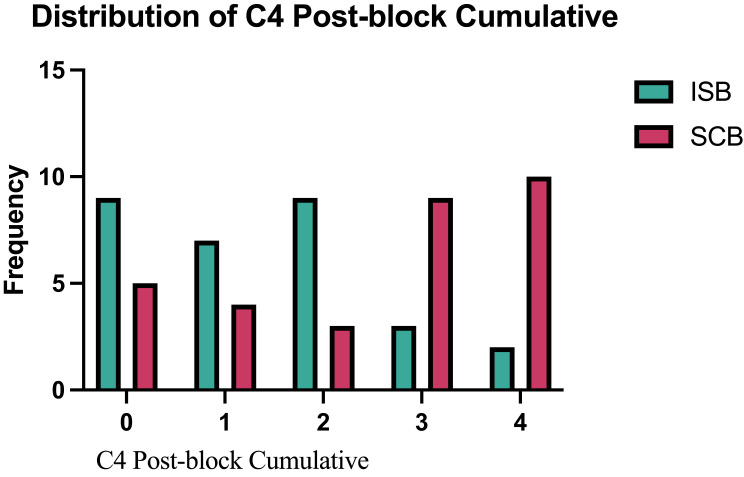
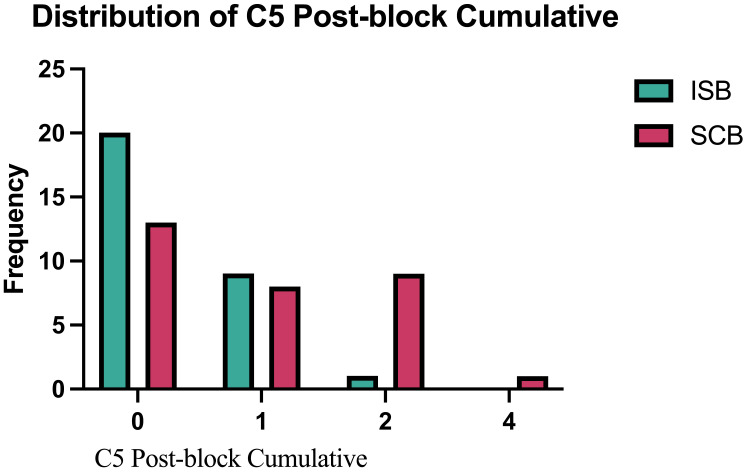
Sixty-one patients were recruited: 30 for ISB and 31 for SCB. C4 dermatome coverage was achieved in 53% and 29% of patients in the ISB and SCB groups, respectively (p=0.0268). Additionally, C5 dermatome coverage was achieved in 97% and 68% of patients in the ISB and SCB groups, respectively (p=0.0034). A moderate correlation coefficient (r=0.47) was observed between C4 sensory scores and postoperative pain scores.
Ultrasound-guided ISB successfully provided C4 coverage in 53% of cases, suggesting that performing an additional C4 block alongside ISB could be advantageous when aiming for complete surgical anesthesia. SCB may not be the primary choice for shoulder surgeries as it often fails to achieve satisfactory sensory blocks at the C4 and C5 levels.
C4皮节麻醉对肩关节镜手术具有重要意义。然而,目前低剂量超声引导下的肌间沟阻滞(ISB)和锁骨上阻滞(SCB)实现C4皮节麻醉的可靠性仍不确定。这项前瞻性单中心研究探讨了超声引导下的肌间沟阻滞(ISB)和锁骨上阻滞(SCB)对接受肩部、手部或腕部手术患者C4感觉皮节的影响。
接受门诊肩部、手部或腕部手术的患者接受超声引导下的肌间沟阻滞(用于肩部手术),注射12 - 15 mL 0.5%布比卡因,或超声引导下的锁骨上阻滞(用于手部和腕部手术),注射20 - 24 mL 0.5%布比卡因。该研究的主要目的是调查肌间沟阻滞和锁骨上阻滞后对C4皮节的感觉效果。次要结果包括肌间沟阻滞和锁骨上阻滞后对C5皮节的感觉效果、到达麻醉后护理单元(PACU)时的疼痛评分以及不良反应的发生率。
招募了61名患者:30名接受肌间沟阻滞,31名接受锁骨上阻滞。肌间沟阻滞组和锁骨上阻滞组分别有53%和29%的患者实现了C4皮节覆盖(p = 0.0268)。此外,肌间沟阻滞组和锁骨上阻滞组分别有97%和68%的患者实现了C5皮节覆盖(p = 0.0034)。观察到C4感觉评分与术后疼痛评分之间存在中度相关系数(r = 0.47)。
超声引导下的肌间沟阻滞在53%的病例中成功实现了C4覆盖,这表明在追求完全手术麻醉时,在肌间沟阻滞的基础上额外进行C4阻滞可能是有益的。锁骨上阻滞可能不是肩部手术的首选,因为它常常无法在C4和C5水平实现满意的感觉阻滞。