Alsaied Tarek, Lubert Adam M, Goldberg David J, Schumacher Kurt, Rathod Rahul, Katz David A, Opotowsky Alexander R, Jenkins Meredith, Smith Christopher, Rychik Jack, Amdani Shahnawaz, Lanford Lizabeth, Cetta Frank, Kreutzer Christian, Feingold Brian, Goldstein Bryan H
Heart Institute, UPMC Children's Hospital of Pittsburgh, Division of Pediatric Cardiology, University of Pittsburgh School of Medicine, Pittsburgh, PA, USA.
Heart Institute, Department of Pediatrics, Cincinnati Children's Hospital Medical Center, University of Cincinnati, Cincinnati, OH, USA.
Int J Cardiol Congenit Heart Dis. 2022 Jan 26;7:100338. doi: 10.1016/j.ijcchd.2022.100338. eCollection 2022 Mar.
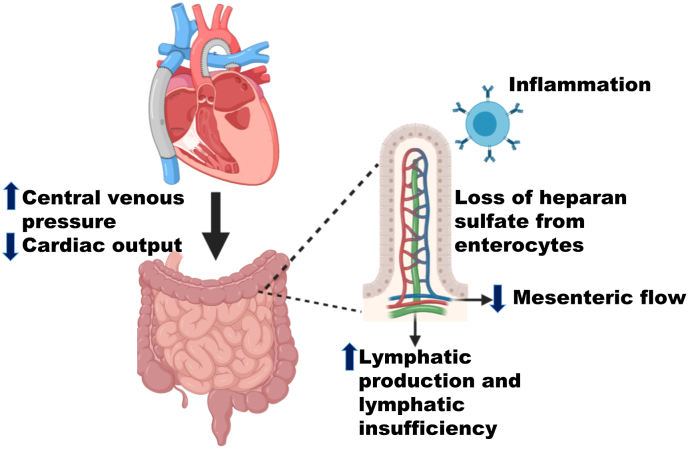
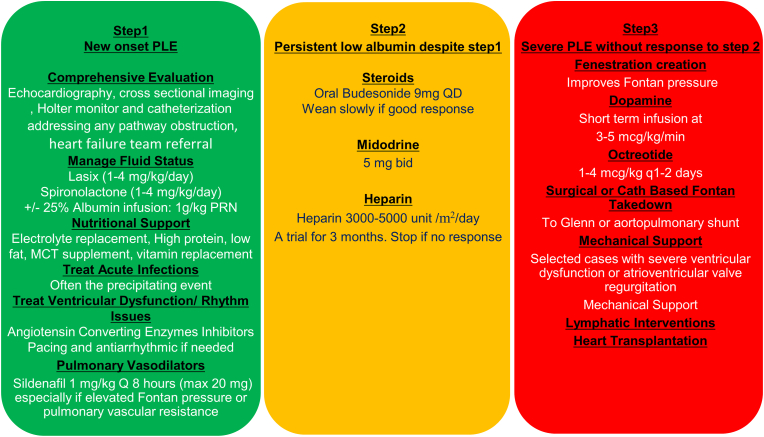
The Fontan or Fontan Kreutzer procedure is the culmination of staged, surgical palliation of functional single ventricle congenital heart disease, offering the potential for survival and good quality of life well into adulthood. As more patients with Fontan circulation age, a variety of complications involving almost every organ system may occur. Protein-losing enteropathy is a major cause of morbidity and mortality after the Fontan operation, occurring more often in patients with adverse hemodynamics and presenting weeks to years after Fontan surgery. The causes are not well understood, but likely include a combination of lymphatic insufficiency, high central venous pressure, loss of heparan sulfate from intestinal epithelial cells, abnormal mesenteric circulation, and intestinal inflammation. A comprehensive evaluation including multimodality imaging and cardiac catheterization is necessary to diagnose and treat any reversible causes. In advanced cases, early referral for heart transplantation evaluation or lymphatic decompression procedures (if the single ventricle function remains adequate) is indicated. Despite the improvement in detection and management options, the mortality remains high. Standardization of protein-losing enteropathy definition and management strategies will help facilitate interpretation of research and clinical experience, potentially fostering the identification of new therapies. Based on the published data, this review suggests a standardized approach to diagnosis and treatment.
Fontan手术或Fontan-Kreutzer手术是功能性单心室先天性心脏病分期手术姑息治疗的最终阶段,为患者存活至成年并拥有良好生活质量提供了可能。随着越来越多接受Fontan循环的患者年龄增长,几乎累及每个器官系统的各种并发症都可能出现。蛋白丢失性肠病是Fontan手术后发病和死亡的主要原因,在血流动力学不良的患者中更常发生,且在Fontan手术数周或数年之后出现。其病因尚不完全清楚,但可能包括淋巴管功能不全、中心静脉压升高、肠上皮细胞硫酸乙酰肝素丢失、肠系膜循环异常以及肠道炎症等多种因素。进行包括多模态成像和心导管检查在内的全面评估对于诊断和治疗任何可逆性病因很有必要。在病情晚期,对于单心室功能仍足够的患者,应尽早转诊进行心脏移植评估或淋巴管减压手术。尽管在检测和管理方法上有所改进,但死亡率仍然很高。蛋白丢失性肠病定义和管理策略的标准化将有助于促进对研究和临床经验的解读,可能有助于发现新的治疗方法。基于已发表的数据,本综述提出了一种标准化的诊断和治疗方法。