Colwill Michael, Baillie Samantha, Pollok Richard, Poullis Andrew
Department of Gastroenterology, St George's University Hospital NHS Foundation Trust, London SW17 0QT, United Kingdom.
World J Methodol. 2024 Dec 20;14(4):91387. doi: 10.5662/wjm.v14.i4.91387.
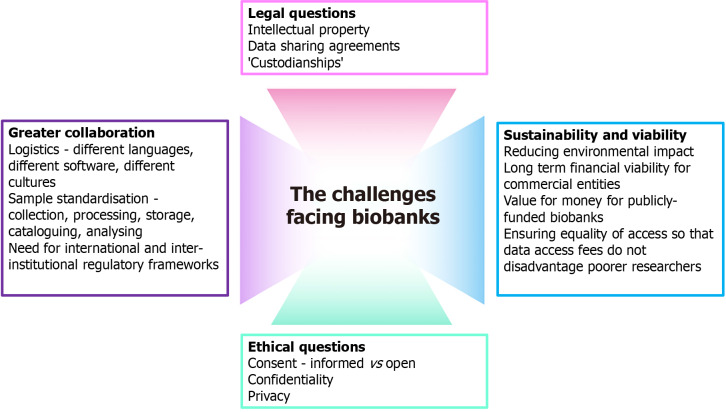
The importance and utility of biobanks has increased exponentially since their inception and creation. Initially used as part of translational research, they now contribute over 40% of data for all cancer research papers in the United States of America and play a crucial role in all aspects of healthcare. Multiple classification systems exist but a simplified approach is to either classify as population-based or disease-oriented entities. Whilst historically publicly funded institutions, there has been a significant increase in industry funded entities across the world which has changed the dynamic of biobanks offering new possibilities but also new challenges. Biobanks face legal questions over data sharing and intellectual property as well as ethical and sustainability questions particularly as the world attempts to move to a low-carbon economy. International collaboration is required to address some of these challenges but this in itself is fraught with complexity and difficulty. This review will examine the current utility of biobanks in the modern healthcare setting as well as the current and future challenges these vital institutions face.
生物样本库自创立以来,其重要性和实用性呈指数级增长。最初作为转化研究的一部分使用,如今它们为美国所有癌症研究论文贡献了超过40%的数据,并在医疗保健的各个方面发挥着关键作用。存在多种分类系统,但一种简化的方法是将其分类为基于人群或面向疾病的实体。虽然历史上是由公共资金资助的机构,但全球范围内由行业资助的实体显著增加,这改变了生物样本库的动态,带来了新的可能性,但也带来了新的挑战。生物样本库面临数据共享和知识产权方面的法律问题,以及伦理和可持续性问题,特别是在世界试图转向低碳经济的情况下。需要国际合作来应对其中一些挑战,但这本身就充满了复杂性和困难。本综述将探讨生物样本库在现代医疗环境中的当前效用,以及这些重要机构面临的当前和未来挑战。