Rock Jamie L, Becker Heather A
School of Nursing, University of Texas at Austin, USA.
Health Care Transit. 2024 Feb 3;2:100046. doi: 10.1016/j.hctj.2024.100046. eCollection 2024.
As many as 95% of individuals across the lifespan with autism spectrum disorder (ASD) have at least one comorbidity. While research focused only on the health of autistic adolescents is limited, we do know that fewer than 14% of these youth receive appropriate transition services to self-manage their health. These limitations have resulted in poor outcomes and premature mortality. Little is known about how parents and their adolescent children address this health burden.
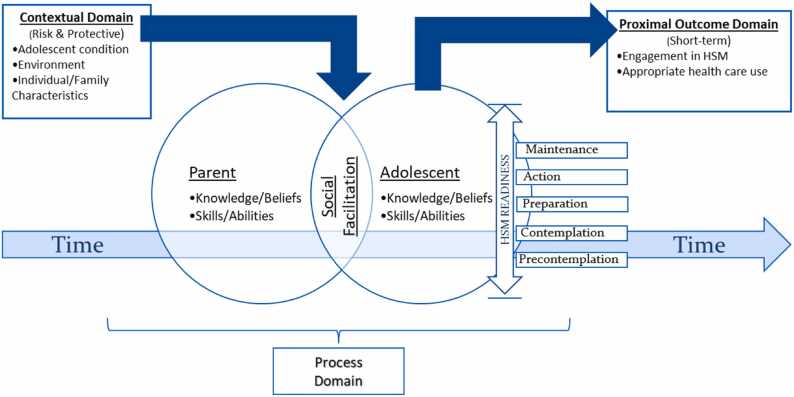
The objective of this study is twofold. First to compare the perceptions of adolescents with ASD and their parents regarding adolescents' contextual and process variables (depressive symptoms, health knowledge, health communication/planning, self-efficacy, self-determination) and health self-management (HSM) behavior. The second is to examine social facilitation for HSM behaviors in adolescents with ASD and their parents.
In this community-based study, an online survey was used to compare the perspectives of 40 adolescents with ASD aged 12 to 22 years and their parents on the adolescents' HSM behaviors. Contextual and process variable measures (PROMISE, Star, General Self-efficacy Scale, AIR Self-determination Scale, Social Facilitation Questionnaire) were completed by both adolescents (adolescent/pediatric version) and parents (parent version).
Descriptive analysis indicated that parents were teaching self-management to adolescents for monitoring and preventing illness, including medication knowledge and how to talk to their doctor. The largest differences were found between parents' and adolescents' perceptions regarding teaching and learning about independent management of existing health conditions. Additionally, adolescents rated their self-efficacy (t (38) = 3.62, < .001) and self-determination (39) = 4.55, < .001) significantly higher than their parents did.
This study contributes perspectives on what parents and adolescents are doing to enhance adolescents' health self-management. Adolescence is a developmental period of social facilitation when parents may teach their adolescent children with ASD to self-manage their health and when those adolescents may learn to do so. During this period, providers should offer adequate planning and guided training to support parents and their adolescent children with ASD to improve adolescents' self-management behaviors and improve health outcomes for this vulnerable population.
在自闭症谱系障碍(ASD)患者的整个生命周期中,多达95%的人至少患有一种合并症。虽然仅关注自闭症青少年健康的研究有限,但我们确实知道,这些青少年中接受适当过渡服务以自我管理健康的比例不到14%。这些限制导致了不良后果和过早死亡。关于父母及其青春期子女如何应对这种健康负担,我们知之甚少。
本研究有两个目的。一是比较患有ASD的青少年及其父母对青少年的背景和过程变量(抑郁症状、健康知识、健康沟通/规划、自我效能感、自主决定权)以及健康自我管理(HSM)行为的看法。二是研究患有ASD的青少年及其父母对HSM行为的社会促进作用。
在这项基于社区的研究中,通过在线调查比较了40名年龄在12至22岁之间患有ASD的青少年及其父母对青少年HSM行为的看法。背景和过程变量测量(PROMISE、Star、一般自我效能感量表、AIR自主决定权量表、社会促进问卷)由青少年(青少年/儿科版)和父母(父母版)共同完成。
描述性分析表明,父母正在教导青少年自我管理以监测和预防疾病,包括用药知识以及如何与医生交谈。在父母和青少年对现有健康状况独立管理的教学和学习方面的看法上,差异最大。此外,青少年对自我效能感(t(38)= 3.62,P <.001)和自主决定权(t(39)= 4.55,P <.001)的评分显著高于父母。
本研究提供了关于父母和青少年为增强青少年健康自我管理所采取措施的观点。青春期是一个社会促进的发展阶段,在此期间父母可以教导患有ASD的青春期子女自我管理健康,而这些青少年也可以学会这样做。在此期间,医疗服务提供者应提供充分的规划和指导培训,以支持父母及其患有ASD的青春期子女,改善青少年的自我管理行为,提高这一弱势群体的健康状况。