Dong Zi-Yue, He Ming-Jie, Hu Yuan, Wang Fang, Ran De-Long, Fu De-Shuang, He Qing, Yang Run-Ping, Zhang Jiang-An
Department of Dermatology, First Affiliated Hospital of Zhengzhou University, Zhengzhou, Henan, People's Republic of China.
Department of Dermatology, People's Hospital of Zhengzhou, Zhengzhou, Henan, People's Republic of China.
Clin Cosmet Investig Dermatol. 2024 Dec 18;17:2923-2932. doi: 10.2147/CCID.S504391. eCollection 2024.
Due to limited treatment options, cutaneous warts caused by human papillomavirus (HPV) remain a significant clinical challenge. Furthermore, the genetic susceptibility and molecular basis of viral warts are not yet fully understood.
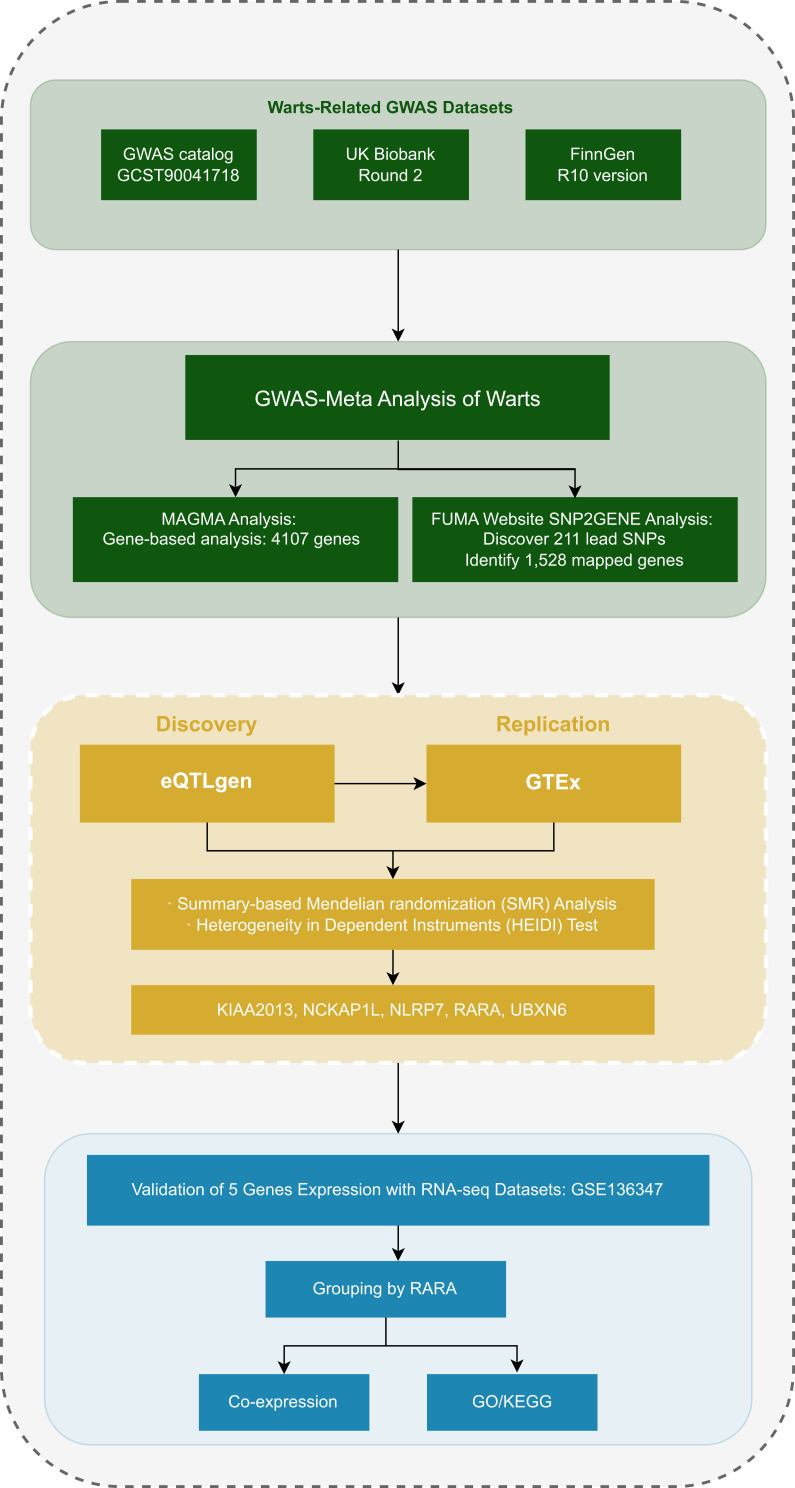
We utilized a multi-omics integration approach, encompassing genome-wide association study (GWAS) meta-analysis, summary data-based Mendelian randomization (SMR) analysis, and transcriptomic validation using the GSE136347 dataset. Differential gene expression (DEG) analysis was conducted to identify significant changes in gene expression between wart tissues and healthy skin.
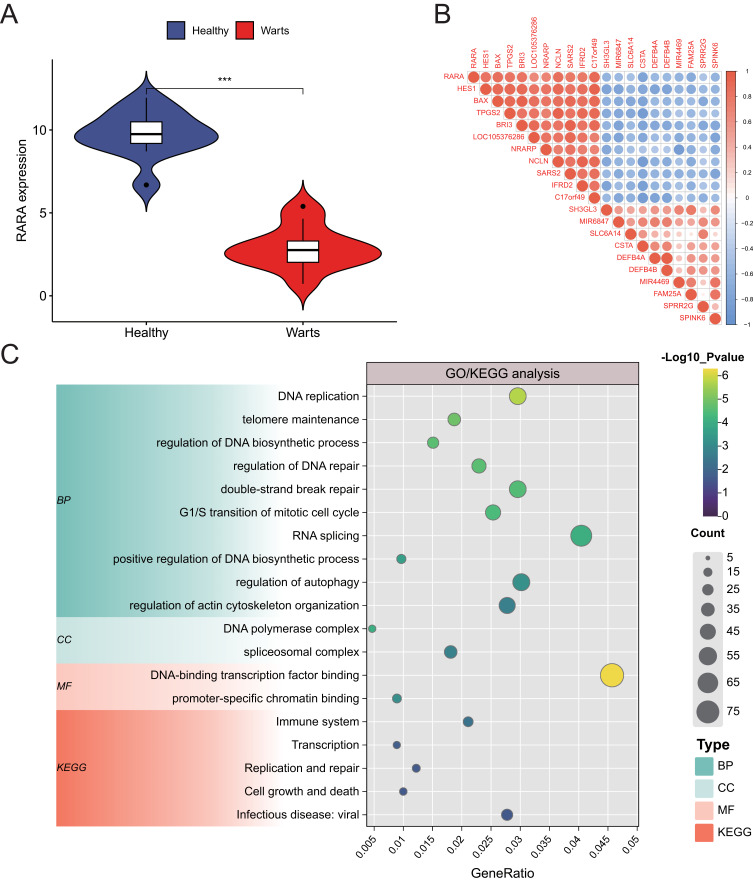
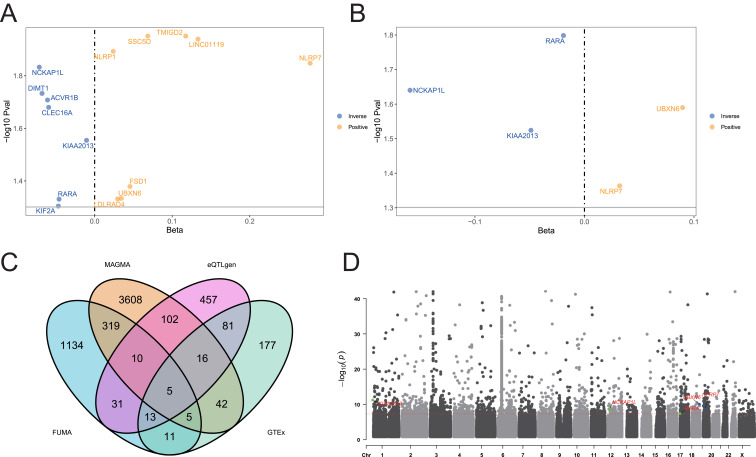
Our analyses revealed five genetic susceptibility genes associated with cutaneous warts, with RARA showing significant differential expression in wart tissues. Co-expression analysis indicated that RARA may regulate apoptosis through interactions with BAX, a pro-apoptotic gene. Additionally, functional annotation via Gene Ontology (GO) and Kyoto Encyclopedia of Genes and Genomes (KEGG) pathway analyses highlighted key biological processes and pathways involved in wart pathogenesis.
This study identifies RARA as a pivotal regulator in the molecular pathology of cutaneous warts and a promising therapeutic target. RA-based therapies could offer effective and less invasive alternatives for wart treatment. Future investigations should refine the molecular role of RARA to optimize clinical interventions.
由于治疗选择有限,人乳头瘤病毒(HPV)引起的皮肤疣仍然是一项重大的临床挑战。此外,病毒疣的遗传易感性和分子基础尚未完全了解。
我们采用了多组学整合方法,包括全基因组关联研究(GWAS)荟萃分析、基于汇总数据的孟德尔随机化(SMR)分析以及使用GSE136347数据集进行转录组验证。进行差异基因表达(DEG)分析以确定疣组织与健康皮肤之间基因表达的显著变化。
我们的分析揭示了五个与皮肤疣相关的遗传易感基因,其中视黄酸受体α(RARA)在疣组织中显示出显著的差异表达。共表达分析表明,RARA可能通过与促凋亡基因BAX相互作用来调节细胞凋亡。此外,通过基因本体论(GO)和京都基因与基因组百科全书(KEGG)通路分析进行的功能注释突出了疣发病机制中涉及的关键生物学过程和通路。
本研究确定RARA是皮肤疣分子病理学中的关键调节因子和有前景的治疗靶点。基于视黄酸(RA)的疗法可为疣治疗提供有效且侵入性较小的替代方案。未来的研究应进一步明确RARA的分子作用,以优化临床干预措施。