Yu Jing, Song Jingru, Shen Qin
School of Nursing, Zhejiang Chinese Medical University, Hangzhou, China.
Front Hum Neurosci. 2024 Dec 6;18:1467697. doi: 10.3389/fnhum.2024.1467697. eCollection 2024.
Mild cognitive impairment (MCI) is a prodromal stage of dementia. There is no specific medication to slow the progression of MCI. Recent studies have confirmed the positive effects of virtual reality (VR). However, the results are inconsistent due to different types of VR interventions, small sample sizes, and the varying quality of the literature. This study aimed to assess the effects of fully immersive VR on cognitive function in MCI patients.
A systematic review of published literature was conducted using PubMed, Cochrane Library, Embase, CINAHL, Web of Science, SinoMed, CNKI, Wanfang, and VIP Database. The search period was from inception through March 1, 2024. Eligible studies were randomized controlled trials evaluating the effects of fully immersive virtual reality training on cognitive function in MCI patients. Two investigators independently performed literature screening, data extraction, and quality assessment; a meta-analysis of the included literature was performed using RevMan 5.4. The Cochrane Risk of Bias tool was used to assess the methodological quality.
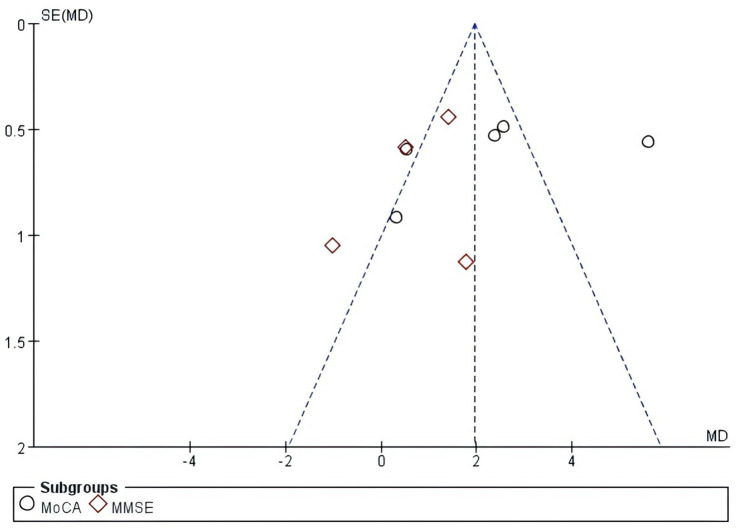
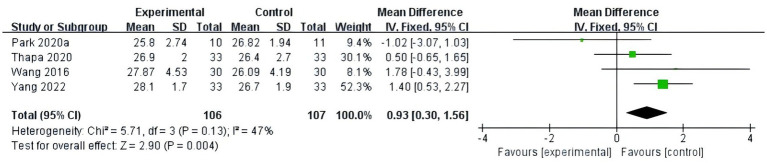
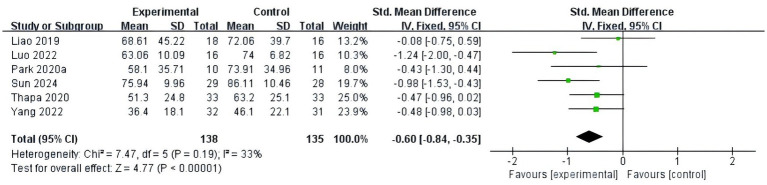
A total of 11 randomized controlled trials with 525 patients were included. The meta-analysis showed that fully immersive virtual reality training had significant effects on global cognitive function (MD = 2.34, 95% CI [0.55, 4.12], = 0.01); (MD = 0.93, 95% CI [0.30, 1.56], < 0.01), executive function (SMD = -0.60, 95% CI [-0.84, -0.35], < 0.01), and attention (MD = 0.69, 95% CI [0.15, 1.23], = 0.01). Still, the difference in memory (SMD = 0.27, 95% CI [-0.24, 0.78], = 0.30) was not statistically significant. Subgroup analyses showed that executive function could be improved only when the intervention duration was ≥40 h. In contrast, excessive training (≥30 times) was counterproductive.
Fully immersive virtual reality training improved cognitive functioning, executive functioning, and attention in MCI patients but was less effective in improving memory. Subgroup analysis suggests that fully immersive VR training must ensure sufficient intervention duration while avoiding frequent interventions.
https://www.crd.york.ac.uk/PROSPERO/, PROSPERO (CRD42024498629).
轻度认知障碍(MCI)是痴呆的前驱阶段。目前尚无特异性药物可减缓MCI的进展。近期研究证实了虚拟现实(VR)的积极作用。然而,由于VR干预类型不同、样本量小以及文献质量参差不齐,结果并不一致。本研究旨在评估完全沉浸式VR对MCI患者认知功能的影响。
使用PubMed、Cochrane图书馆、Embase、CINAHL、科学网、中国生物医学文献数据库、中国知网、万方数据库和维普数据库对已发表文献进行系统综述。检索时间范围为建库至2024年3月1日。符合条件的研究为评估完全沉浸式虚拟现实训练对MCI患者认知功能影响的随机对照试验。两名研究者独立进行文献筛选、数据提取和质量评估;使用RevMan 5.4对纳入文献进行荟萃分析。采用Cochrane偏倚风险工具评估方法学质量。
共纳入11项随机对照试验,涉及525例患者。荟萃分析表明,完全沉浸式虚拟现实训练对整体认知功能有显著影响(MD = 2.34,95%CI[0.55, 4.12],P = 0.01);(MD = 0.93,95%CI[0.30, 1.56],P < 0.01),对执行功能(SMD = -0.60,95%CI[-0.84, -0.35],P < 0.01)和注意力(MD = 0.69,95%CI[0.15, 1.23],P = 0.01)也有显著影响。然而,记忆方面的差异(SMD = 0.27,95%CI[-0.24, 0.78],P = 0.30)无统计学意义。亚组分析表明,仅当干预时长≥40小时时,执行功能才能得到改善。相反,过度训练(≥30次)会适得其反。
完全沉浸式虚拟现实训练可改善MCI患者的认知功能、执行功能和注意力,但对改善记忆效果较差。亚组分析表明,完全沉浸式VR训练必须确保足够的干预时长,同时避免频繁干预。
https://www.crd.york.ac.uk/PROSPERO/,PROSPERO(CRD42024498629)。