Wagner Andrew R, Chirumbole Sophia G, Caccese Jaclyn B, Chaudhari Ajit M W, Merfeld Daniel M
Department of Physical Therapy, School of Pharmacy and Health Professions, Creighton University, Omaha, NE, United States.
Department of Otolaryngology-Head and Neck Surgery, Ohio State University Wexner Medical Center, Columbus, OH, United States.
Front Hum Neurosci. 2024 Dec 6;18:1471132. doi: 10.3389/fnhum.2024.1471132. eCollection 2024.
Pseudorandom balance perturbations use unpredictable disturbances of the support surface to quantify reactive postural control. The ability to quantify postural responses to a continuous multidirectional perturbation in two orthogonal dimensions of sway (e.g., AP and ML) has yet to be investigated.
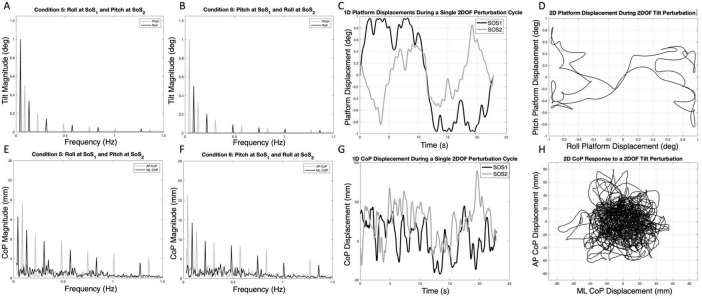
We developed a balance perturbation paradigm that used two spectrally independent sum of sinusoids signals (SoS, SoS), one for each orthogonal dimension of tilt (roll and pitch), to deliver a two-dimensional (2D) balance perturbation. In a group of 10 healthy adults we measured postural sway during 2D perturbations, as well as for each of the two individual 1D perturbation components.
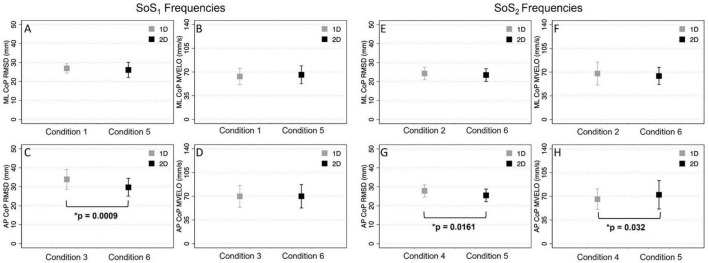
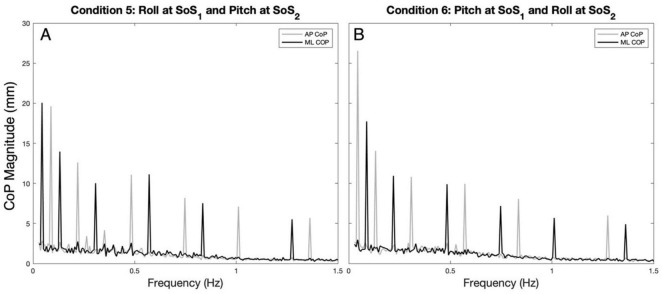
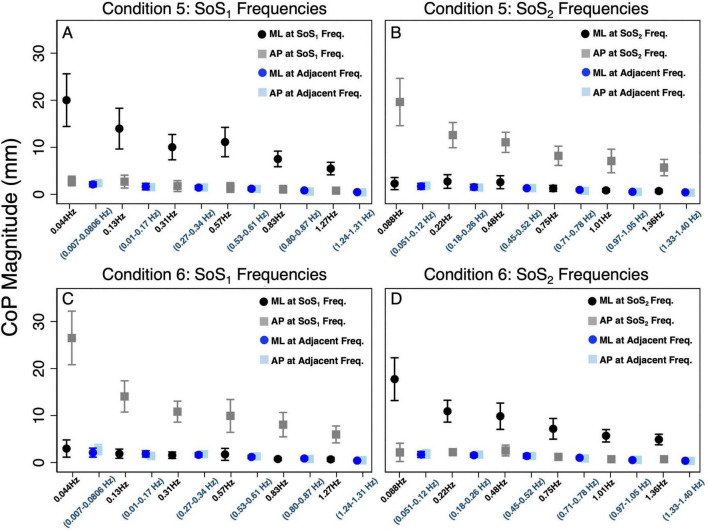
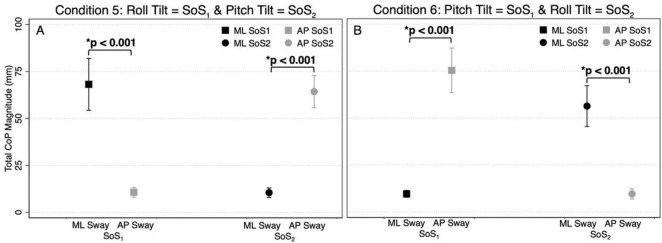
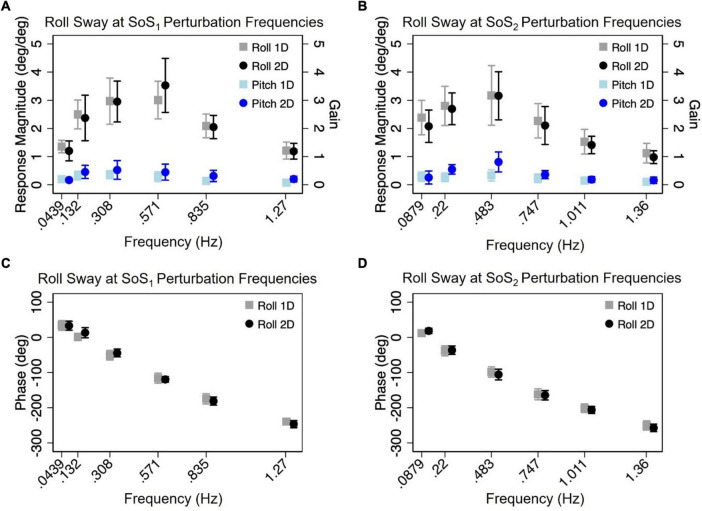
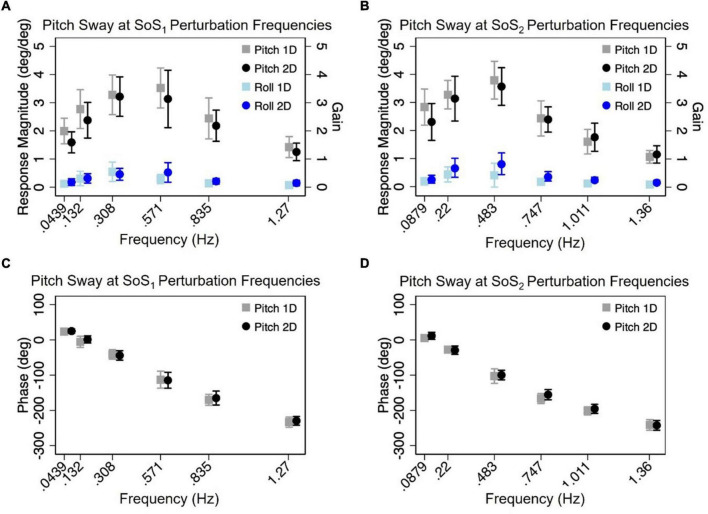
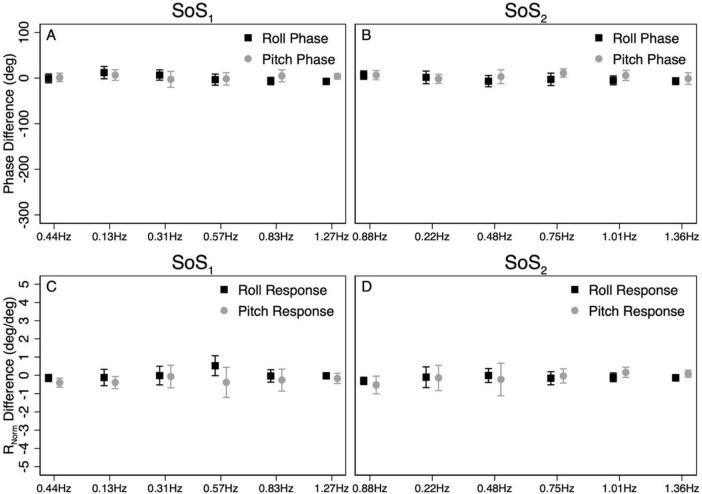
We found that during 2D perturbations, spectral peaks in the sway response were larger at the perturbed frequencies when compared to (1) the adjacent non-perturbed frequencies and (2) the frequencies contained within the orthogonal, spectrally independent perturbation signal. We also found that for each of the two spectra (SoS, SoS), the magnitude and timing of the sway response relative to the platform disturbance was similar when measured during 1D and 2D conditions.
These data support that our novel 2D SoS perturbation test was able to evoke ML and AP postural responses that were (1) specific to the roll and pitch perturbations, respectively, and (2) similar to the responses provoked by individual 1D perturbations.
伪随机平衡扰动利用支撑面的不可预测干扰来量化反应性姿势控制。在摇摆的两个正交维度(例如前后和左右)上量化对连续多向扰动的姿势反应的能力尚未得到研究。
我们开发了一种平衡扰动范式,该范式使用两个频谱独立的正弦信号总和(SoS,SoS),每个信号用于倾斜(横滚和俯仰)的一个正交维度,以提供二维(2D)平衡扰动。在一组10名健康成年人中,我们测量了二维扰动期间以及两个单独的一维扰动分量各自的姿势摇摆。
我们发现,在二维扰动期间,与(1)相邻的未扰动频率和(2)正交的、频谱独立的扰动信号中包含的频率相比,摇摆反应中的频谱峰值在扰动频率处更大。我们还发现,对于两个频谱(SoS,SoS)中的每一个,在一维和二维条件下测量时,相对于平台干扰的摇摆反应的幅度和时间相似。
这些数据支持我们新颖的二维SoS扰动测试能够引发分别特定于横滚和俯仰扰动的左右和前后姿势反应,并且(2)类似于由单独的一维扰动引发的反应。