Yamasaki Bumpei, Goto Rei, Imamura Hirotoshi, Sakai Nobuyuki
Graduate School of Health Management, Keio University, Fujisawa, Kanagawa, Japan.
Department of Neurosurgery, National Cerebral and Cardiovascular Center, Suita, Osaka, Japan.
J Neuroendovasc Ther. 2024;18(12):305-312. doi: 10.5797/jnet.oa.2024-0057. Epub 2024 Oct 5.
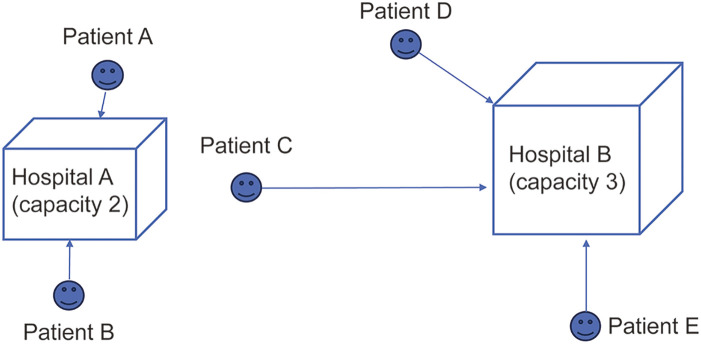
This study aimed to simulate patient transportation to a mechanical thrombectomy (MT)-capable hospital within 60 minutes, taking into account patient volume (demand side of healthcare) and hospital capacity to accept patients (supply side of healthcare).
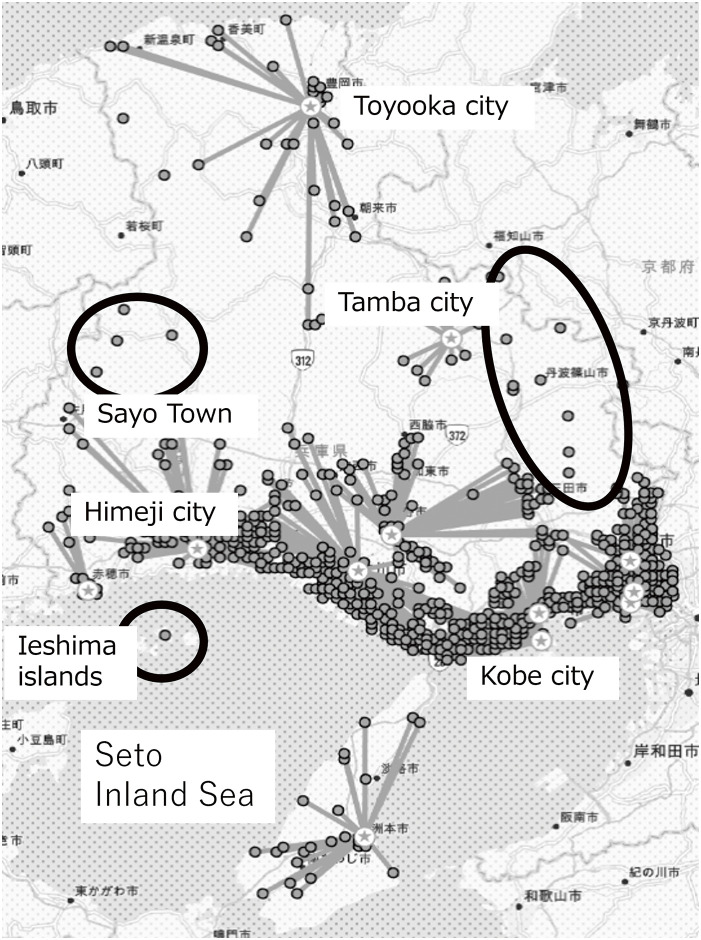
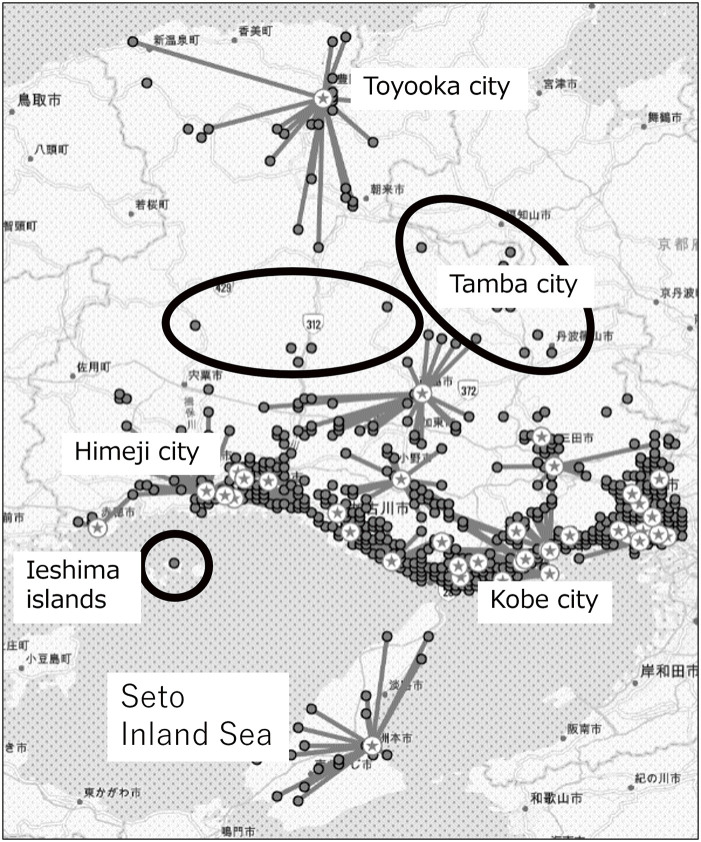
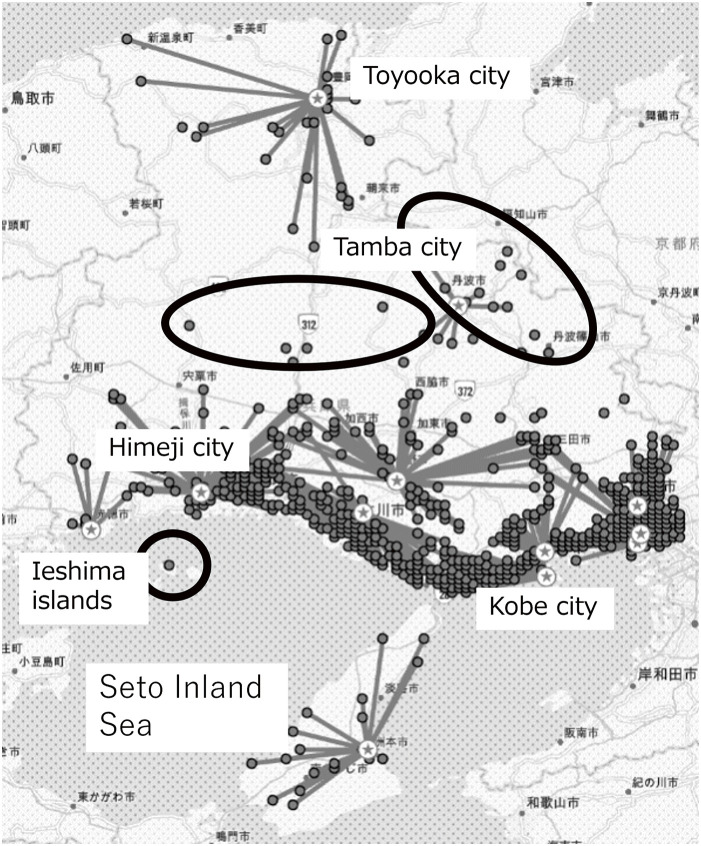
Simulations were conducted in Hyogo Prefecture, Japan. The estimates of the annual number of patients with stroke eligible for MT in 2020 were based on the incidence of stroke by age group and the percentage of patients with stroke indicated for MT in existing publications. Patients were then randomly placed on a 1 km mesh map. The patients were randomly generated 100 times using R software (version 4.1.2; R Foundation for Statistical Computing, Vienna, Austria). Hospitals were selected based on 2 criteria: (1) actual provision patterns (39 hospitals) and (2) consolidated patterns (12 hospitals). Simulations were performed using ArcGIS Pro (version 10.8; Esri, Redlands, CA, USA) and Network Analyst extension (Esri) in 3 cases: (1) number of patients estimated from the population in 2020 transported to hospitals that provided MT, (2) number of patients estimated based on the 2020 population transported to selected hospitals in the case of consolidation, and (3) number of patients estimated based on 2040's projected population and transportation to the selected hospitals.
In Case 1, the estimated annual number of patients undergoing MT in 2020 was 976. The average number of patients undergoing MT and transported was 961, indicating that 98% (961/976) of the total generated patients could be transported within 60 min. In Case 2, the average number of patients undergoing MT and transported was 940, indicating that 96.3% (940/976) of the total patients could be transported within 60 min. In Case 3, the average number of patients undergoing MT and transported was 1184, showing that 95.1% (1184/1244) of the total generated patients could be transported within 60 min. A few patients in rural areas and remote islands required longer transport times.
The simulations showed that patient estimates from the incidence of cerebral infarction by age group and the percentage of patients with stroke indicated for MT were similar to the actual values. The simulation was closed to reality when both the supply and demand sides of healthcare were considered. Thus, this simulation study informs future healthcare policy by demonstrating the geographic distribution of human and capital resources and potential cost reduction through consolidation, taking into account demographic changes.
本研究旨在模拟在60分钟内将患者转运至具备机械取栓(MT)能力的医院,同时考虑患者数量(医疗保健的需求方)和医院接收患者的能力(医疗保健的供应方)。
在日本兵库县进行模拟。2020年符合MT治疗的中风患者年估计数是基于各年龄组的中风发病率以及现有出版物中适合MT治疗的中风患者百分比得出的。然后将患者随机放置在1公里网格地图上。使用R软件(版本4.1.2;R统计计算基金会,奥地利维也纳)对患者进行100次随机生成。根据两个标准选择医院:(1)实际提供模式(39家医院)和(2)合并模式(12家医院)。使用ArcGIS Pro(版本10.8;美国加利福尼亚州雷德兰兹市的Esri公司)和网络分析扩展工具(Esri)进行了3种情况的模拟:(1)根据2020年人口估计数,将患者转运至提供MT治疗的医院;(2)在合并情况下,根据2020年人口估计数,将患者转运至选定医院;(3)根据2040年预计人口数,并将患者转运至选定医院。
在情况1中,2020年估计接受MT治疗的患者年数为976例。接受MT治疗并被转运的患者平均数量为961例,这表明所生成患者总数的98%(961/976)能够在60分钟内被转运。在情况2中,接受MT治疗并被转运的患者平均数量为940例,这表明患者总数的96.3%(940/976)能够在60分钟内被转运。在情况3中,接受MT治疗并被转运的患者平均数量为1184例,这表明所生成患者总数的95.1%(1184/1244)能够在60分钟内被转运。农村地区和偏远岛屿的少数患者需要更长的转运时间。
模拟结果表明,根据年龄组脑梗死发病率和适合MT治疗的中风患者百分比得出的患者估计数与实际值相似。当同时考虑医疗保健的供应方和需求方时,模拟结果更接近现实。因此,本模拟研究通过展示人力和资本资源的地理分布以及考虑人口变化通过合并实现潜在成本降低,为未来的医疗保健政策提供了参考。