Harper Nicholas W, Birdsall Gavin A, Honeywell Megan E, Pai Athma A, Lee Michael J
Department of Systems Biology, UMass Chan Medical School; Worcester, MA, USA.
RNA Therapeutics Institute, UMass Chan Medical School; Worcester, MA, USA.
bioRxiv. 2025 Jan 14:2024.12.09.627542. doi: 10.1101/2024.12.09.627542.
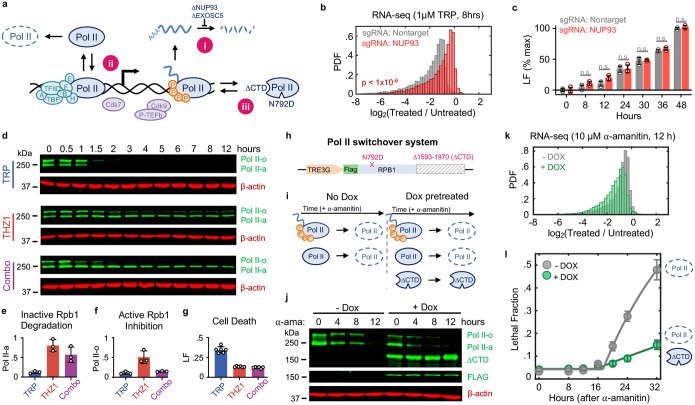
Pol II-mediated transcription is essential for eukaryotic life. While loss of transcription is thought to be universally lethal, the associated mechanisms promoting cell death are not yet known. Here, we show that death following loss of Pol II is not caused by dysregulated gene expression. Instead, death occurs in response to the loss of Pol II protein itself, specifically loss of the enzymatic subunit, Rbp1. Loss of Pol II exclusively activates apoptosis, and expression of a transcriptionally inactive version of Rpb1 rescues cell viability. Using functional genomics, we identify a previously uncharacterized mechanism that regulates lethality following loss of Pol II, which we call the ol II egradation-dependent poptotic esponse (). Using the genetic dependencies of PDAR, we identify clinically used drugs that owe their efficacy to a PDAR-dependent mechanism. Our findings unveil a novel apoptotic signaling response that contributes to the efficacy of a wide array of anti-cancer therapies.
RNA聚合酶II介导的转录对于真核生物的生存至关重要。虽然转录缺失被认为普遍具有致死性,但其促进细胞死亡的相关机制尚不清楚。在这里,我们表明RNA聚合酶II缺失后的死亡并非由基因表达失调引起。相反,死亡是由于RNA聚合酶II蛋白本身的缺失,特别是酶亚基Rbp1的缺失而发生的。RNA聚合酶II的缺失仅激活细胞凋亡,而转录无活性版本的Rpb1的表达可挽救细胞活力。利用功能基因组学,我们确定了一种以前未被描述的机制,该机制调节RNA聚合酶II缺失后的致死性,我们将其称为RNA聚合酶II降解依赖性凋亡反应(PDAR)。利用PDAR的基因依赖性,我们确定了临床上使用的药物,其疗效归因于PDAR依赖性机制。我们的研究结果揭示了一种新的凋亡信号反应,该反应有助于多种抗癌疗法的疗效。