Almomen Hassan, Mahmoud Ahmed Abdulhamid, Elkatatny Salaheldin, Abdulraheem Abdulazeez
Department of Petroleum Engineering, King Fahd University of Petroleum & Minerals, Dhahran 31261, Saudi Arabia.
Center for Integrative Petroleum Research, King Fahd University of Petroleum & Minerals, Dhahran 31261, Saudi Arabia.
ACS Omega. 2024 Dec 4;9(50):49719-49727. doi: 10.1021/acsomega.4c08006. eCollection 2024 Dec 17.
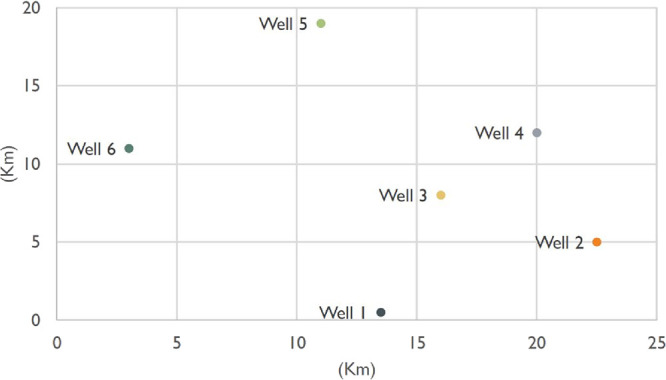
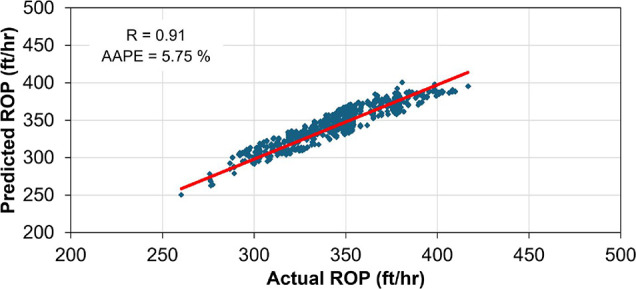
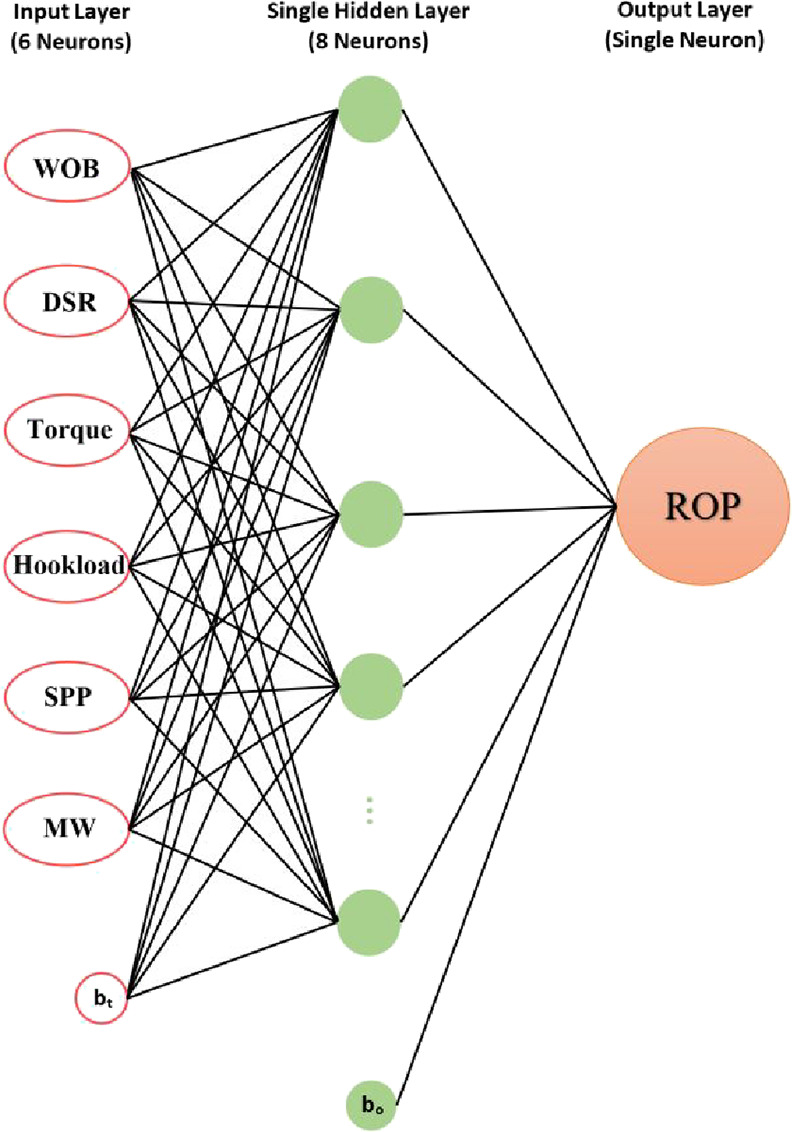
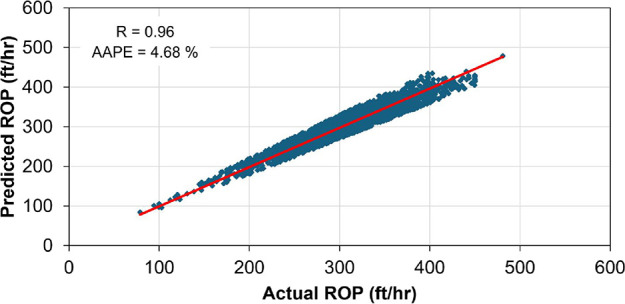
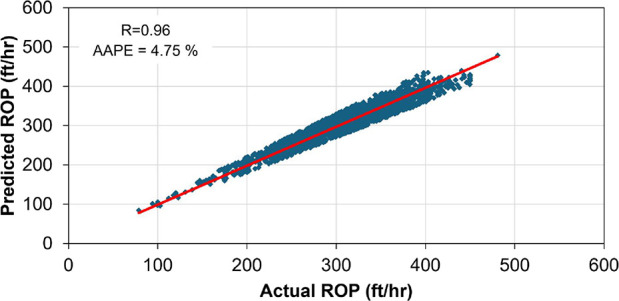
Estimating the rate of penetration (ROP) is one of most critical tasks for evaluating the efficiency and profitability of drilling operation, which will aim in decision-making related to well planning, time estimation, cost estimation, bit selection, operational troubles, and logistics in drilling operation. The rise in unconventional resource development underscores the need for accurate ROP prediction to optimize drilling operations in these valuable reserves. ROP prediction and optimization in unconventional hydrocarbon reservoirs are challenging due to the formations' heterogeneity, high strength, and brittleness. These reservoirs often involve complex well designs, high pressures, and high temperatures, making it difficult to maintain optimal drilling conditions. This study presents the optimization and validation of the artificial neural network (ANN) model to predict the ROP during horizontal drilling through unconventional hydrocarbon reservoirs. The ANN model was trained using 34,869 data points from five wells (Well-1 to Well-5) and achieved a high correlation coefficient of 0.96 and an average absolute percentage error (AAPE) of 4.68%. An empirical correlation was developed based on the weights and biases of the optimized ANN model. The empirical correlation performance was rigorously tested with 23,246 data points, representing 40% of the data from the same wells, yielding an AAPE of 4.75% and a correlation coefficient of 0.96. Validation of the developed equation on data from Well-6 further confirmed the model's robustness, maintaining a correlation coefficient of 0.91 and an AAPE of 5.75%. These results demonstrate the ANN model's and empirical equation's accuracy and reliability in predicting the ROP, highlighting their potential to optimize drilling operations in unconventional hydrocarbon reservoirs.
估算钻速(ROP)是评估钻井作业效率和盈利能力的最关键任务之一,其目的在于与井眼规划、时间估算、成本估算、钻头选型、作业故障以及钻井作业物流相关的决策。非常规资源开发的增加凸显了准确预测钻速以优化这些宝贵储量钻井作业的必要性。由于地层的非均质性、高强度和脆性,非常规油气藏中的钻速预测和优化具有挑战性。这些油藏通常涉及复杂的井身设计、高压和高温,难以维持最佳钻井条件。本研究提出了人工神经网络(ANN)模型的优化和验证,以预测在非常规油气藏水平钻井过程中的钻速。ANN模型使用来自五口井(井1至井5)的34869个数据点进行训练,获得了0.96的高相关系数和4.68%的平均绝对百分比误差(AAPE)。基于优化后的ANN模型的权重和偏差建立了经验关联式。使用代表同一井40%数据的23246个数据点对经验关联式性能进行了严格测试,得出AAPE为4.75%,相关系数为0.96。对井6数据的所开发方程的验证进一步证实了该模型的稳健性,保持了0.91的相关系数和5.75%的AAPE。这些结果证明了ANN模型和经验方程在预测钻速方面的准确性和可靠性,突出了它们在优化非常规油气藏钻井作业方面的潜力。