Yıldız Melek, Yıldırım Ruken, Baş Firdevs
İstanbul University, İstanbul Faculty of Medicine, Department of Pediatric Endocrinology, İstanbul, Turkey
Diyarbakır Children’s Hospital, Clinic of Pediatrics, Diyarbakır, Turkey
J Clin Res Pediatr Endocrinol. 2025 Jan 10;17(Suppl 1):72-79. doi: 10.4274/jcrpe.galenos.2024.2024-7-2-S. Epub 2024 Dec 23.
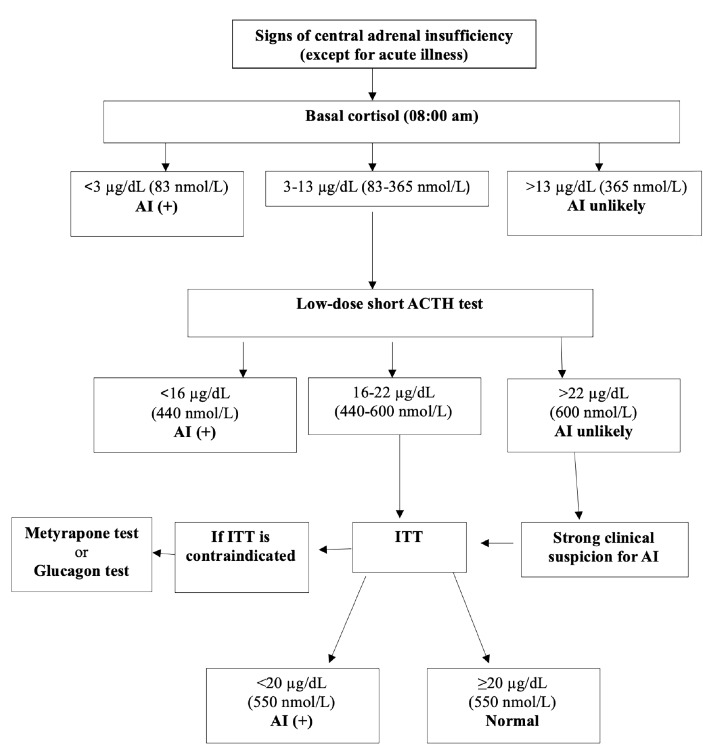
Central adrenal insufficiency (CAI) occurs due to a pituitary gland disorder (secondary AI) or hypothalamic dysfunction (tertiary AI). It is a potentially life-threatening condition that has many congenital and acquired causes. Adrenocorticotropic hormone deficiency may be isolated or more commonly it can be accompanied by other pituitary hormone deficiencies or midline defects. The signs and symptoms of CAI are associated with glucocorticoid deficiency. A three-step diagnostic approach including dynamic stimulation tests is recommended in the evaluation of patients with suspected CAI. Here, members of the ‘Adrenal Working Group’ of ‘The Turkish Society for Pediatric Endocrinology and Diabetes’ present an evidence-based review with good practice points and recommendations for etiology and diagnostic approach in children and adolescents with CAI.
中枢性肾上腺皮质功能减退症(CAI)是由垂体疾病(继发性肾上腺皮质功能减退症)或下丘脑功能障碍(三发性肾上腺皮质功能减退症)引起的。它是一种潜在的危及生命的疾病,有许多先天性和后天性病因。促肾上腺皮质激素缺乏可能是孤立的,或更常见的是,它可能伴有其他垂体激素缺乏或中线缺陷。CAI的体征和症状与糖皮质激素缺乏有关。在评估疑似CAI的患者时,建议采用包括动态刺激试验在内的三步诊断方法。在此,土耳其儿科内分泌与糖尿病学会“肾上腺工作组”的成员对儿童和青少年CAI的病因及诊断方法进行了循证综述,并给出了实用要点和建议。