Büyükyılmaz Gönül, Çavdarlı Büşranur, Koca Serkan Bilge, Toksoy Adıgüzel Keziban, Topaloğlu Oya, Aydın Cevdet, Hepsen Sema, Çakal Erman, Semerci Gündüz Nur, Boyraz Mehmet, Gürbüz Fatih, Demirbilek Hüseyin
Ankara Bilkent City Hospital, Clinic of Pediatric Endocrinology, Ankara, Türkiye
Ankara Bilkent City Hospital, Clinic of Medical Genetics, Ankara, Türkiye
J Clin Res Pediatr Endocrinol. 2025 May 27;17(2):191-201. doi: 10.4274/jcrpe.galenos.2024.2024-8-14. Epub 2024 Dec 23.
Resistance to thyroid hormone beta (RTHβ) is a rare disorder characterized by a fairly heterogeneous clinical presentation due to varying degrees of tissue response to thyroid hormone. The present study aimed to evaluate the clinical and laboratory features and genotype-phenotype relationship of Turkish patients with RTHβ.
Patients who underwent a THRβ gene analysis between September 2019 and September 2023 were retrospectively reviewed.
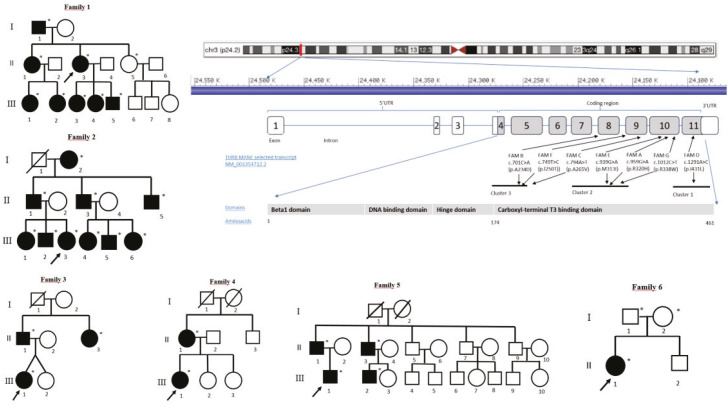
Fifty patients with the clinical features of RTHβ syndrome or a family history of an index case were included. A total of eight different heterozygous pathogenic/likely pathogenic missense variants, three of which were novel, were detected in in 30 patients from 8 unrelated families. Although most patients with RTHβ were asymptomatic, seven patients exhibited various symptoms. Moreover, seven patients had received various treatments before diagnosis. Thyroid autoantibody was positive in 23% of all cases with a variant, and goitre was detected in 56% of children with a variant. While thyroid nodules were detected in seven adult patients, two adults had been diagnosed with papillary thyroid cancer. One child had attention-deficit disorder, learning disability, and type 1 diabetes mellitus. Of the 20 patients without a variant, TSHoma was detected in one.
The present study provides an overview of clinical and genetic characteristics of patients with genetically confirmed RTHβ and expanded the gene variant database with three novel variants. Although most patients with RTHβ are asymptomatic, molecular genetic analysis of the gene and regular follow-up because of the apparent risk of concurrent autoimmune diseases or thyroid cancer is warranted.
甲状腺激素β抵抗(RTHβ)是一种罕见疾病,由于组织对甲状腺激素的反应程度不同,其临床表现相当异质性。本研究旨在评估土耳其RTHβ患者的临床和实验室特征以及基因型与表型的关系。
回顾性分析2019年9月至2023年9月期间接受THRβ基因分析的患者。
纳入了50例具有RTHβ综合征临床特征或索引病例家族史患者。在来自8个无关家庭的30例患者中,共检测到8种不同的杂合致病性/可能致病性错义变异,其中3种为新变异。虽然大多数RTHβ患者无症状,但7例患者表现出各种症状。此外,7例患者在诊断前接受了各种治疗。所有携带变异的病例中,23%的患者甲状腺自身抗体呈阳性,携带变异的儿童中56%检测到甲状腺肿。7例成年患者检测到甲状腺结节,2例成年人被诊断为甲状腺乳头状癌。1名儿童患有注意力缺陷障碍、学习障碍和1型糖尿病。在20例无变异的患者中,1例检测到促甲状腺素瘤。
本研究概述了基因确诊的RTHβ患者的临床和遗传特征,并用3种新变异扩展了基因变异数据库。虽然大多数RTHβ患者无症状,但鉴于并发自身免疫性疾病或甲状腺癌的明显风险,对该基因进行分子遗传学分析并定期随访是必要的。