Ngo Lien Thi, Jung Woojin, Bui Tham Thi, Yun Hwi-Yeol, Chae Jung-Woo, Momper Jeremiah D
College of Pharmacy, Chungnam National University, Daejeon, Korea.
Faculty of Pharmacy, PHENIKAA University, Hanoi, Vietnam.
CPT Pharmacometrics Syst Pharmacol. 2025 Mar;14(3):523-539. doi: 10.1002/psp4.13293. Epub 2024 Dec 23.
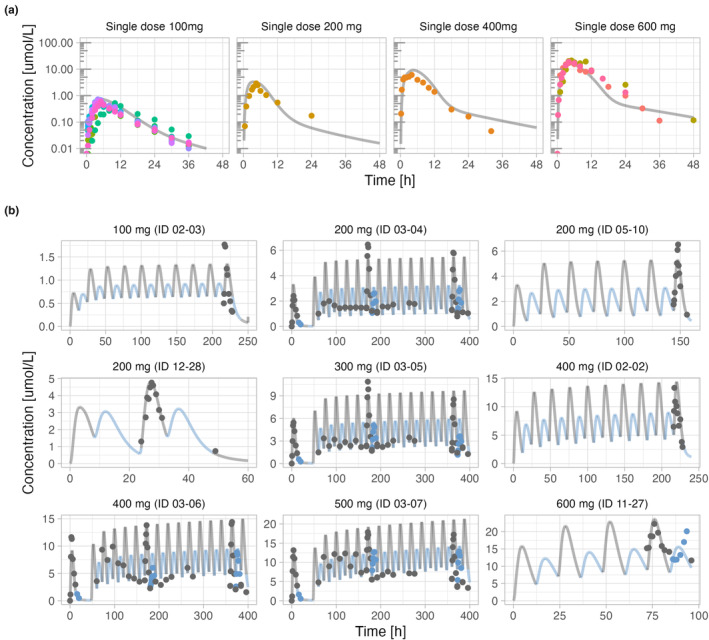
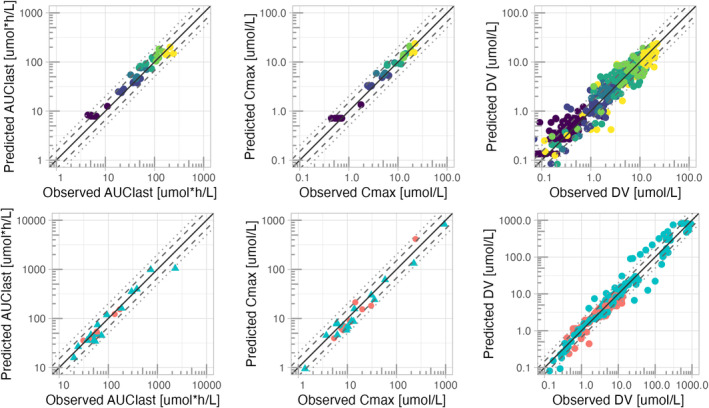
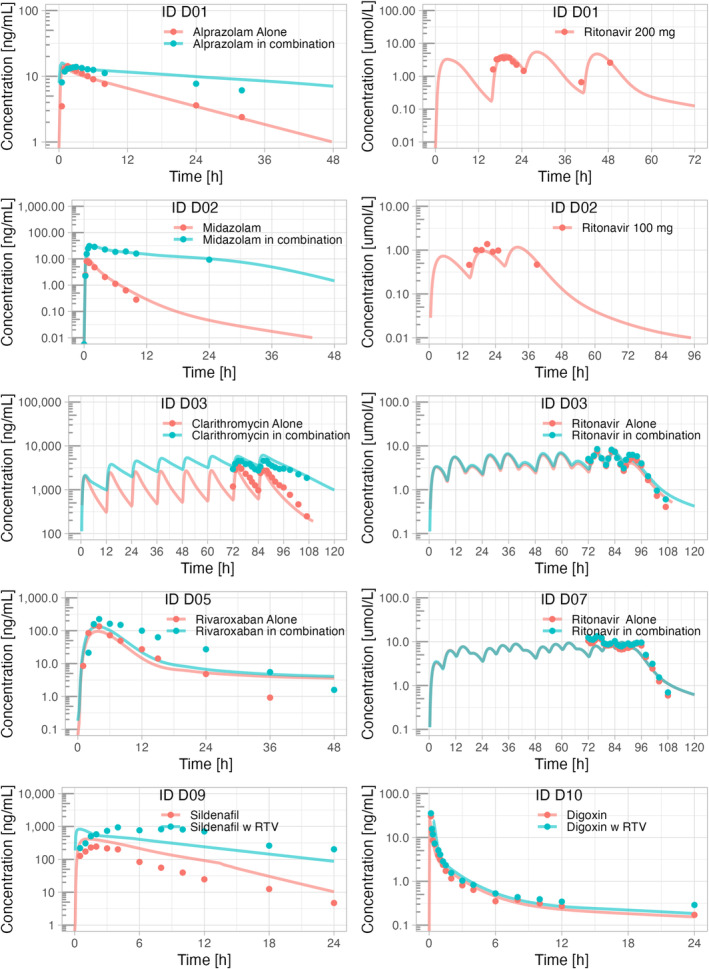
Ritonavir (RTV) is a potent CYP3A inhibitor that is widely used as a pharmacokinetic (PK) enhancer to increase exposure to select protease inhibitors. However, as a strong and complex perpetrator of CYP3A interactions, RTV can also enhance the exposure of other co-administered CYP3A substrates, potentially causing toxicity. Therefore, the prediction of drug-drug interactions (DDIs) and estimation of dosing requirements for concomitantly administered drugs is imperative. In this study, we aimed to develop a physiologically-based PK (PBPK) model for RTV using the PK-sim® software platform. A total of 13 clinical PK studies of RTV covering a wide dose range (100 to 600 mg including both single and multiple dosing), and eight clinical DDI studies with RTV on CYP3A and P-gp substrates, including alprazolam, midazolam, rivaroxaban, clarithromycin, fluconazole, sildenafil, and digoxin were used for the model development and evaluation. Chronopharmacokinetic differences (between morning vs. evening doses) and limitations in parameter estimation for biochemical processes of RTV from in vitro studies were incorporated in the PBPK model. The final developed PBPK model predicted 100% of RTV AUC and C within a twofold dimension error. The geometric mean fold error (GMFE) from all PK datasets was 1.275 and 1.194, respectively. In addition, 97% of the DDI profiles were predicted with the DDI ratios within a twofold dimension error. The GMFE values from all DDI datasets were 1.297 and 1.212, respectively. Accordingly, this model could be applied to the prediction of DDI profiles of RTV and CYP3A substrates and used to estimate dosing requirements for concomitantly administered drugs.
利托那韦(RTV)是一种强效的细胞色素P450 3A(CYP3A)抑制剂,被广泛用作药代动力学(PK)增强剂,以提高对特定蛋白酶抑制剂的暴露量。然而,作为CYP3A相互作用的强大而复杂的引发剂,RTV也可增加其他共同给药的CYP3A底物的暴露量,从而可能导致毒性。因此,预测药物-药物相互作用(DDI)并估计同时给药药物的剂量要求至关重要。在本研究中,我们旨在使用PK-sim®软件平台开发一种基于生理学的RTV药代动力学(PBPK)模型。总共13项涵盖广泛剂量范围(100至600mg,包括单次和多次给药)的RTV临床PK研究,以及8项关于RTV与CYP3A和P-糖蛋白底物(包括阿普唑仑、咪达唑仑、利伐沙班、克拉霉素、氟康唑、西地那非和地高辛)的临床DDI研究被用于模型开发和评估。PBPK模型纳入了时辰药代动力学差异(早晨与晚上剂量之间)以及体外研究中RTV生化过程参数估计的局限性。最终开发的PBPK模型在两倍维度误差范围内预测了100%的RTV曲线下面积(AUC)和血药浓度(C)。所有PK数据集的几何平均倍数误差(GMFE)分别为1.275和1.194。此外,97%的DDI曲线在两倍维度误差范围内通过DDI比率进行了预测。所有DDI数据集的GMFE值分别为1.297和1.212。因此,该模型可应用于预测RTV与CYP3A底物的DDI曲线,并用于估计同时给药药物的剂量要求。