Kostadinov Georgi, Görgen Carolin-Isabel, Schmidtmann Irene, Weibrich Gernot, Abou-Ayash Samir, Wentaschek Stefan
Department for Prosthetic Dentistry and Materials, University Medical Centre, Augustusplatz 2, 55131, Mainz, Germany.
Institute for Medical Biostatistics, Epidemiology and Informatics, University Medical Centre, Obere Zahlbacher Str. 69, 55131, Mainz, Germany.
Int J Implant Dent. 2024 Dec 23;10(1):67. doi: 10.1186/s40729-024-00584-5.
This study assesses the impact of Cold Atmospheric Pressure Plasma (CAP) pretreatment on the bond strength of two-piece hybrid ceramic abutment crowns in implant dentistry. The objective is to ascertain whether CAP can be employed as an alternative or complementary technique to conventional methods.
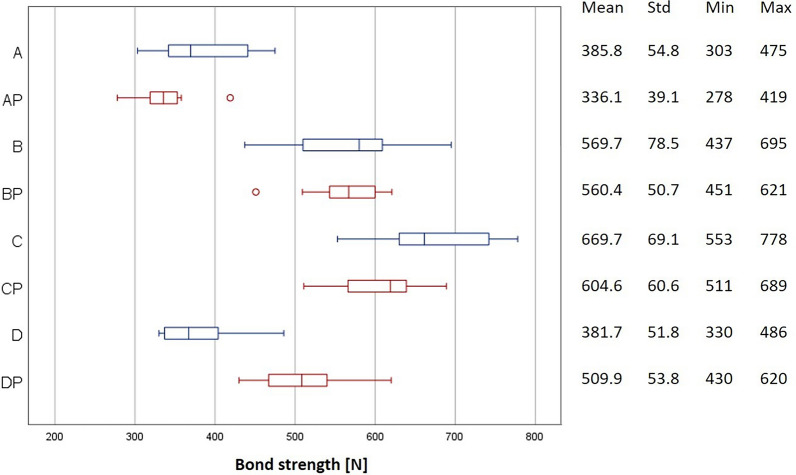
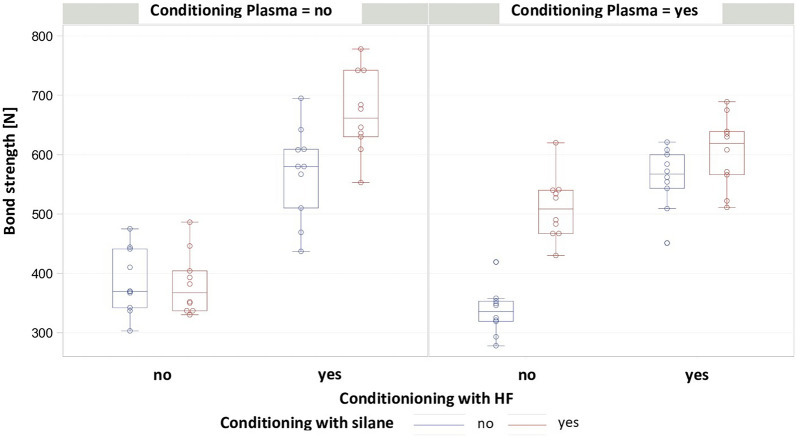
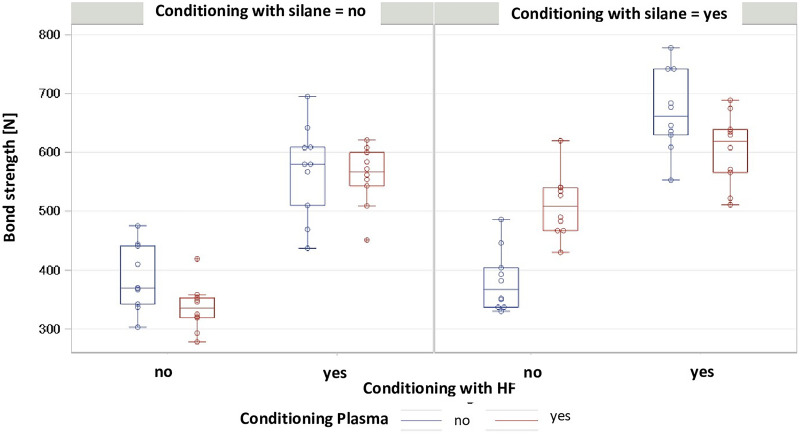
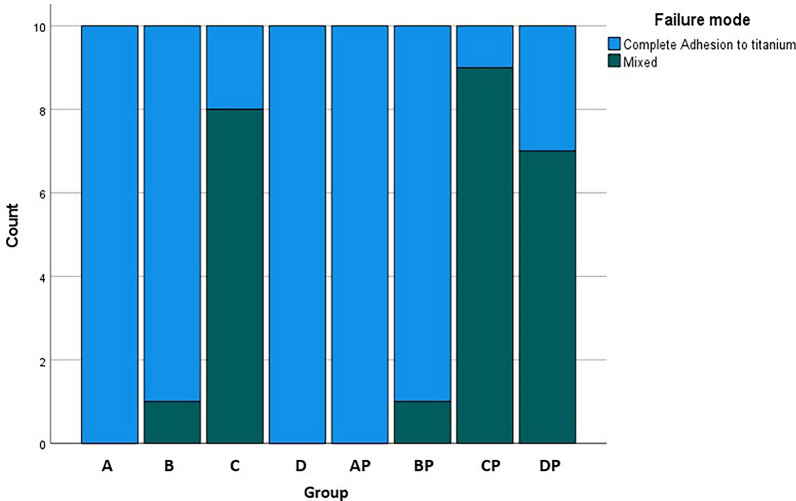
80 titanium bases and 80 VITA ENAMIC polymer-infiltrated ceramic network (PICN) crowns were divided into 8 groups (n = 10) based on different surface pretreatments of the crowns before cementation: no treatment (A), hydrofluoric acid (HF) (B), HF and silane (C), silane (D), CAP (AP), HF and CAP (BP), HF, CAP, and silane (CP), and CAP and silane (DP). Bond strength (BS) was measured after thermocycling (5000 cycles at 5 °C/55 °C), and statistical analysis was performed using three-way ANOVA.
The highest bond strength (BS) was recorded in the conventionally pretreated group C. Both HF and silane alone had significant effects (p < 0.0001), but CAP alone did not (p = 0.9377). Significant interactions were found between silane and CAP (p = 0.0222), and HF and CAP (p = 0.0046). The combined effects exceeded individual effects. Although group C showed the highest BS, no significant interaction was found between HF and silane (p = 0.6270). Three-factor interactions were significant (p < 0.0001).
In the setting used, CAP could not replace conventional pretreatment. The highest BS of a group without HF was achieved by combining silane with CAP. However, BS of this pretreatment was approximately 24% lower than that of the conventional pretreatment.
本研究评估冷大气压力等离子体(CAP)预处理对种植牙科中两件式混合陶瓷基台冠粘结强度的影响。目的是确定CAP是否可作为传统方法的替代或补充技术。
80个钛基底和80个维他灵瓷聚合渗透陶瓷网络(PICN)冠根据粘结前冠的不同表面预处理分为8组(n = 10):未处理(A)、氢氟酸(HF)(B)、HF和硅烷(C)、硅烷(D)、CAP(AP)、HF和CAP(BP)、HF、CAP和硅烷(CP)以及CAP和硅烷(DP)。在热循环(5℃/55℃下5000次循环)后测量粘结强度(BS),并使用三因素方差分析进行统计分析。
传统预处理的C组记录到最高粘结强度(BS)。单独使用HF和硅烷均有显著影响(p < 0.0001),但单独使用CAP没有(p = 0.9377)。发现硅烷与CAP之间(p = 0.0222)以及HF与CAP之间(p = 0.0046)存在显著相互作用。联合效应超过个体效应。虽然C组显示出最高的BS,但HF与硅烷之间未发现显著相互作用(p = 0.6270)。三因素相互作用显著(p < 0.0001)。
在所使用的环境中,CAP不能替代传统预处理。在不使用HF的一组中,通过将硅烷与CAP结合获得了最高的BS。然而,这种预处理的BS比传统预处理低约24%。