Okabe Masahiro, Okabayashi Yusuke, Sasaki Takaya, Koike Kentaro, Tsuboi Nobuo, Matsusaka Taiji, Yokoo Takashi
Division of Nephrology and Hypertension, Department of Internal Medicine, Jikei University School of Medicine, Tokyo, Japan.
Department of Basic Medicine, Tokai University School of Medicine, Isehara, Japan.
Kidney360. 2025 Apr 1;6(4):606-615. doi: 10.34067/KID.0000000688. Epub 2024 Dec 23.
Podocyte injury, as indicated by early growth response 1 expression, was correlated with the clinical and histopathological activities of lupus nephritis (LN). Podocyte injury was associated with poor long-term kidney prognosis in patients with active LN. To improve the prognosis of patients with LN, treatment strategies on the basis of the degree of podocyte injury may be considered.
Lupus nephritis (LN) is a major complication of SLE. Like other types of GN, podocyte injury has been observed in patients with LN. However, the association between podocyte injury and kidney prognosis in patients with LN has not been well elucidated. The aim of this study was to explore the association between podocyte injury and clinical and histological status and kidney prognosis in patients with LN.
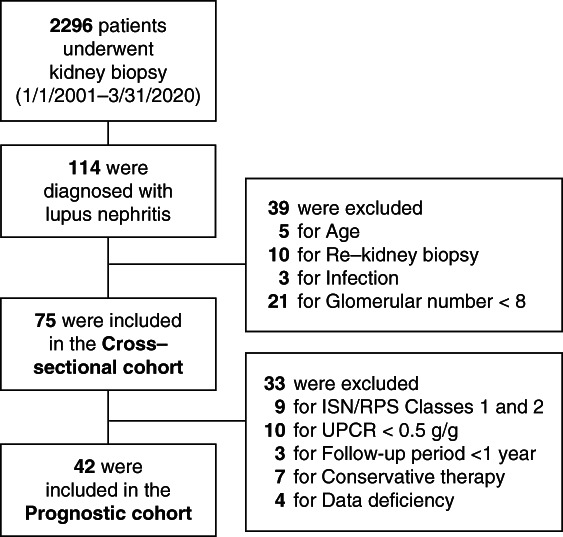
Seventy-five patients histopathologically diagnosed with LN were enrolled in this study. Early growth response 1 (EGR1) expression in podocytes, representing podocyte injury, was detected through immunohistochemistry. The correlation between the proportion of glomeruli with podocytes expressing EGR1 (%EGR1glo) and the clinical and histological features of LN were evaluated. Subsequently, the association between %EGR1glo and kidney prognosis was examined in a group of patients with LN class 3, 4, or 5 who showed ≥0.5 g/g of urinary protein–creatinine ratio and received immunosuppressive therapy. Hazard ratio was calculated using univariate Cox proportional hazards regression.
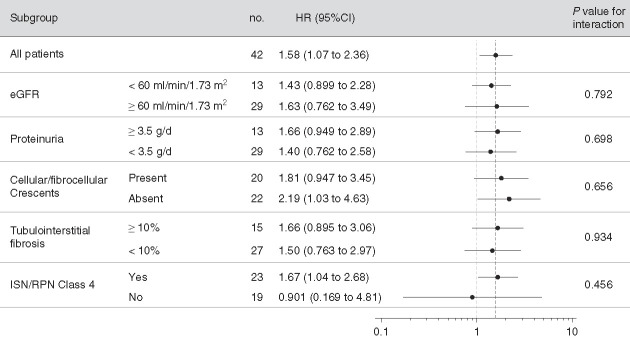
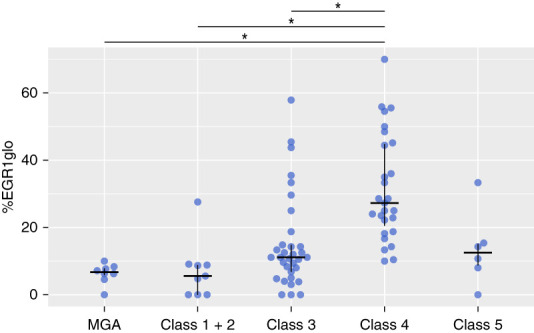
%EGR1glo was highest in patients with LN class 4, significantly correlated with the SLE Disease Activity Index score, urinary protein level, and prevalence of glomeruli showing cellular/fibrocellular crescents, endocapillary hypercellularity, and fibrinoid necrosis and inversely correlated with eGFR. Higher %EGR1glo was significantly associated with sustained ≥30% eGFR decline over 10 years in patients with LN class 3, 4, or 5 (=42; hazard ratio, 1.58 [95% confidence interval, 1.07 to 2.36] per 10% increase in %EGR1glo). There was no significant interaction between patients grouped by kidney function, urinary protein level, presence of cellular/fibrocellular crescents, degree of tubulointerstitial fibrosis, and LN classification.
Podocyte damage, as indicated by EGR1 expression, was associated with poor long-term kidney prognosis in patients with active LN. Treatment strategies on the basis of the extent of podocyte injury may be necessary.
早期生长反应1表达所提示的足细胞损伤与狼疮性肾炎(LN)的临床及组织病理学活动相关。足细胞损伤与活动性LN患者的长期肾脏预后不良有关。为改善LN患者的预后,可考虑基于足细胞损伤程度的治疗策略。
狼疮性肾炎(LN)是系统性红斑狼疮(SLE)的主要并发症。与其他类型的肾小球肾炎一样,LN患者中也观察到了足细胞损伤。然而,LN患者足细胞损伤与肾脏预后之间的关联尚未得到充分阐明。本研究的目的是探讨LN患者足细胞损伤与临床及组织学状态以及肾脏预后之间的关联。
本研究纳入了75例经组织病理学诊断为LN的患者。通过免疫组织化学检测足细胞中代表足细胞损伤的早期生长反应1(EGR1)表达。评估表达EGR1的足细胞的肾小球比例(%EGR1glo)与LN临床及组织学特征之间的相关性。随后,在一组尿蛋白-肌酐比值≥0.5 g/g且接受免疫抑制治疗的LN 3、4或5级患者中,研究%EGR1glo与肾脏预后之间的关联。使用单因素Cox比例风险回归计算风险比。
%EGR1glo在LN 4级患者中最高,与SLE疾病活动指数评分、尿蛋白水平以及出现细胞/纤维细胞性新月体、毛细血管内细胞增多和纤维蛋白样坏死的肾小球患病率显著相关,与估算肾小球滤过率(eGFR)呈负相关。在LN 3、4或5级患者中,较高的%EGR1glo与10年内eGFR持续下降≥30%显著相关(n = 42;每增加10%的%EGR1glo,风险比为1.58 [95%置信区间,1.07至2.36])。按肾功能、尿蛋白水平、细胞/纤维细胞性新月体的存在、肾小管间质纤维化程度和LN分类分组的患者之间没有显著的相互作用。
EGR1表达所提示的足细胞损伤与活动性LN患者的长期肾脏预后不良有关。可能需要基于足细胞损伤程度的治疗策略。