Abraham Armaan A, Tan Zhixin Cyrillus, Shrestha Priyanka, Bozich Emily R, Meyer Aaron S
Department of Bioengineering, University of California, Los Angeles, California, United States of America.
Bioinformatics Interdepartmental Program, University of California, Los Angeles, California, United States of America.
PLoS Comput Biol. 2024 Dec 23;20(12):e1012663. doi: 10.1371/journal.pcbi.1012663. eCollection 2024 Dec.
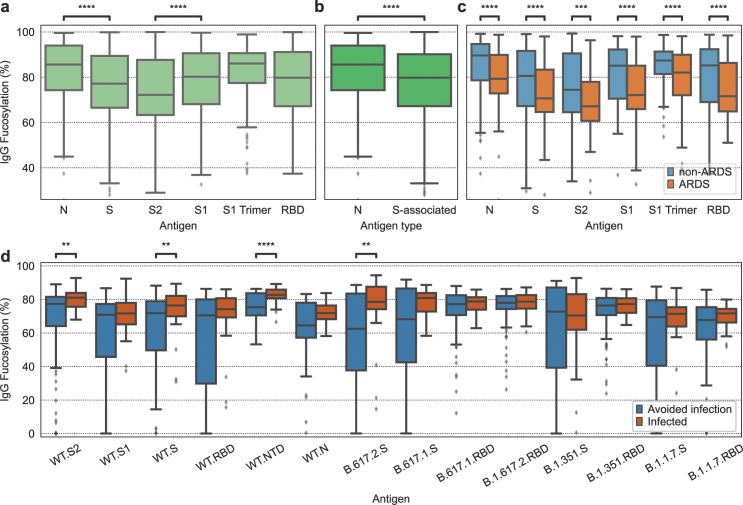
Systems serology aims to broadly profile the antigen binding, Fc biophysical features, immune receptor engagement, and effector functions of antibodies. This experimental approach excels at identifying antibody functional features that are relevant to a particular disease. However, a crucial limitation of this approach is its incomplete description of what structural features of the antibodies are responsible for the observed immune receptor engagement and effector functions. Knowing these antibody features is important for both understanding how effector responses are naturally controlled through antibody Fc structure and designing antibody therapies with specific effector profiles. Here, we address this limitation by modeling the molecular interactions occurring in these assays and using this model to infer quantities of specific antibody Fc species among the antibodies being profiled. We used several validation strategies to show that the model accurately infers antibody properties and then applied the model to infer previously unavailable antibody fucosylation information from existing systems serology data. Using this capability, we find that COVID-19 vaccine efficacy is associated with the induction of afucosylated spike protein-targeting IgG. Our results also question an existing assumption that controllers of HIV exhibit gp120-targeting IgG that are less fucosylated than those of progressors. Additionally, we confirm that afucosylated IgG is associated with membrane-associated antigens for COVID-19 and HIV, and present new evidence indicating that this relationship is specific to the host cell membrane. Finally, we use the model to identify redundant assay measurements and subsets of information-rich measurements from which Fc properties can be inferred. In total, our modeling approach provides a quantitative framework for the reasoning typically applied in these studies, improving the ability to draw mechanistic conclusions from these data.
系统血清学旨在广泛描述抗体的抗原结合、Fc生物物理特征、免疫受体结合及效应器功能。这种实验方法擅长识别与特定疾病相关的抗体功能特征。然而,该方法的一个关键局限性在于,它并未完整描述抗体的哪些结构特征导致了所观察到的免疫受体结合及效应器功能。了解这些抗体特征对于理解效应反应如何通过抗体Fc结构自然调控以及设计具有特定效应特征的抗体疗法都很重要。在此,我们通过对这些检测中发生的分子相互作用进行建模,并利用该模型推断被分析抗体中特定抗体Fc种类的数量,来解决这一局限性。我们使用了多种验证策略来表明该模型能准确推断抗体特性,然后将该模型应用于从现有的系统血清学数据中推断先前无法获得的抗体岩藻糖基化信息。利用这一能力,我们发现COVID-19疫苗的效力与去岩藻糖基化的刺突蛋白靶向IgG的诱导有关。我们的结果还对一个现有假设提出了质疑,即HIV控制器表现出靶向gp120的IgG,其岩藻糖基化程度低于疾病进展者的IgG。此外,我们证实去岩藻糖基化的IgG与COVID-19和HIV的膜相关抗原有关,并提供了新证据表明这种关系特定于宿主细胞膜。最后,我们使用该模型来识别冗余的检测测量值和富含信息的测量值子集,从中可以推断Fc特性。总的来说,我们的建模方法为这些研究中通常应用的推理提供了一个定量框架,提高了从这些数据得出机制性结论的能力。