Berghout Bernhard P, Heshmatollah Alis, Bos Daniel, Kavousi Maryam, Ikram Mohammad Kamran
Department of Epidemiology, Erasmus University Medical Center.
Department of Radiology and Nuclear Medicine, Erasmus University Medical Center; and.
Neurology. 2025 Jan 28;104(2):e210214. doi: 10.1212/WNL.0000000000210214. Epub 2024 Dec 23.
Nonfocal transient neurologic attacks (TNA) have been suggested to increase the risk of stroke, yet the optimal clinical approach of these attacks remains uncertain. We determined whether people who have a nonfocal TNA are at an increased risk of subsequent cardiovascular disease (CVD), akin to the known increased risk of stroke following transient ischemic attack (TIA).
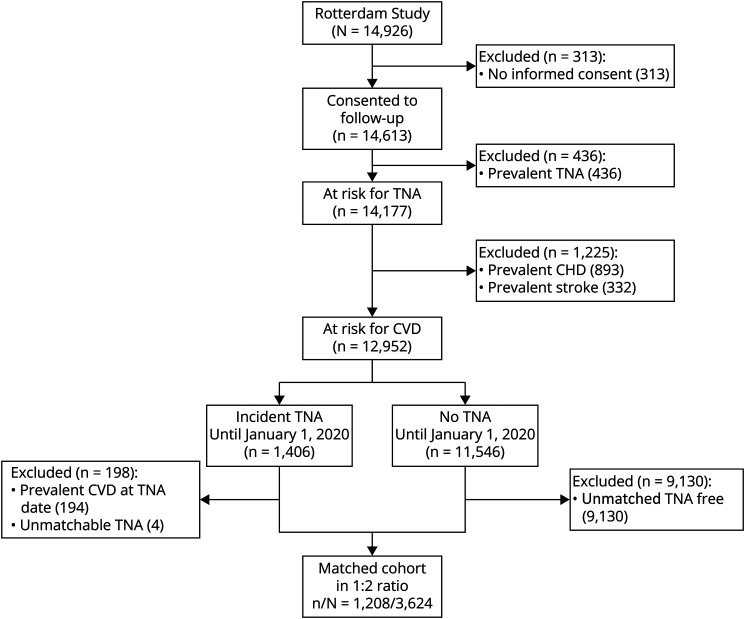
Within a population-based cohort study among Dutch participants aged 45 years or older, we selected participants who had first-ever TNA, defined as an attack of sudden neurologic symptoms resolving within 24 hours without clear evidence for an alternative diagnosis, during follow-up between 1990 and 2020. Nonfocal TNAs were attacks with nonfocal symptoms only, whereas attacks with focal symptoms were regarded as TIA. Each participant with TNA was matched to 2 participants who did not experience TNA, with similar age and sex at the date of TNA diagnosis. Participants were then followed up for any incident CVD, defined by any stroke or any coronary heart disease (CHD), and follow-up was complete for 98.6% of potential person-years. The association between TNA and risk of subsequent CVD was analyzed using Cox proportional hazard models adjusting for demographic and cardiovascular risk factors at baseline.
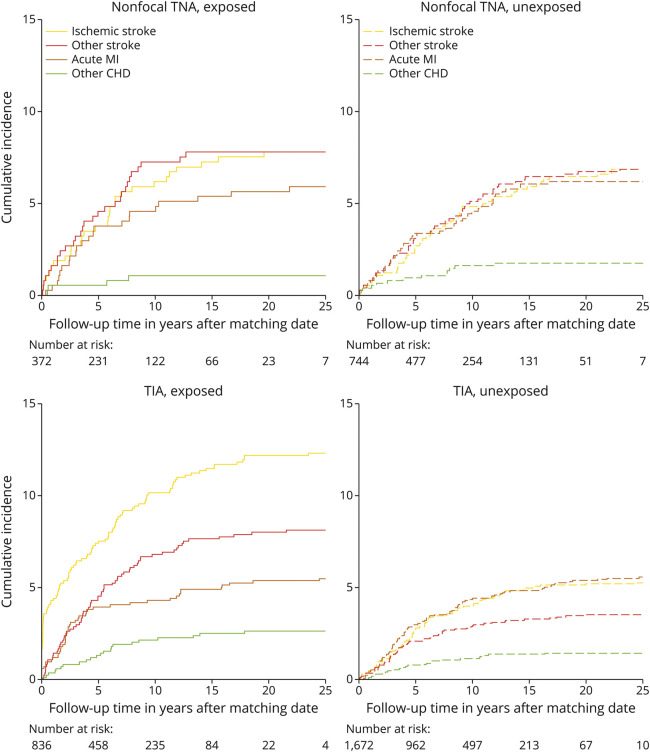
During follow-up, 1,208 participants (mean [SD] age 76.9 [9.3] years, 65.4% female) experienced a first-ever TNA and were matched to 2,416 participants without TNA. After 27,833 person-years of follow-up, 230 (19.0%) participants suffered stroke and 94 (7.8%) suffered CHD. For those without TNA, these numbers were 250 (10.4%) and 176 (7.3%). Incident nonfocal TNA was not associated with the risk of any stroke (hazard ratio 1.25%, 95% CI [0.89-1.77]), only ischemic stroke (1.26 [0.76-2.08]), any CHD (0.80 [0.49-1.31]), and only acute myocardial infarction (0.89 [0.51-1.56]). By comparison, participants with TIA had an increased risk of all stroke (2.55 [2.04-3.19]) and ischemic stroke (2.51[1.88-3.35]).
In this study, participants with nonfocal TNA did not have a subsequently elevated risk of CVD when compared with their matched counterparts, which contrasts with the elevated risk of stroke following a TIA. In the absence of other indications, initiating secondary prevention specifically after nonfocal TNA seems unwarranted.
非局灶性短暂性神经发作(TNA)被认为会增加中风风险,但这些发作的最佳临床处理方法仍不明确。我们确定了发生非局灶性TNA的人后续患心血管疾病(CVD)的风险是否增加,这类似于短暂性脑缺血发作(TIA)后已知的中风风险增加情况。
在一项针对45岁及以上荷兰参与者的基于人群的队列研究中,我们选择了在1990年至2020年随访期间首次发生TNA的参与者,TNA定义为突发神经症状发作,在24小时内缓解且无明确的其他诊断依据。非局灶性TNA仅为具有非局灶性症状的发作,而具有局灶性症状的发作被视为TIA。每个TNA参与者与2名在TNA诊断时年龄和性别相似但未经历TNA的参与者进行匹配。然后对参与者进行随访,观察任何由中风或任何冠心病(CHD)定义的CVD事件,98.6%的潜在人年随访完整。使用Cox比例风险模型分析TNA与后续CVD风险之间的关联,并对基线时的人口统计学和心血管危险因素进行调整。
在随访期间,1208名参与者(平均[标准差]年龄76.9[9.3]岁,65.4%为女性)首次发生TNA,并与2416名未发生TNA的参与者进行了匹配。经过27833人年的随访,230名(19.0%)参与者发生中风,94名(7.8%)参与者发生CHD。对于未发生TNA的人,这些数字分别为250名(10.4%)和176名(7.3%)。新发非局灶性TNA与任何中风风险(风险比1.25%,95%置信区间[0.89 - 1.77])、仅缺血性中风(1.26[0.76 - 2.08])、任何CHD(0.80[0.49 - 1.31])以及仅急性心肌梗死(0.89[0.51 - 1.56])均无关联。相比之下,TIA参与者发生所有中风(2.55[2.04 - 3.19])和缺血性中风(2.51[1.88 - 3.35])的风险增加。
在本研究中,与匹配的对照者相比,非局灶性TNA参与者后续患CVD的风险并未升高,这与TIA后中风风险升高形成对比。在没有其他指征的情况下,专门在非局灶性TNA后启动二级预防似乎没有必要。