Föhr Junwei, Prümmer Julia K, Maiolini Arianna, Marti Eliane, Jelcic Ilijas, Vidondo Beatriz, Ziegler Mario, Bathen-Nöthen Andrea, Tipold Andrea, Volk Holger A, Stein Veronika M
Division of Clinical Neurology, Vetsuisse Faculty, University of Bern, Bern, Switzerland.
Division of Neurological Sciences, Vetsuisse Faculty, University of Bern, Bern, Switzerland.
J Vet Intern Med. 2025 Jan-Feb;39(1):e17265. doi: 10.1111/jvim.17265.
In dogs with idiopathic epilepsy (IE), 33% develop resistance to conventional anti-seizure medication (ASM) despite adequate treatment. In human medicine, an immune-mediated etiology is suspected in a subset of ASM-resistant patients with epilepsy and cerebrospinal fluid (CSF)-specific immunoglobulin G (IgG)-type oligoclonal bands (OCBs) have been detected. In dogs, cases of autoimmune encephalitis recently were reported. Neuroinflammation may provide an additional explanation for the lack of response of certain dogs with IE to ASM.
Cerebrospinal fluid-specific OCBs are found in a subgroup of dogs with ASM-resistant IE.
Eighty-four dogs with IE were recruited from 3 referral centers and classified based on their response to ASM treatment (responsive, n = 56; resistant, n = 28).
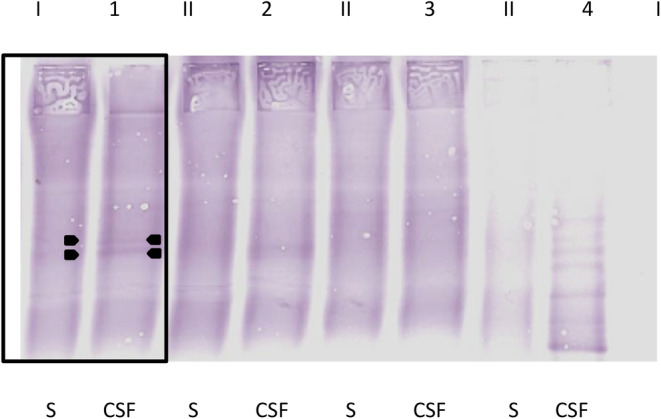
Detection of OCBs was performed using isoelectric focusing (IEF) followed by immunoblotting. Associations of CSF-specific OCBs with seizure type, severity, and response to ASM were calculated using logistic regression models.
The overall frequency of CSF-specific OCBs in dogs with IE was 15.5% (95% confidence interval [CI], 8.5%-25%). In dogs with ASM-resistant IE, 21.4% (6/28) had CSF-specific OCBs compared with only 12.5% (7/56) in those responsive to ASM, but no evidence of an association was detected (odds ratio, 1.9; 95% CI, 0.57-6.35; P = .29).
Cerebrospinal fluid-specific OCBs were detected in a subgroup of dogs with IE. This finding could indicate that intrathecal IgG synthesis as a sign of neuroinflammation may play a role in disease pathogenesis.
在特发性癫痫(IE)犬中,尽管接受了充分治疗,但仍有33%的犬对传统抗癫痫药物(ASM)产生耐药性。在人类医学中,对于一部分对ASM耐药的癫痫患者,怀疑存在免疫介导的病因,并且已检测到脑脊液(CSF)特异性免疫球蛋白G(IgG)型寡克隆带(OCB)。在犬类中,最近也报道了自身免疫性脑炎病例。神经炎症可能为某些IE犬对ASM缺乏反应提供另一种解释。
在对ASM耐药的IE犬亚组中发现脑脊液特异性OCB。
从3个转诊中心招募了84只IE犬,并根据它们对ASM治疗的反应进行分类(反应性,n = 56;耐药性,n = 28)。
使用等电聚焦(IEF)随后进行免疫印迹检测OCB。使用逻辑回归模型计算脑脊液特异性OCB与癫痫类型、严重程度和对ASM反应之间的关联。
IE犬脑脊液特异性OCB的总体频率为15.5%(95%置信区间[CI],8.5%-25%)。在对ASM耐药的IE犬中,21.4%(6/28)有脑脊液特异性OCB,而在对ASM有反应的犬中仅为12.5%(7/56),但未检测到关联证据(优势比,1.9;95%CI,0.57-6.35;P = 0.29)。
在一部分IE犬中检测到脑脊液特异性OCB。这一发现可能表明鞘内IgG合成作为神经炎症的标志可能在疾病发病机制中起作用。