Deng Guangchuan, Zhang Qunxing, Fan Jing, Zhao Chenran, Jiao Hui, Li Zhenxiang
Department of Cancer Center, The Second Affiliated Hospital of Chongqing Medical University, Tianwen Avenue No. 288, Nan'an District, Chongqing, 400010, China.
Duanpolan Township Hospital, Jimo District, Shandong Province, Qingdao City, 266225, China.
BMC Cancer. 2024 Dec 23;24(1):1571. doi: 10.1186/s12885-024-13363-7.
Intracranial radiation in combination with EGFR targeted therapy demonstrated signals of superiority to EGFR targeted therapy alone based on several observational studies. The timing based on specific criteria is not clear, and we evaluated the efficacy of intervention timing of craniocerebral radiotherapy (RT) combined with epidermal growth factor receptor tyrosine kinase inhibitors (EGFR-TKIs) on prognosis of patients with EGFR mutant lung adenocarcinoma complicated with brain metastasis.
In total, 603 patients with advanced non-small cell lung cancer (NSCLC) harboring EGFR mutations were enrolled in this retrospective study between March 2008-September 2023. Propensity score matching (PSM) was conducted to adjust for demographic and clinical covariates and to compare survival differences between the EGFR-TKI plus craniocerebral RT group and the EGFR-TKI only group. Patients were divided into upfront group and delayed group according to timing of craniocerebral RT interventions and analyses. Graded prognostic assessment for lung cancer using molecular markers (Lung molGPA), overall survival (OS), and intracranial progression-free survival (iPFS) were calculated. Kaplan-Meier was used to compare iPFS and OS in different groups.
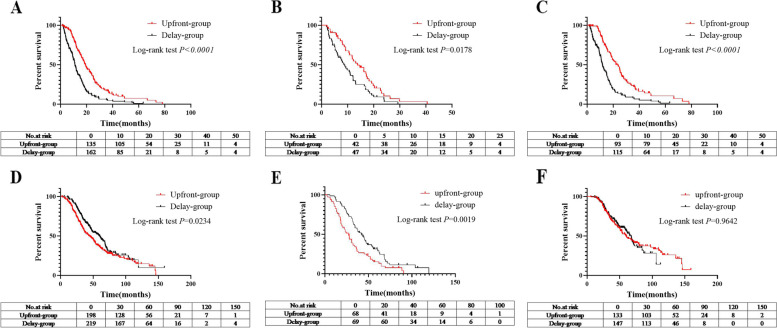
In our study, the median overall survival (OS) was 48.8 months, and the median intracranial progression-free survival (iPFS) was 14.2 months before PSM. After PSM, the median OS of EGFR-TKIs + craniocerebral RT group and EGFR-TKI only group was 52.0 months and 43.2 months, respectively (p = 0.0363). In total of 417 patients who underwent craniocerebral RT, were enrolled subsequently and divided into groups A (Lung-molGPA 1-2) and B (Lung-molGPA 2.5-4) according to the lung-molGPA score. For group A, the median OS of upfront-group and delay-group was 27 and 42.1 months, respectively (p = 0.0019). For patients in group B, there was no significant difference in OS between the two groups (p = 0.9642).
For patients with craniocerebral metastases of EGFR-mutant lung adenocarcinoma, combination of EGFR-TKIs and craniocerebral RT confers enhanced survival benefits. In patients with lower Lung-molGPA scores, delayed administration of craniocerebral RT is recommended to improve both iPFS and OS.
基于多项观察性研究,颅内放疗联合表皮生长因子受体(EGFR)靶向治疗显示出优于单纯EGFR靶向治疗的迹象。基于特定标准的时机尚不清楚,我们评估了颅脑放疗(RT)联合表皮生长因子受体酪氨酸激酶抑制剂(EGFR-TKIs)的干预时机对EGFR突变型肺腺癌合并脑转移患者预后的影响。
2008年3月至2023年9月期间,共有603例携带EGFR突变的晚期非小细胞肺癌(NSCLC)患者纳入本回顾性研究。采用倾向评分匹配(PSM)方法调整人口统计学和临床协变量,比较EGFR-TKI加颅脑放疗组和单纯EGFR-TKI组的生存差异。根据颅脑放疗干预时机将患者分为早期组和延迟组并进行分析。计算使用分子标志物的肺癌分级预后评估(Lung molGPA)、总生存期(OS)和颅内无进展生存期(iPFS)。采用Kaplan-Meier法比较不同组的iPFS和OS。
在我们的研究中,PSM前的中位总生存期(OS)为48.8个月,中位颅内无进展生存期(iPFS)为14.2个月。PSM后,EGFR-TKIs联合颅脑放疗组和单纯EGFR-TKI组的中位OS分别为52.0个月和43.2个月(p = 0.0363)。共有417例接受颅脑放疗的患者随后被纳入研究,并根据Lung-molGPA评分分为A组(Lung-molGPA 1-2)和B组(Lung-molGPA 2.5-4)。对于A组,早期组和延迟组的中位OS分别为27个月和42.1个月(p = 0.0019)。对于B组患者,两组的OS无显著差异(p = 0.9642)。
对于EGFR突变型肺腺癌脑转移患者,EGFR-TKIs与颅脑放疗联合使用可提高生存获益。对于Lung-molGPA评分较低的患者,建议延迟给予颅脑放疗以改善iPFS和OS。