Li Qian, Yan Jiaqi, Qiao Minjie, Quan Jiuqing, Chen Yiqing, Gong Mingxin, Niu Wenxin, Wang Lejun
Sport and Health Research Center, Shanghai YangZhi Rehabilitation Hospital (Shanghai Sunshine Rehabilitation Center), Physical Education Department, Tongji University, Shanghai, China.
School of Physical Education, Shaanxi Normal University, Xi'an, China.
Eur J Sport Sci. 2025 Jan;25(1):e12243. doi: 10.1002/ejsc.12243.
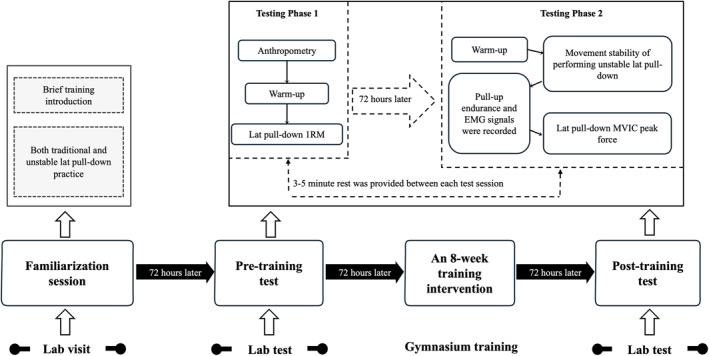
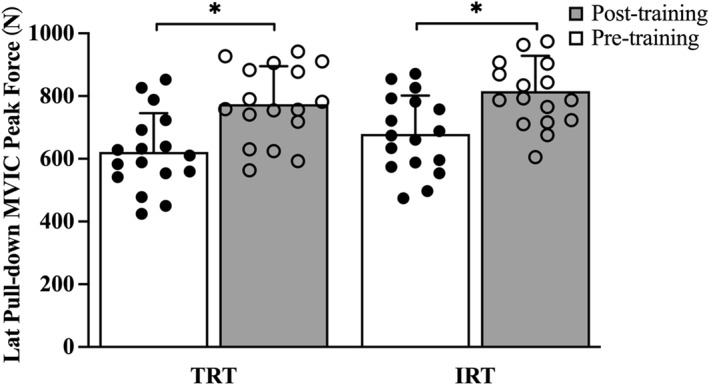
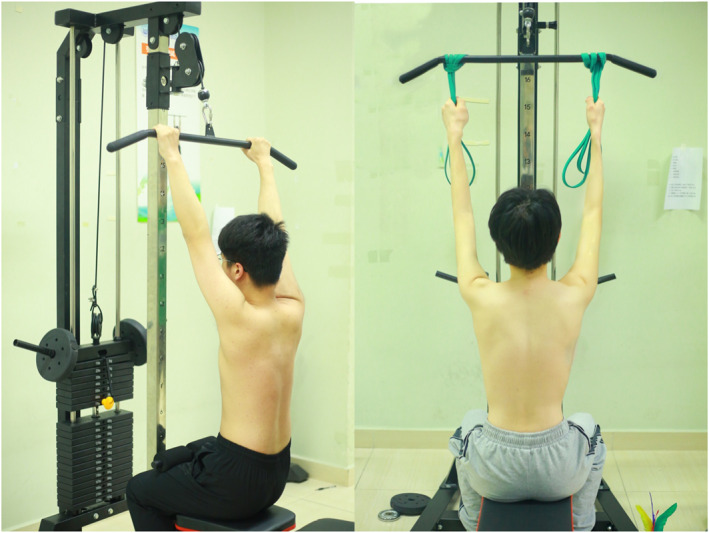
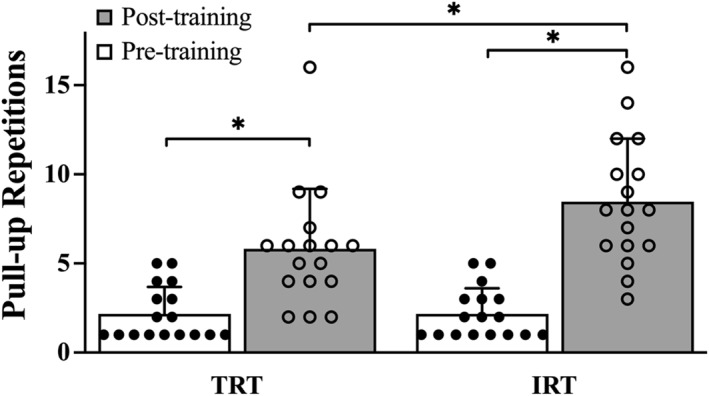
This study aimed to investigate the effects of an 8-week lat pull-down resistance training program with joint instability on pull-up performance in male college students. Thirty-four healthy recreationally active male college students were randomly assigned to either the joint instability resistance training (IRT) or traditional resistance training (TRT) group. Participants of the TRT and IRT groups performed lat pull-down training on stable and joint instability conditions for 8 weeks, respectively. Pull-up endurance (number of repetitions), anthropometry, lat pull-down maximal voluntary isometric contraction (MVIC) peak force, and movement stability of performing unstable lat pull-down were tested before and after the 8-week training. Surface electromyography of biceps brachii (BB), triceps brachii (TB), brachioradialis (BR), anterior deltoid (AD), middle deltoid (MD), posterior deltoid (PD), pectoralis major (PM), and latissimus dorsi (LD) muscles were recorded during the pull-up endurance test. The level of significance is set at p ≤ 0.05. The results demonstrated that the pull-up endurance and lat pull-down MVIC peak force of both IRT and TRT groups were significantly enhanced after 8-week training compared to the pre-training test. Notably, the number of pull-up repetitions of the IRT group was 45.5% higher than the TRT group. These findings suggest that lat pull-down training performed with joint instability may lead to greater improvements in pull-up endurance compared to the stable condition, possibly attributed to enhanced muscle contraction efficiency as indicated by decreased antagonist coactivation activity.
本研究旨在调查一项为期8周的、伴有关节不稳定因素的下拉抗阻训练计划对男性大学生引体向上表现的影响。34名健康且有休闲运动习惯的男性大学生被随机分配到关节不稳定抗阻训练(IRT)组或传统抗阻训练(TRT)组。TRT组和IRT组的参与者分别在稳定和关节不稳定条件下进行了8周的下拉训练。在为期8周的训练前后,对引体向上耐力(重复次数)、人体测量学指标、下拉最大自主等长收缩(MVIC)峰值力量以及进行不稳定下拉时的动作稳定性进行了测试。在引体向上耐力测试期间,记录了肱二头肌(BB)、肱三头肌(TB)、肱桡肌(BR)、三角肌前束(AD)、三角肌中束(MD)、三角肌后束(PD)、胸大肌(PM)和背阔肌(LD)的表面肌电图。显著性水平设定为p≤0.05。结果表明,与训练前测试相比,IRT组和TRT组在8周训练后的引体向上耐力和下拉MVIC峰值力量均显著提高。值得注意的是,IRT组的引体向上重复次数比TRT组高45.5%。这些发现表明,与稳定状态相比,在关节不稳定状态下进行下拉训练可能会使引体向上耐力有更大的提高,这可能归因于拮抗肌共同激活活动减少所表明的肌肉收缩效率提高。