Brooks Rebecca, Wei Xianhui, Lei Mang Leng, Cid Francisca Cisterna, Roper James A, Williamson Rosalind C, Bass Mark D
S chool of Biochemistry, University of Bristol, University Walk, Bristol BS8 1TD, UK.
School of Biosciences, University of Sheffield, Firth Court, Sheffield S10 2TN, UK.
J Mol Cell Biol. 2025 Jun 28;17(1). doi: 10.1093/jmcb/mjae054.
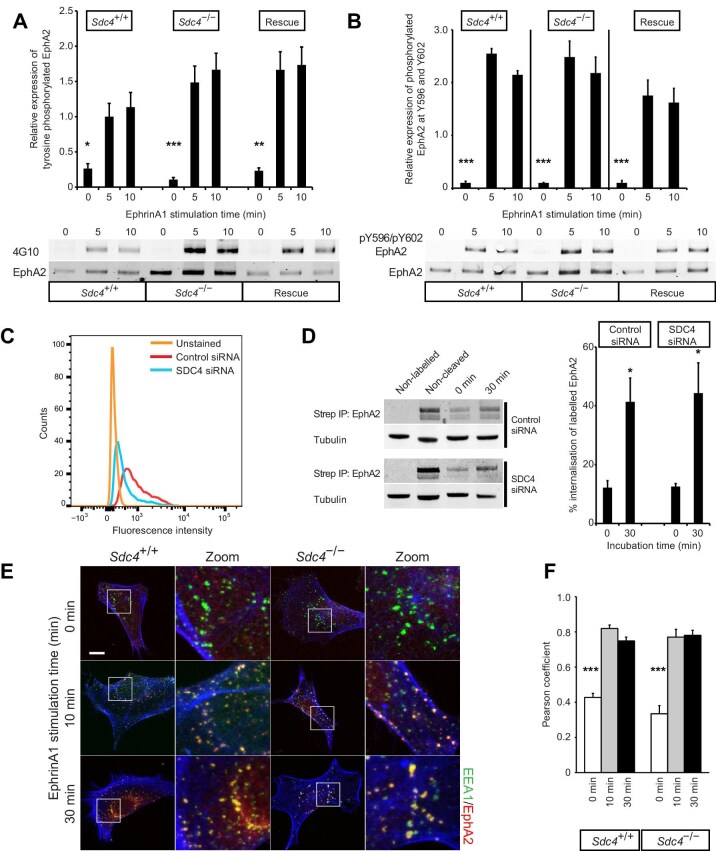
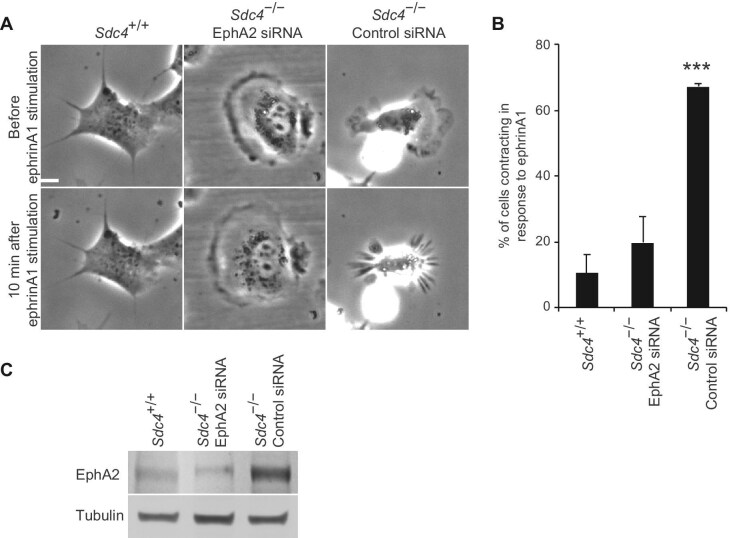
Upon injury, fibroblasts in the surrounding tissue become activated, migrating into the wound in a controlled manner. Once they arrive, they contract the wound and remodel the stroma. While certain cell surface receptors promote fibroblast migration, others cause repulsion between fibroblasts upon contact, seemingly opposing their clustering within the wound bed. Eph receptor-ephrin interactions on colliding cells trigger this repulsion, but how fibroblasts transition to clustering behaviour during healing remains unclear. Syndecan-4 modulates transmembrane receptors involved in wound healing, including receptors for the extracellular matrix and growth factors. As a result, Sdc4-/- mice experience delayed healing due to impaired fibroblast recruitment. In this study, we report that syndecan-4 also regulates fibroblast repulsion during wound healing. We discover that syndecan-4 inhibits the expression and signalling of EphA2 by activating PKCα. Changes in syndecan-4 expression, such as those observed during wound healing, alter fibroblast behaviour from repulsion to adhesion upon cell collision by modulating EphA2 levels. Moreover, we find that EphA2 expression is suppressed in wound bed fibroblasts in a syndecan-4-dependent manner, explaining how fibroblast clustering is achieved during wound healing.
受伤后,周围组织中的成纤维细胞被激活,以可控的方式迁移到伤口处。一旦到达,它们会收缩伤口并重塑基质。虽然某些细胞表面受体促进成纤维细胞迁移,但其他受体在接触时会导致成纤维细胞之间相互排斥,这似乎与它们在伤口床内的聚集相反。碰撞细胞上的Eph受体-ephrin相互作用引发这种排斥,但在愈合过程中,成纤维细胞如何转变为聚集行为仍不清楚。Syndecan-4调节参与伤口愈合的跨膜受体,包括细胞外基质和生长因子的受体。因此,Sdc4基因敲除小鼠由于成纤维细胞募集受损而愈合延迟。在本研究中,我们报告syndecan-4在伤口愈合过程中也调节成纤维细胞排斥。我们发现syndecan-4通过激活PKCα抑制EphA2的表达和信号传导。syndecan-4表达的变化,如在伤口愈合过程中观察到的变化,通过调节EphA2水平,使成纤维细胞在细胞碰撞时的行为从排斥转变为粘附。此外,我们发现伤口床成纤维细胞中的EphA2表达以syndecan-4依赖的方式被抑制,这解释了在伤口愈合过程中如何实现成纤维细胞聚集。