Wu Zhongyu, Wang Zhanqi, Chen Tao, Wang Dongyang, Zhou Feng, Zhang Guorui, Wei Shan, Wu Yingying
Department of Oral Diseases & National Center for Stomatology & National Clinical Research Center for Oral Diseases, Department of Oral Implantology, West China Hospital of Stomatology, Sichuan University, Chengdu 610041, Sichuan, PR China.
Department of Prosthodontics, Peking University School and Hospital of Stomatology, National Engineering Laboratory for Digital and Material Technology of Stomatology, National Clinical Research Center for Oral Diseases, Beijing Key Laboratory of Digital Stomatology, 22 Zhongguancun Avenue South, Haidian District, Beijing 100081, PR China.
Regen Ther. 2024 Dec 5;28:115-125. doi: 10.1016/j.reth.2024.11.015. eCollection 2025 Mar.
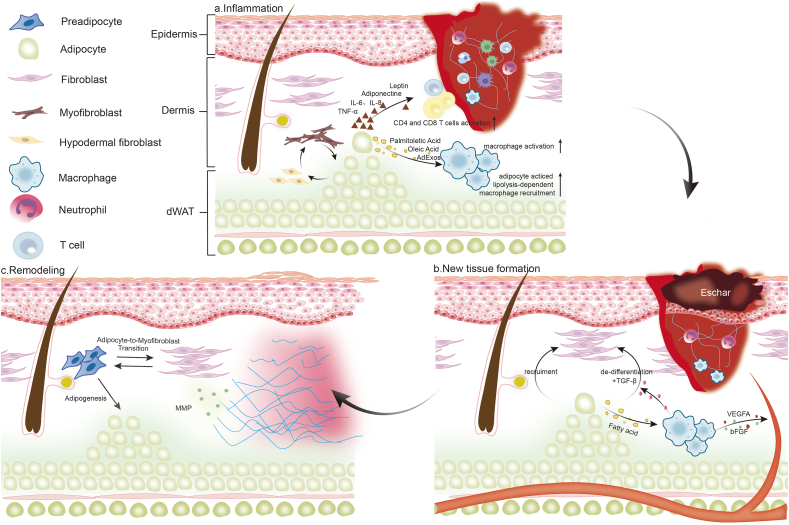
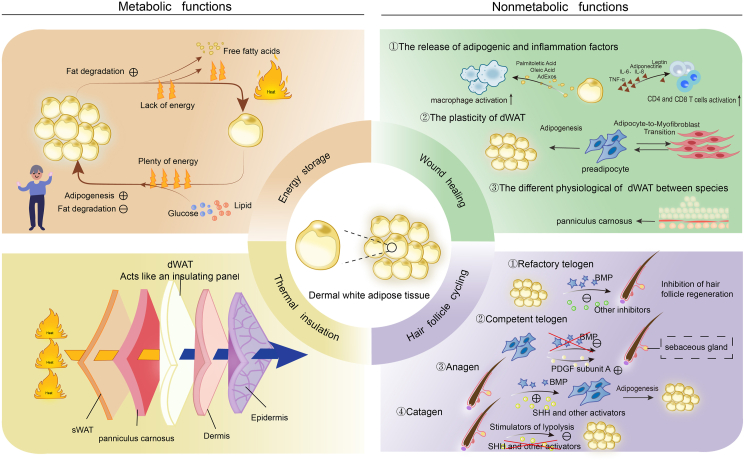
Dermal white adipose tissue (dWAT), distinguished by its origin from cells within the dermis and independence from subcutaneous fat tissue, has garnered significant attention for its non-metabolic functions. Characterized by strong communication with other components of the skin, dWAT mediates the proliferation and recruitment of various cell types by releasing adipogenic and inflammatory factors. Here, we focus on the modulatory role of dWAT at different stages during wound healing, highlighting its ability to mediate the adipocyte-to-myofibroblast transition which plays a pivotal role in the physiology and pathology processes of skin fibrosis, scarring, and aging. This review highlights the regulatory potential of dWAT in modulating wound healing processes and presents it as a target for developing therapeutic strategies aimed at reducing scarring and enhancing regenerative outcomes in skin-related disorders.
真皮白色脂肪组织(dWAT)因其起源于真皮内的细胞且独立于皮下脂肪组织而独具特色,其非代谢功能已引起广泛关注。dWAT与皮肤的其他成分有着密切的相互作用,通过释放脂肪生成因子和炎症因子来介导多种细胞类型的增殖和募集。在此,我们重点关注dWAT在伤口愈合不同阶段的调节作用,强调其介导脂肪细胞向肌成纤维细胞转变的能力,这一转变在皮肤纤维化、瘢痕形成和衰老的生理和病理过程中起着关键作用。本综述强调了dWAT在调节伤口愈合过程中的潜在调节作用,并将其作为开发旨在减少瘢痕形成和改善皮肤相关疾病再生效果的治疗策略的靶点。