Schulz Claudia, Twele Friederike, Meller Sebastian, Ten Hagen Nele A, Pilchová Veronika, Wirz Katrin, Clever Sabrina, Meyer Zu Natrup Christian, Volz Asisa, von Köckritz-Blickwede Maren, Volk Holger A
Research Center for Emerging Infections and Zoonoses (RIZ), University of Veterinary Medicine Hannover, Hannover, Germany.
Department of Small Animal Medicine and Surgery, University of Veterinary Medicine Hannover, Hannover, Germany.
Front Med (Lausanne). 2024 Dec 9;11:1476300. doi: 10.3389/fmed.2024.1476300. eCollection 2024.
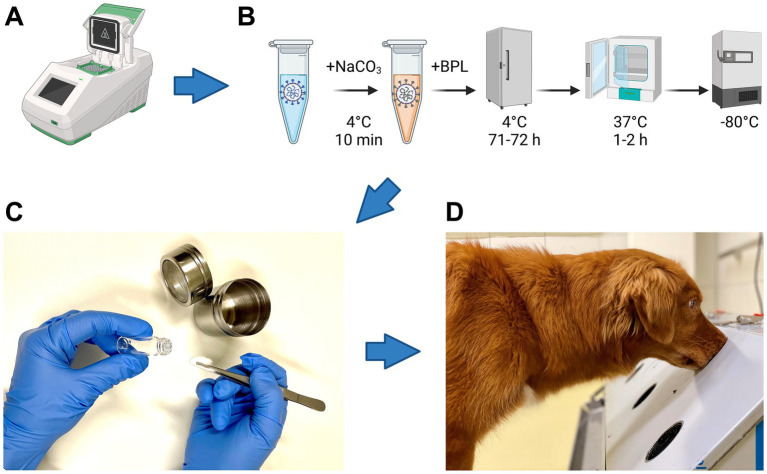
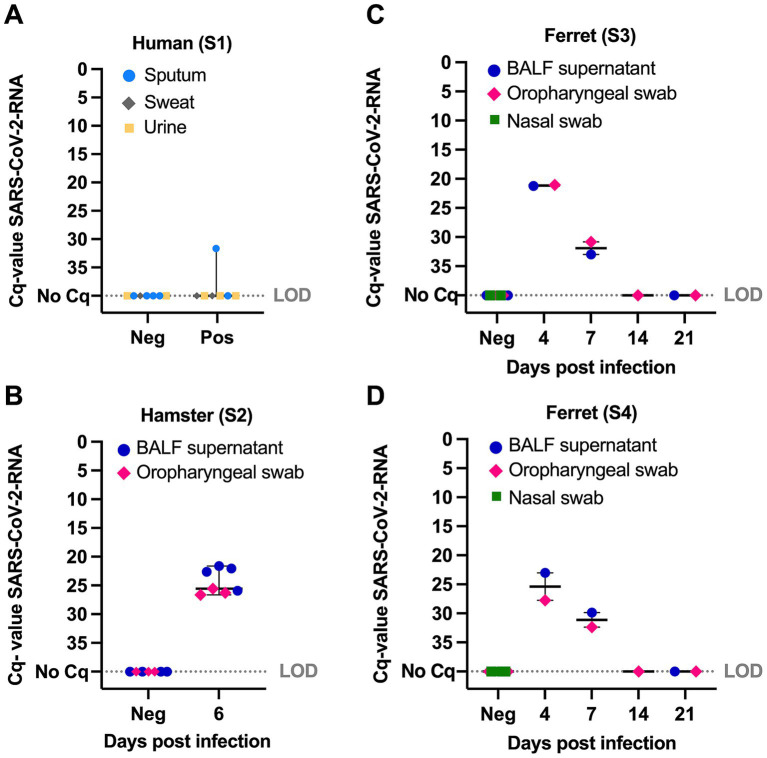
Rapid and sensitive diagnostic measures are a pre-requisite for the control of SARS-CoV-2 outbreaks. Dogs detect SARS-CoV-2-infected human individuals with high speed due to their extraordinary olfactory acuity. In the post-pandemic phase of SARS-CoV-2 it is difficult to obtain samples from infected humans for scent dog training. Established animal models for COVID-19 include hamsters and ferrets, which could overcome this shortcoming and have the advantage that samples are generated under controlled conditions. Respiratory samples from humans, hamsters and ferrets infected with SARS-CoV-2 and from ferrets infected with an H7-Influenza A virus were inactivated with -propiolactone and presented via a device called "Detection Dog Training System" (DDTS). DDTS allows a fast, blinded, randomized, and automated sample presentation without trainer interference. Scent dogs generally showed a similar diagnostic sensitivity (DSe) and specificity (Dsp) for four tested scenarios (S1-4) and as reported previously for respiratory samples from humans. (S1) Human with COVID-19: DSe 88.1 [74.0-100.0% CI] and DSp 89.6 [80.6-98.5% CI]. (S2) Hamster with COVID-19: DSe 82.4 [74.1-90.7% CI] and DSp 96.7 [93.7-99.7% CI]. (S3) Ferret with COVID-19: DSe 86.2 [69.8-100.0% CI] and DSp 95.1 [89.5-100.0% CI]. (S4) Ferrets infected with an H7 Influenza A-virus (IAV) as a distractor: DSe 96.9 [57.2-100.0% CI] and DSp 89.86 [40.3-100.0% CI]. We provide evidence that scent dogs detect samples from SARS-CoV-2-infected hamsters and ferrets with a similar accuracy as reported for humans. The study highlights that volatile organic compound odor patterns are similar in humans, hamsters, and ferrets after SARS-CoV-2 infection, but distinct after IAV-infection.
快速且灵敏的诊断措施是控制新型冠状病毒(SARS-CoV-2)疫情的先决条件。狗因其超凡的嗅觉敏锐度,能够快速检测出感染SARS-CoV-2的人类个体。在SARS-CoV-2疫情的大流行后阶段,很难从受感染的人类身上获取样本用于嗅探犬训练。已建立的新冠病毒(COVID-19)动物模型包括仓鼠和雪貂,它们可以克服这一缺点,并且具有在可控条件下生成样本的优势。用β-丙内酯对感染SARS-CoV-2的人类、仓鼠和雪貂以及感染H7甲型流感病毒的雪貂的呼吸道样本进行灭活,并通过一种名为“检测犬训练系统”(DDTS)的设备呈现。DDTS允许在没有训练员干扰的情况下进行快速、盲法、随机和自动的样本呈现。嗅探犬对四种测试场景(S1 - 4)的诊断敏感性(DSe)和特异性(Dsp)通常表现出与先前报道的人类呼吸道样本相似的水平。(S1)感染COVID-19的人类:DSe 88.1 [74.0 - 100.0%置信区间],DSp 89.6 [80.6 - 98.5%置信区间]。(S2)感染COVID-19的仓鼠:DSe 82.4 [74.1 - 90.7%置信区间],DSp 96.7 [93.7 - 99.7%置信区间]。(S3)感染COVID-19的雪貂:DSe 86.2 [69.8 - 100.0%置信区间],DSp 95.1 [89.5 - 100.0%置信区间]。(S4)感染H7甲型流感病毒(IAV)作为干扰物的雪貂:DSe 96.9 [57.2 - 100.0%置信区间],DSp 89.86 [40.3 - 100.0%置信区间]。我们提供的证据表明,嗅探犬检测感染SARS-CoV-2的仓鼠和雪貂样本的准确性与检测人类样本的准确性相似。该研究强调,SARS-CoV-2感染后,人类、仓鼠和雪貂体内的挥发性有机化合物气味模式相似,但感染IAV后则不同。