Yang Wen-Yi, Huang Kuan, Lin Zhi-Jian, Zeng Wen, Liu Xin, Liu Hong-Bo, Zhong Mao-Lin, Wei Jun, Liang Wei-Dong, Wang Li-Feng, Chen Li
The First Clinical Medical College of Gannan Medical University, Ganzhou, Jiangxi, People's Republic of China.
Anesthesia Surgical Center, The First Affiliated Hospital of Gannan Medical University, Ganzhou, Jiangxi, People's Republic of China.
Drug Des Devel Ther. 2024 Dec 17;18:6061-6073. doi: 10.2147/DDDT.S487463. eCollection 2024.
To evaluate the efficacy and safety of intranasal dexmedetomidine (Dex), oral lorazepam, and a placebo in managing preoperative anxiety-related insomnia.
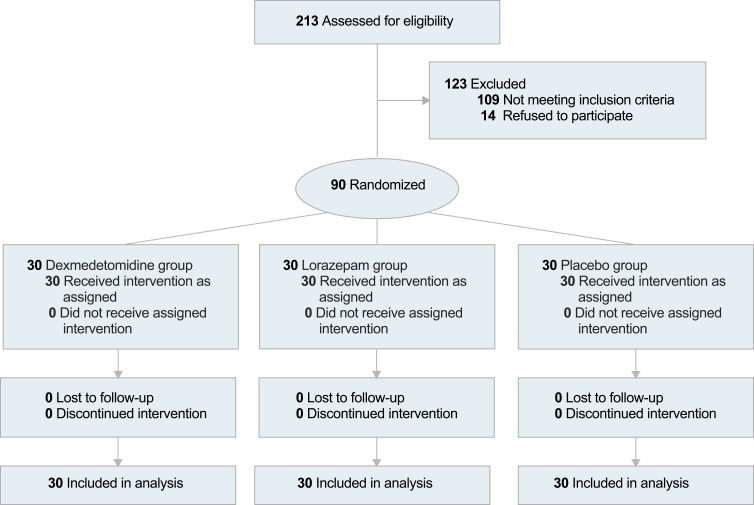
A total of 90 patients exhibiting symptoms of preoperative anxiety and insomnia were randomly assigned to three groups: Dex (receiving 2.5 µg/kg Dex intranasally and starch tablets orally), lorazepam (receiving saline intranasally and 2 mg lorazepam orally), and placebo (receiving saline intranasally and starch tablets orally). Interventions were conducted the night before surgery. The primary outcome was measured using the Leeds Sleep Evaluation Questionnaire (LSEQ) to evaluate changes in sleep quality pre- and post-intervention. Secondary outcomes included monitoring sleep on the night of the intervention, sleep satisfaction scores, changes in vital signs within 2 hours post-intervention, and adverse reaction rates.
According to sleep assessments using the LSEQ, the Dex group demonstrated significant improvements in ease of getting to sleep (GTS), ease of awakening (AFS), and alertness and behavior after waking (BFW) compared to the lorazepam group ( < 0.05). However, no significant differences were observed in the quality of sleep (QOS) between the two groups ( > 0.05). Sleep monitoring indicated that the Dex group had a median sleep onset latency (SOL) of 19.0 min, significantly shorter than those recorded for the lorazepam group at 33.5 min and the placebo group at 57.0 min ( < 0.001). The total sleep time (TST) and sleep efficiency (SE) were 403.7 min and 84.5% for the Dex group, similar to the lorazepam group (408.6 min, 83.2%)( >0.999) and superior to the placebo group (278.8 min, 57.4%)( < 0.001). Sleep satisfaction scores did not significantly differ between the Dex and lorazepam groups ( > 0.999). No serious adverse reactions were reported across the groups.
Both 2.5 μg/kg intranasal Dex and 2 mg oral lorazepam effectively improved sleep quality in patients with preoperative anxiety-related insomnia. While both treatments were comparable in maintaining sleep, intranasal Dex was more effective in initiating sleep and enhancing daytime functionality than lorazepam.
评估鼻内给予右美托咪定(Dex)、口服劳拉西泮和安慰剂治疗术前焦虑相关失眠的疗效和安全性。
总共90例表现出术前焦虑和失眠症状的患者被随机分为三组:Dex组(鼻内给予2.5μg/kg Dex并口服淀粉片)、劳拉西泮组(鼻内给予生理盐水并口服2mg劳拉西泮)和安慰剂组(鼻内给予生理盐水并口服淀粉片)。干预在手术前一晚进行。主要结局通过利兹睡眠评估问卷(LSEQ)测量,以评估干预前后睡眠质量的变化。次要结局包括干预当晚的睡眠监测、睡眠满意度评分、干预后2小时内生命体征的变化以及不良反应发生率。
根据使用LSEQ进行的睡眠评估,与劳拉西泮组相比,Dex组在入睡难易程度(GTS)、觉醒难易程度(AFS)以及醒来后的警觉性和行为(BFW)方面有显著改善(<0.05)。然而,两组之间的睡眠质量(QOS)没有显著差异(>0.05)。睡眠监测表明,Dex组的中位入睡潜伏期(SOL)为19.0分钟,显著短于劳拉西泮组记录的33.5分钟和安慰剂组记录的57.0分钟(<0.001)。Dex组的总睡眠时间(TST)和睡眠效率(SE)分别为403.7分钟和84.5%,与劳拉西泮组相似(408.6分钟,83.2%)(>0.999),且优于安慰剂组(278.8分钟,57.4%)(<0.001)。Dex组和劳拉西泮组的睡眠满意度评分没有显著差异(>0.999)。各组均未报告严重不良反应。
2.5μg/kg鼻内给予Dex和2mg口服劳拉西泮均能有效改善术前焦虑相关失眠患者的睡眠质量。虽然两种治疗在维持睡眠方面相当,但鼻内给予Dex在启动睡眠和增强日间功能方面比劳拉西泮更有效。