Joodaki Mehran, Radahmadi Maryam, Alaei Hojjatallah
Department of Physiology, School of Medicine, Isfahan University of Medical Sciences, Isfahan, Iran.
Adv Biomed Res. 2024 Oct 28;13:99. doi: 10.4103/abr.abr_259_23. eCollection 2024.
Chronic stress can lead to anxiety and depression. Escitalopram is a selective serotonin reuptake inhibitor (SSRI), and crocin is a natural compound derived from saffron. Both of them are used to treat these disorders in clinical and traditional medicine, respectively. This study compared the antidepressant and anxiolytic effects of escitalopram, crocin, and their combination in rats.
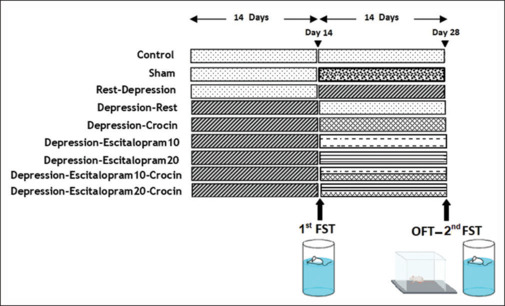
Rats were divided into nine groups: control, sham, rest-depression, depression-rest, depression-crocin, depression-escitalopram10, depression-escitalopram20, depression-escitalopram10-crocin, and depression-escitalopram20-crocin. Forced swimming and open field tests (FST and OFT, respectively) were used to evaluate depression, anxiety, and locomotor activity.
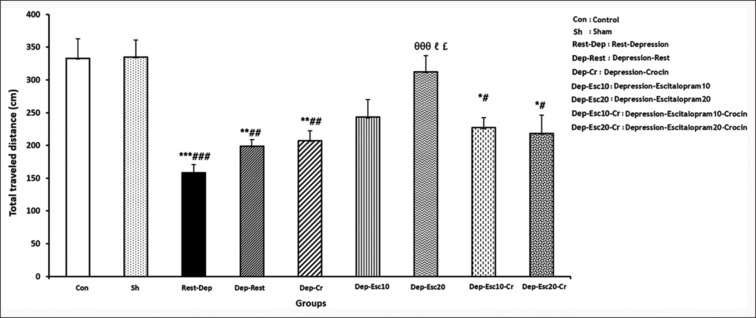
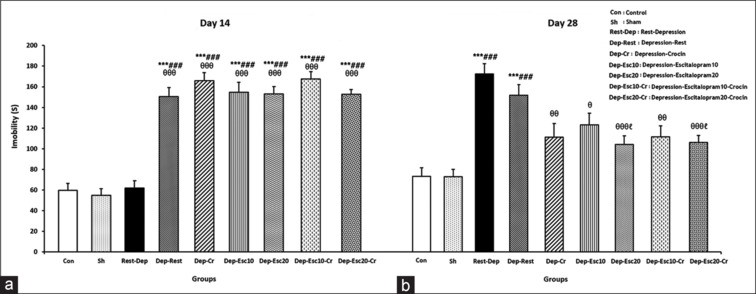
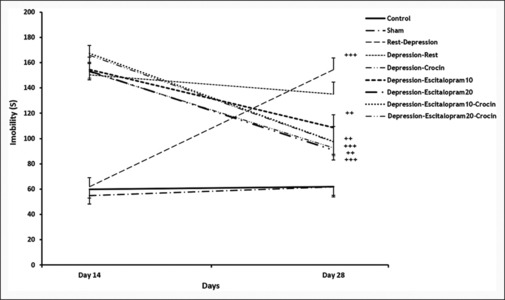
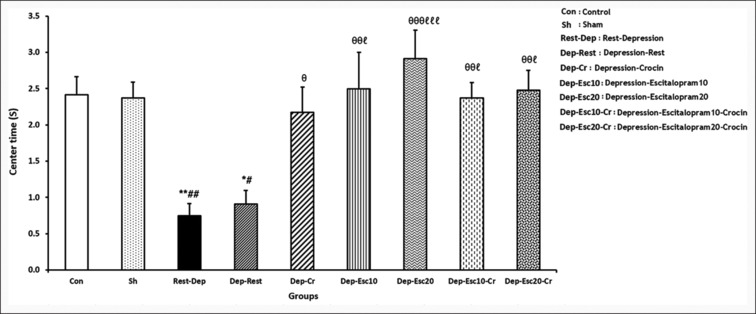
In the FST, the immobility time on day 28 significantly decreased in all depressed groups that received escitalopram, crocin, and their combination compared to the rest-depression group. Whereas, conversely, the time spent at the center in the OFT was significantly higher in similar comparisons. The total distance traveled by the OFT was significantly lower in all depressed groups, except for the depression-escitalopram10 and depression-escitalopram20 groups. The total distance traveled was significantly higher in the depression-escitalopram20 compared to the rest-depression group.
Crocin, both doses of escitalopram and their combination, reduced depression. A high dose of escitalopram, with and without crocin, was partially more effective than a low dose of escitalopram in reversing depression. There was anxiety-like behavior observed after inducing depression with and without a recovery period. Whereas, crocin alone and both doses of escitalopram, with and without crocin, decreased anxiety-like behaviors in subjects with depression. This effect may be attributed to a modulation of brain neurotransmitter ratios.
慢性应激可导致焦虑和抑郁。艾司西酞普兰是一种选择性5-羟色胺再摄取抑制剂(SSRI),藏红花素是一种从藏红花中提取的天然化合物。它们分别在临床医学和传统医学中用于治疗这些疾病。本研究比较了艾司西酞普兰、藏红花素及其组合对大鼠的抗抑郁和抗焦虑作用。
将大鼠分为九组:对照组、假手术组、休息性抑郁组、抑郁恢复期组、抑郁藏红花素组、抑郁艾司西酞普兰10mg组、抑郁艾司西酞普兰20mg组、抑郁艾司西酞普兰10mg+藏红花素组和抑郁艾司西酞普兰20mg+藏红花素组。分别采用强迫游泳试验和旷场试验(分别为FST和OFT)来评估抑郁、焦虑和运动活性。
在FST中,与休息性抑郁组相比,所有接受艾司西酞普兰、藏红花素及其组合治疗的抑郁组在第28天的不动时间显著减少。然而,相反地,在类似比较中,OFT中在中央区域停留的时间显著更长。除抑郁艾司西酞普兰10mg组和抑郁艾司西酞普兰20mg组外,所有抑郁组的OFT总行进距离显著更低。与休息性抑郁组相比,抑郁艾司西酞普兰20mg组的总行进距离显著更高。
藏红花素、两种剂量的艾司西酞普兰及其组合均可减轻抑郁。高剂量的艾司西酞普兰,无论有无藏红花素,在逆转抑郁方面比低剂量的艾司西酞普兰部分更有效。在诱导抑郁且有或无恢复期后均观察到焦虑样行为。然而,单独使用藏红花素以及两种剂量的艾司西酞普兰,无论有无藏红花素,均可降低抑郁受试者的焦虑样行为。这种作用可能归因于对脑内神经递质比例的调节。