Pili Sergio, Lecca Luigi Isaia, Pedrazzi Tatiana, Ghitti Roberta, Murru Alessandro, Uras Michele, Fabbri Daniele, Campagna Marcello, De Palma Giuseppe
Department of Medical Sciences and Public Health, University of Cagliari, 09042, Monserrato, Italy.
Unit of Occupational Health and Industrial Hygiene, Department of Medical and Surgical Specialties, Radiological Sciences and Public Health, University of Brescia, 25121, Brescia, Italy.
Heliyon. 2024 Nov 29;10(23):e40815. doi: 10.1016/j.heliyon.2024.e40815. eCollection 2024 Dec 15.
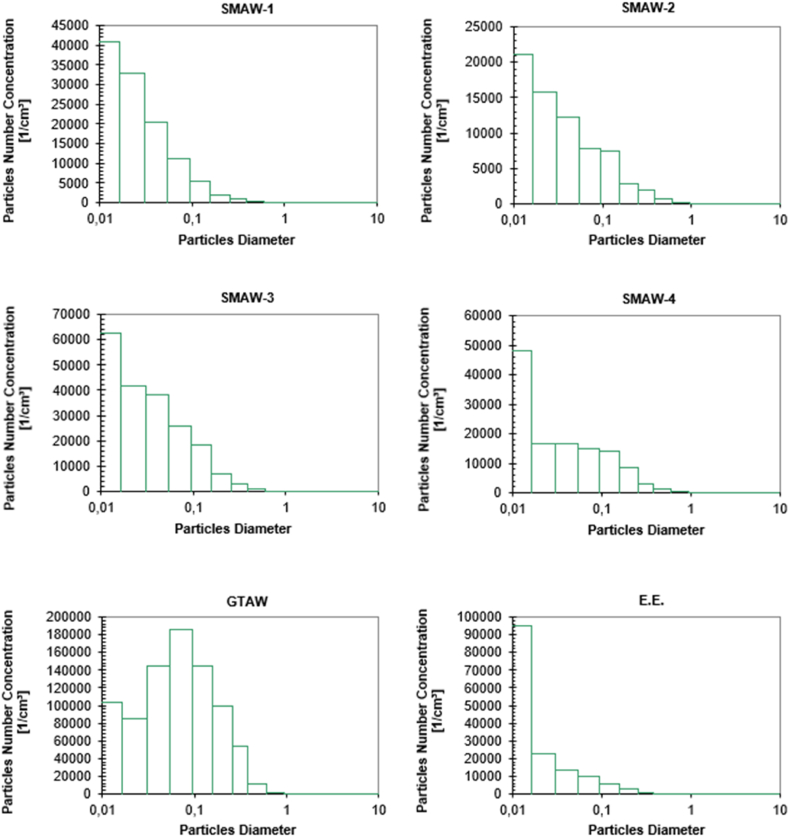
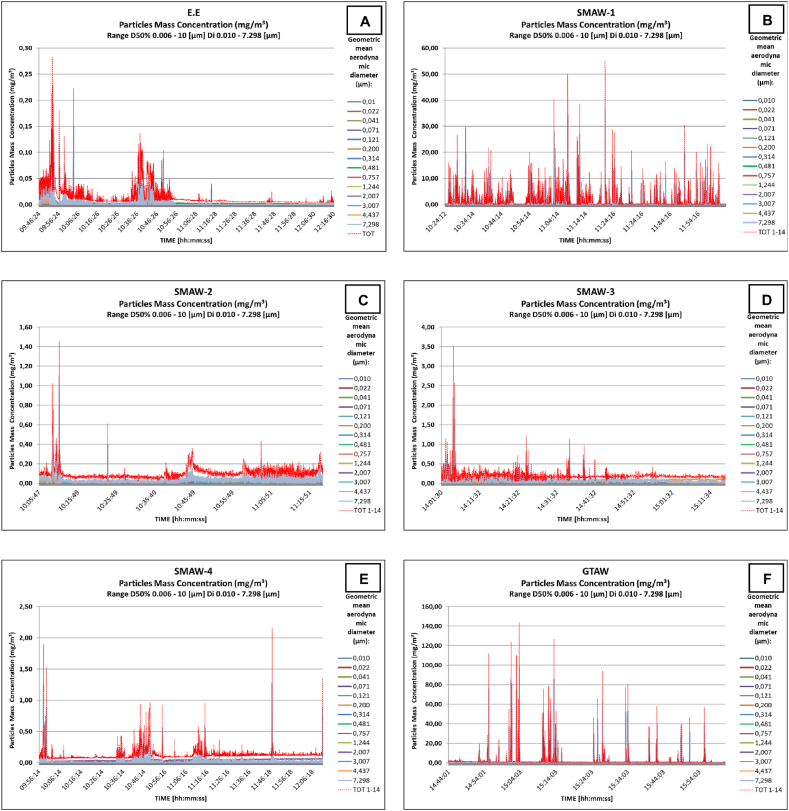
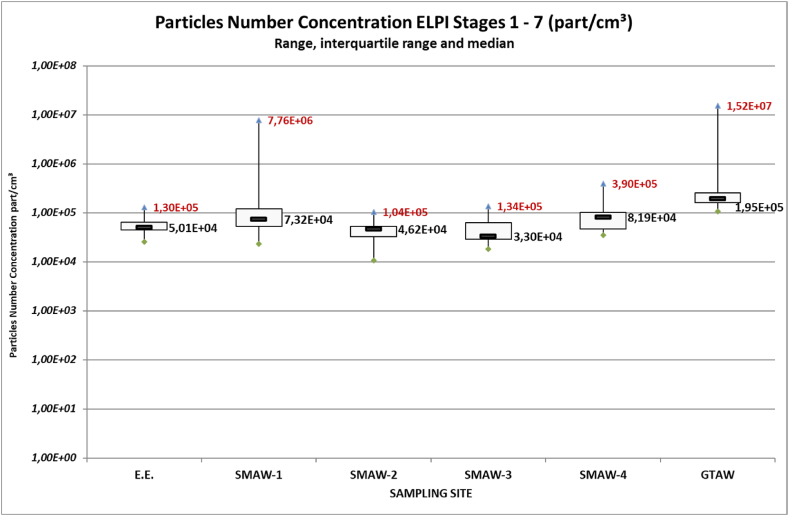
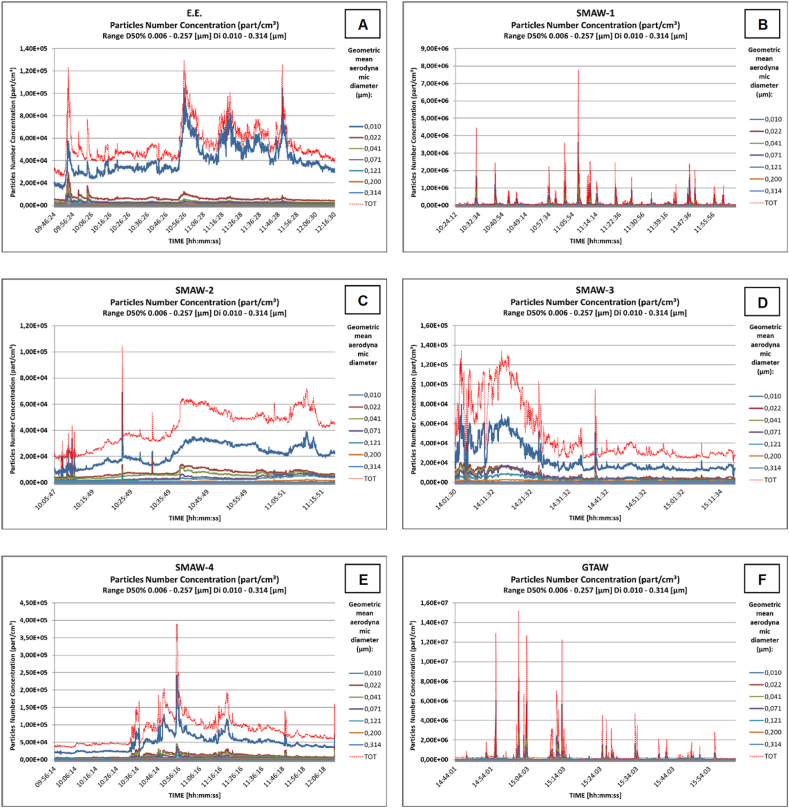
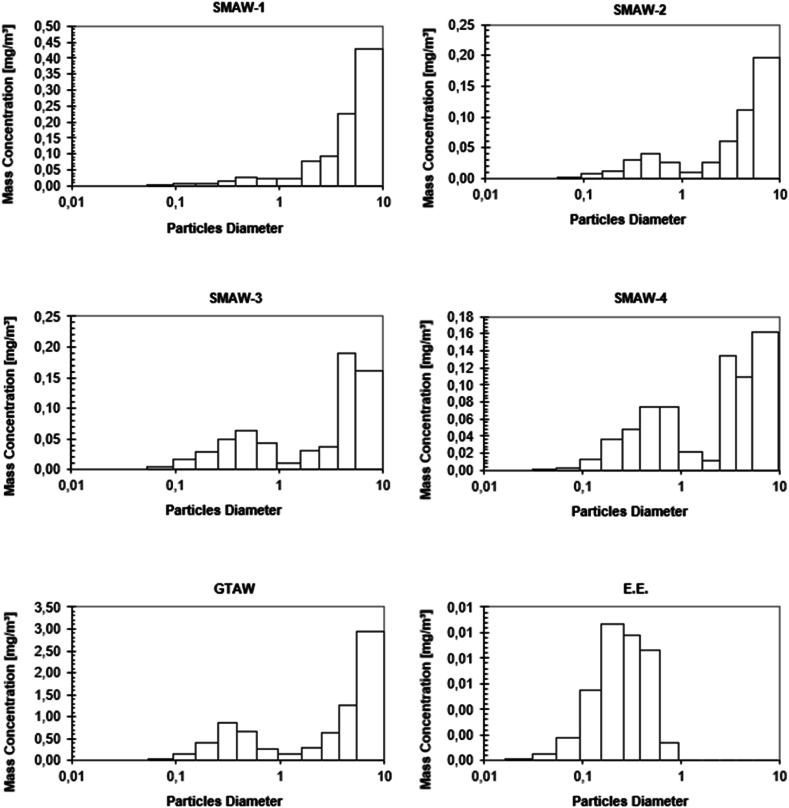
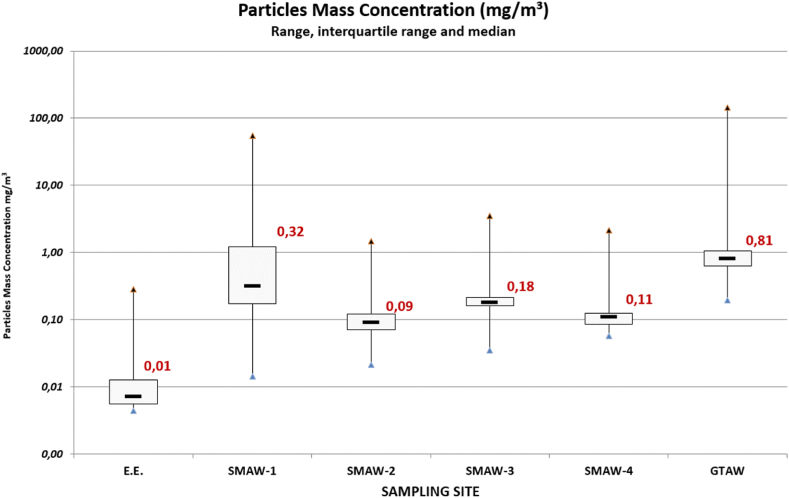
Welding fumes are a main source of occupational exposure to particulate matter (PM), besides gases and ultraviolet radiations, that involves millions of operators worldwide and is related to several health effects, including lung cancer. Our study aims to evaluate the exposure to fine and ultrafine airborne particulate in welding operators working in a steel making factory.In October 2019, air monitoring was performed for four days in five different welding scenarios and in the external area of a steelmaking factory to assess the exposure to airborne particles, ultrafine (UFP) particulate and inhalable fraction, during welding activities. The airborne particles distribution as particle number and mass concentration were measured using a low-pressure electric impactor, model ELPI™ (range of sampling 0.006 μm and 10 μm), whereas the airborne inhalable fraction was collected by filtration, using the IOM Sampler selector.The particle concentration, i.e. the number of particles per cm (part/cm) showed significantly higher exposure figures for nanoscale particles, especially for the fractions included in the last 4 stages sampled by ELPI (from 0.010 μm to 0.071 μm), the figure representing between 85 % and 91 % of the total, whereas for the last 7 stages (0.010 μm-0.314 μm), they represented from 98 % to 99 % of the total. The average figure was approximately 5.01 × 10 part/cm, while the maximum average was 1.95 × 10 part/cm on TIG welding, with a peak of 1.52 × 10 parts/cm. In terms of mass concentration, the levels of PM inhalable fraction ranged between 0.1 mg/m and 1.08 mg/m.The results of the present study substantially confirm previous studies regarding the distributions in terms of number and mass of welding fumes for SMAW and TIG techniques on steel, the mass concentration levels resulting within the permissible exposure limits (PEL) indicated by OSHA regulations. The results highlighted the importance of the efficiency of localized aspiration systems and the need to apply prevention and protection measures despite the low levels of exposure measured in terms of mass.
Overall, The particle number concentrations showed an important contribution in the emission of UFP compared to background levels. The PM inhalable fraction was substantially contained within the PEL. Further studies are needed to better understand the chemical characterization of the particulate also considering further variables of the working process that could influence the levels of exposure to welding fumes.
焊接烟尘是职业接触颗粒物(PM)的主要来源,此外还有气体和紫外线辐射,全球数百万操作人员都面临这种情况,并且与多种健康影响相关,包括肺癌。我们的研究旨在评估在一家炼钢厂工作的焊接操作人员暴露于空气中细颗粒物和超细颗粒物的情况。2019年10月,在炼钢厂的五个不同焊接场景及外部区域进行了为期四天的空气监测,以评估焊接活动期间空气中颗粒物、超细颗粒物(UFP)和可吸入部分的暴露情况。使用ELPI™型低压电冲击器(采样范围为0.006μm至10μm)测量空气中颗粒物按颗粒数和质量浓度的分布,而空气中可吸入部分则使用IOM采样器通过过滤收集。颗粒浓度,即每立方厘米的颗粒数(part/cm³)显示,纳米级颗粒暴露数值显著更高,特别是对于ELPI采样的最后4个阶段(从0.010μm至0.071μm)所包含的部分,该数值占总数的85%至91%,而对于最后7个阶段(0.010μm - 0.314μm),它们占总数的98%至99%。平均数值约为5.01×10⁴ part/cm³,而在钨极惰性气体保护焊(TIG)焊接时最大平均值为1.95×10⁵ part/cm³,峰值为1.52×10⁶ parts/cm³。就质量浓度而言,可吸入颗粒物(PM)部分的水平在0.1mg/m³至1.08mg/m³之间。本研究结果基本证实了先前关于手工电弧焊(SMAW)和钨极惰性气体保护焊(TIG)技术在钢材上焊接烟尘数量和质量分布的研究,质量浓度水平在职业安全与健康管理局(OSHA)法规规定的允许暴露限值(PEL)范围内。结果突出了局部抽吸系统效率的重要性,以及尽管按质量测量的暴露水平较低但仍需采取预防和保护措施的必要性。
总体而言,与背景水平相比,颗粒数浓度在超细颗粒物排放中起重要作用。可吸入颗粒物(PM)部分基本在允许暴露限值(PEL)范围内。需要进一步研究以更好地了解颗粒物的化学特征,并考虑可能影响焊接烟尘暴露水平的工作过程的更多变量。