Schalkwijk Hanna Helena, Andrei Graciela, Snoeck Robert
Laboratory of Virology and Chemotherapy, Department of Microbiology, Immunology and Transplantation, Rega Institute for Medical Research, KU Leuven, Herestraat 49 box 1043, Leuven 3000, Belgium.
Virus Evol. 2024 Nov 23;10(1):veae101. doi: 10.1093/ve/veae101. eCollection 2024.
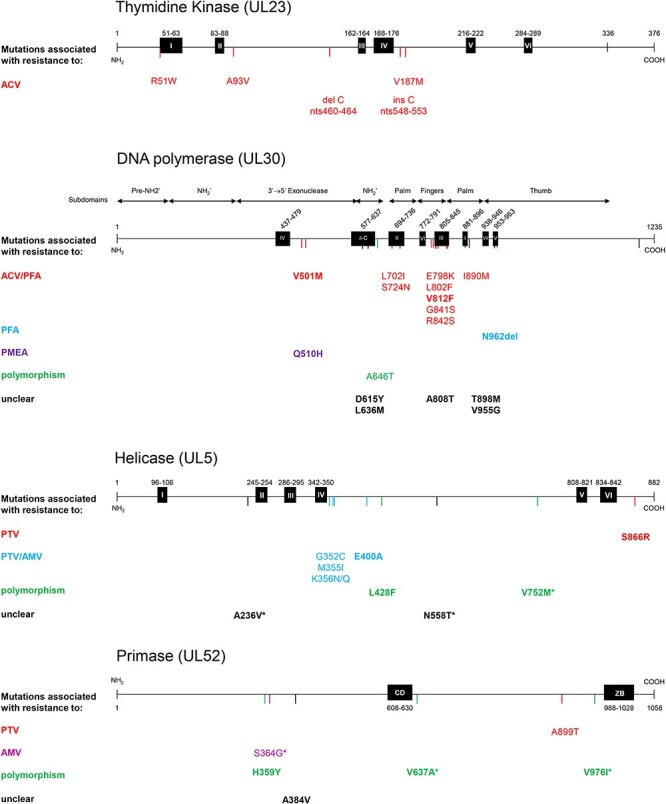
The widespread use of antivirals in immunocompromised individuals has led to frequent occurrences of drug-resistant herpes simplex virus 1 (HSV-1) infections. Current antivirals target the viral DNA polymerase (DP), resulting in cross-resistance patterns that emphasize the need for novel treatment strategies. In this study, we assessed whether combining antivirals with different targets affects drug resistance emergence by passaging wild-type HSV-1 under increasing concentrations of acyclovir (ACV), foscarnet (phosphonoformic acid, PFA), or the helicase-primase inhibitor pritelivir (PTV), individually or in combination (ACV + PTV or PFA + PTV). The resistance selection procedure was initiated from two different drug concentrations for each condition. Deep sequencing and subsequent phenotyping showed the rapid acquisition of resistance mutations under monotherapy pressure, whereas combination therapy resulted in either no mutations or mutations conferring ACV and/or PFA resistance. Notably, mutations associated with PTV resistance were not detected after five passages under combination pressure. Strains resistant to both ACV and PTV were eventually obtained upon further passaging under ACV + PTV pressure initiated from lower drug concentrations. PFA + PTV dual treatment induced PFA resistance mutations in the DP, but PTV resistance mutations were not acquired, even after 15 passages. Our data suggest that combining the helicase-primase inhibitor PTV with a DP inhibitor may be an effective strategy to prevent drug resistance evolution in HSV-1.
抗病毒药物在免疫功能低下个体中的广泛使用导致耐药性单纯疱疹病毒1型(HSV-1)感染频繁发生。目前的抗病毒药物靶向病毒DNA聚合酶(DP),导致出现交叉耐药模式,这凸显了对新型治疗策略的需求。在本研究中,我们评估了将具有不同靶点的抗病毒药物联合使用是否会影响耐药性的产生,方法是在阿昔洛韦(ACV)、膦甲酸(PFA)或解旋酶-引物酶抑制剂普瑞替韦(PTV)浓度不断增加的情况下,单独或联合(ACV + PTV或PFA + PTV)传代野生型HSV-1。每种情况均从两种不同的药物浓度开始进行耐药性选择程序。深度测序及后续表型分析表明,在单一疗法压力下可快速获得耐药性突变,而联合疗法要么不产生突变,要么产生赋予ACV和/或PFA耐药性的突变。值得注意的是,在联合压力下传代五次后未检测到与PTV耐药性相关的突变。在从较低药物浓度开始的ACV + PTV压力下进一步传代后,最终获得了对ACV和PTV均耐药的毒株。PFA + PTV双重治疗在DP中诱导了PFA耐药性突变,但即使传代15次后也未获得PTV耐药性突变。我们的数据表明,将解旋酶-引物酶抑制剂PTV与DP抑制剂联合使用可能是预防HSV-1耐药性演变的有效策略。