Li Dezhi, Geng Ke, Hao Yuan, Gu Jiajia, Kumar Saurav, Olson Annabel T, Kuismi Christina C, Kim Hye Mi, Pan Yuanwang, Sherman Fiona, Williams Asia M, Li Yiting, Li Fei, Chen Ting, Thakurdin Cassandra, Ranieri Michela, Meynardie Mary, Levin Daniel S, Stephens Janaye, Chafitz Alison, Chen Joy, Donald-Paladino Mia S, Powell Jaylen M, Zhang Ze-Yan, Chen Wei, Ploszaj Magdalena, Han Han, Gu Shengqing Stan, Zhang Tinghu, Hu Baoli, Nacev Benjamin A, Kaiza Medard Ernest, Berger Alice H, Wang Xuerui, Li Jing, Sun Xuejiao, Liu Yang, Zhang Xiaoyang, Bruno Tullia C, Gray Nathanael S, Nabet Behnam, Wong Kwok-Kin, Zhang Hua
Division of Hematology and Medical Oncology, Laura and Isaac Perlmutter Cancer Center, New York University Langone Health, New York, New York, USA.
Applied Bioinformatics Laboratories, Office of Science and Research, New York University Grossman School of Medicine, New York, New York, USA.
J Clin Invest. 2024 Dec 24;135(2):e174249. doi: 10.1172/JCI174249.
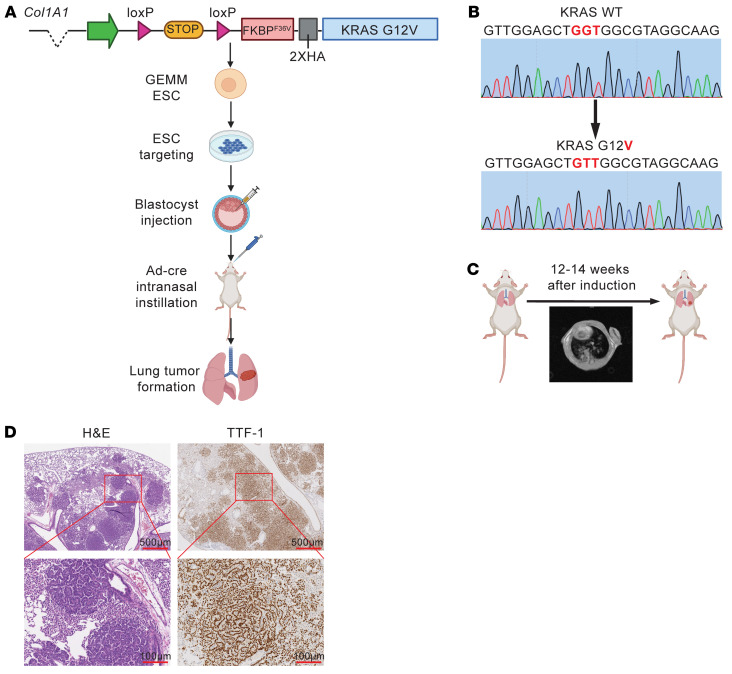
Kirsten rat sarcoma viral oncogene homolog (KRAS) is the most frequently mutated oncogene in lung adenocarcinoma, with G12C and G12V being the most predominant forms. Recent breakthroughs in KRASG12C inhibitors have transformed the clinical management of patients with the G12C mutation and advanced our understanding of the function of this mutation. However, little is known about the targeted disruption of KRASG12V, partly due to a lack of specific inhibitors. Here, we leverage the degradation tag (dTAG) system to develop a KRASG12V-transgenic mouse model. We explored the therapeutic potential of KRASG12V degradation and characterized its effect on the tumor microenvironment (TME). Our study reveals that degradation of KRASG12V abolished lung and pancreatic tumors in mice and caused a robust inhibition of KRAS-regulated cancer-intrinsic signaling. Importantly, targeted degradation of KRASG12V reprogrammed the TME toward a stimulatory milieu and drove antitumor immunity, elicited mainly by effector and cytotoxic CD8+ T cells. Our work provides insights into the effect of KRASG12V degradation on both tumor progression and the immune response, highlighting degraders as a powerful strategy for targeting KRAS-mutant cancers.
Kirsten 大鼠肉瘤病毒癌基因同源物(KRAS)是肺腺癌中最常发生突变的癌基因,其中 G12C 和 G12V 是最主要的形式。KRASG12C 抑制剂的近期突破改变了 G12C 突变患者的临床管理,并加深了我们对该突变功能的理解。然而,关于 KRASG12V 的靶向破坏知之甚少,部分原因是缺乏特异性抑制剂。在此,我们利用降解标签(dTAG)系统开发了一种 KRASG12V 转基因小鼠模型。我们探索了 KRASG12V 降解的治疗潜力,并表征了其对肿瘤微环境(TME)的影响。我们的研究表明,KRASG12V 的降解消除了小鼠的肺癌和胰腺癌,并对 KRAS 调节的癌症内在信号产生了强烈抑制。重要的是,KRASG12V 的靶向降解使 TME 重编程为刺激性微环境,并驱动抗肿瘤免疫,主要由效应性和细胞毒性 CD8+T 细胞引发。我们的工作为 KRASG12V 降解对肿瘤进展和免疫反应的影响提供了见解,突出了降解剂作为靶向 KRAS 突变癌症的有力策略。