Li Fan, Yang Ya
School of Journalism and Communication, Beijing Normal University, Beijing, China.
JMIR Form Res. 2024 Dec 24;8:e60024. doi: 10.2196/60024.
The proliferation of generative artificial intelligence (AI), such as ChatGPT, has added complexity and richness to the virtual environment by increasing the presence of AI-generated content (AIGC). Although social media platforms such as TikTok have begun labeling AIGC to facilitate the ability for users to distinguish it from human-generated content, little research has been performed to examine the effect of these AIGC labels.
This study investigated the impact of AIGC labels on perceived accuracy, message credibility, and sharing intention for misinformation through a web-based experimental design, aiming to refine the strategic application of AIGC labels.
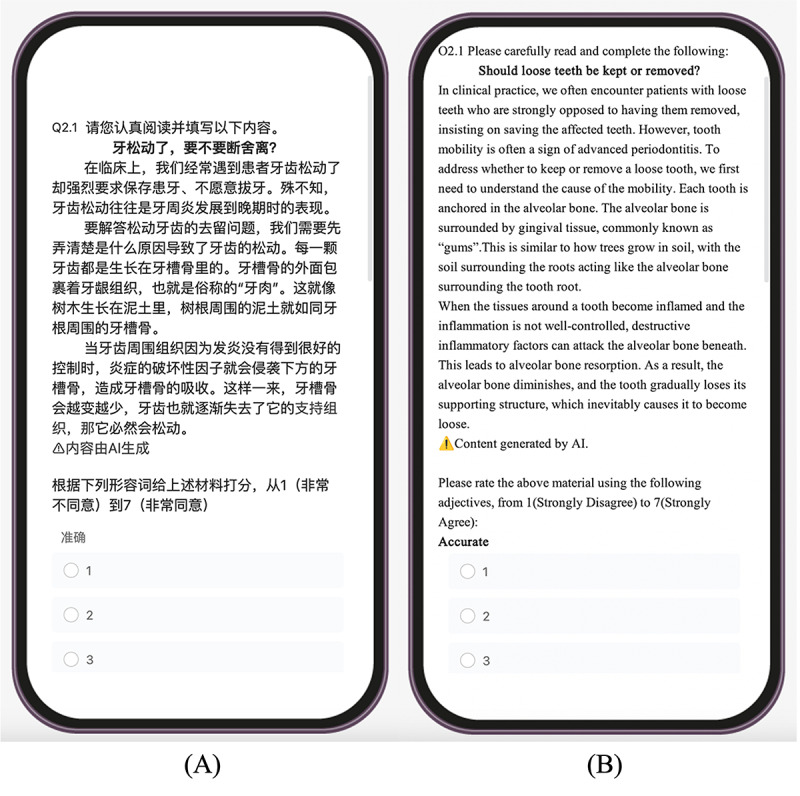
The study conducted a 2×2×2 mixed experimental design, using the AIGC labels (presence vs absence) as the between-subjects factor and information type (accurate vs inaccurate) and content category (for-profit vs not-for-profit) as within-subjects factors. Participants, recruited via the Credamo platform, were randomly assigned to either an experimental group (with labels) or a control group (without labels). Each participant evaluated 4 sets of content, providing feedback on perceived accuracy, message credibility, and sharing intention for misinformation. Statistical analyses were performed using SPSS version 29 and included repeated-measures ANOVA and simple effects analysis, with significance set at P<.05.
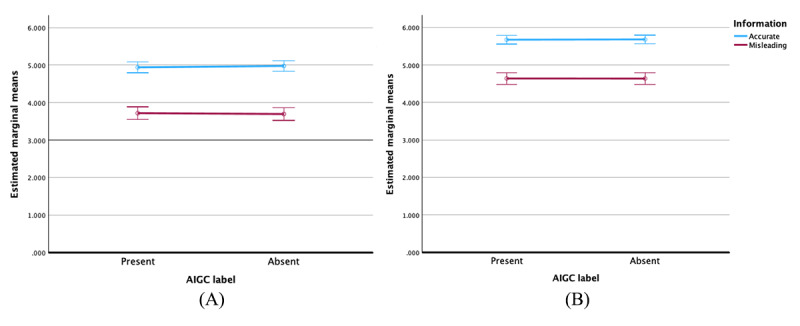
As of April 2024, this study recruited a total of 957 participants, and after screening, 400 participants each were allocated to the experimental and control groups. The main effects of AIGC labels were not significant for perceived accuracy, message credibility, or sharing intention. However, the main effects of information type were significant for all 3 dependent variables (P<.001), as were the effects of content category (P<.001). There were significant differences in interaction effects among the 3 variables. For perceived accuracy, the interaction between information type and content category was significant (P=.005). For message credibility, the interaction between information type and content category was significant (P<.001). Regarding sharing intention, both the interaction between information type and content category (P<.001) and the interaction between information type and AIGC labels (P=.008) were significant.
This study found that AIGC labels minimally affect perceived accuracy, message credibility, or sharing intention but help distinguish AIGC from human-generated content. The labels do not negatively impact users' perceptions of platform content, indicating their potential for fact-checking and governance. However, AIGC labeling applications should vary by information type; they can slightly enhance sharing intention and perceived accuracy for misinformation. This highlights the need for more nuanced strategies for AIGC labels, necessitating further research.
生成式人工智能(AI)的扩散,如ChatGPT,通过增加人工智能生成内容(AIGC)的出现,给虚拟环境增添了复杂性和丰富性。尽管TikTok等社交媒体平台已开始为AIGC贴上标签,以方便用户将其与人类生成的内容区分开来,但很少有研究探讨这些AIGC标签的效果。
本研究通过基于网络的实验设计,调查AIGC标签对错误信息的感知准确性、信息可信度和分享意愿的影响,旨在优化AIGC标签的策略应用。
该研究采用2×2×2混合实验设计,将AIGC标签(存在与否)作为组间因素,信息类型(准确与不准确)和内容类别(营利性与非营利性)作为组内因素。通过Credamo平台招募的参与者被随机分配到实验组(有标签)或对照组(无标签)。每位参与者评估4组内容,提供关于感知准确性、信息可信度和错误信息分享意愿的反馈。使用SPSS 29版进行统计分析,包括重复测量方差分析和简单效应分析,显著性设定为P<0.05。
截至2024年4月,本研究共招募了957名参与者,筛选后,实验组和对照组各分配了400名参与者。AIGC标签对感知准确性、信息可信度或分享意愿的主效应不显著。然而,信息类型对所有3个因变量的主效应显著(P<0.001),内容类别效应也显著(P<0.001)。这3个变量之间的交互效应存在显著差异。对于感知准确性,信息类型和内容类别之间的交互显著(P=0.005)。对于信息可信度,信息类型和内容类别之间的交互显著(P<0.001)。关于分享意愿,信息类型和内容类别之间的交互(P<0.001)以及信息类型和AIGC标签之间的交互(P=0.008)均显著。
本研究发现,AIGC标签对感知准确性、信息可信度或分享意愿的影响极小,但有助于将AIGC与人类生成的内容区分开来。这些标签不会对用户对平台内容的认知产生负面影响,表明它们在事实核查和治理方面的潜力。然而,AIGC标签的应用应因信息类型而异;它们可以略微提高错误信息的分享意愿和感知准确性。这凸显了对AIGC标签采用更细致入微策略的必要性,需要进一步研究。