Wang Xiuhong, Wang Xueyan, Wan Xiaofeng, Wen Xueheng, Lv Cailing, Zhai Jinguo
School of Nursing, Southern Medical University, Guangzhou, 510080, China.
Delivery Room, Guangzhou Women and Children's Medical Center, Guangzhou, 510623, China.
BMC Pregnancy Childbirth. 2024 Dec 24;24(1):859. doi: 10.1186/s12884-024-07092-9.
This study aims to determine the impact of a childbirth educational intervention, based on empowerment theory, on childbirth experience and empowerment in women with fetal occiput posterior and occiput transverse malpositions.
A randomized controlled trial was conducted from February 2022 to December 2022 involving pregnant women with fetal occiput posterior and occiput transverse malpositions. Eligible women were randomly assigned to either the control or study group. The control group received routine care during childbirth, while the study group received routine care and a childbirth-empowering educational intervention delivered by midwives. Primary outcomes assessed were childbirth experience and patient perceptions of patient-empowering nurse behaviors in pregnant women. Secondary outcomes included pregnancy outcomes, delivery support and control, maternal coping behavior during delivery, maternal participation in delivery decisions, and perception of empowerment.
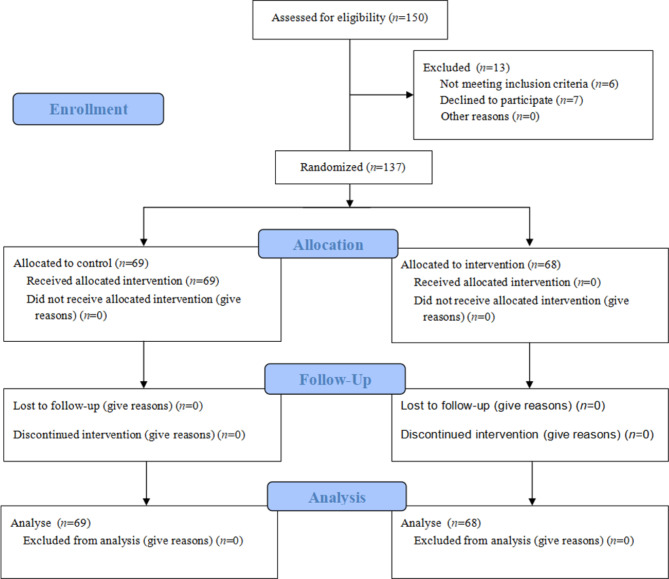
A total of 137 pregnant women were enrolled, with 69 and 68 in the control and study groups, respectively. The study group showed significantly higher levels of childbirth experience and reported better patient perceptions of patient-empowering nurse behaviors than the control group. Additionally, the study group demonstrated higher levels of delivery support and control, maternal coping behavior, and specific aspects of perceived participation and patient perception of empowerment compared to the control group. There were no statistically significant differences in pregnancy outcomes between the two groups.
The childbirth empowering educational intervention effectively improved the childbirth experience and empowerment of women with fetal occiput posterior and occiput transverse malpositions. However, further studies are required to investigate its impact on pregnancy outcomes.
The study protocol was approved by the hospital ethics committee (approval number:2020140A01) and registered at the Chinese Clinical Trial Registry (registration number: ChiCTR2300070915; date of first registration: 26/04/2023).
本研究旨在确定基于赋权理论的分娩教育干预对枕后位和枕横位胎儿孕妇的分娩体验及赋权的影响。
于2022年2月至2022年12月进行了一项随机对照试验,纳入枕后位和枕横位胎儿的孕妇。符合条件的女性被随机分配至对照组或研究组。对照组在分娩期间接受常规护理,而研究组接受常规护理以及由助产士提供的分娩赋权教育干预。评估的主要结局是分娩体验以及孕妇对赋予患者权力的护士行为的看法。次要结局包括妊娠结局、分娩支持与控制、分娩期间的产妇应对行为、产妇对分娩决策的参与度以及赋权感。
共招募了137名孕妇,对照组和研究组分别有69名和68名。研究组的分娩体验水平显著更高,且报告称对赋予患者权力的护士行为的看法优于对照组。此外,与对照组相比,研究组在分娩支持与控制、产妇应对行为以及感知参与度和赋权感的特定方面表现出更高水平。两组之间的妊娠结局无统计学显著差异。
分娩赋权教育干预有效改善了枕后位和枕横位胎儿孕妇的分娩体验及赋权情况。然而,需要进一步研究以调查其对妊娠结局的影响。
该研究方案已获医院伦理委员会批准(批准号:2020140A01),并在中国临床试验注册中心注册(注册号:ChiCTR2300070915;首次注册日期:2023年4月26日)。