Wang Yu, Yu Jing, Chen Binqin, Jin Wenqi, Wang Meili, Chen Xuenan, Jian Mengqiong, Sun Liwei, Piao Chunli
College of Traditional Chinese Medicine, Changchun University of Chinese Medicine, Changchun, Jilin, China.
Department of Endocrinology, the Affiliated Hospital of Changchun University of Chinese Medicine, Changchun, Jilin, China.
Front Endocrinol (Lausanne). 2024 Dec 10;15:1481270. doi: 10.3389/fendo.2024.1481270. eCollection 2024.
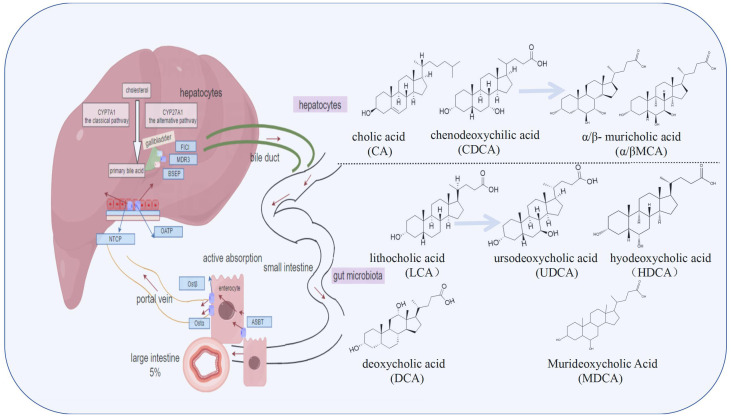
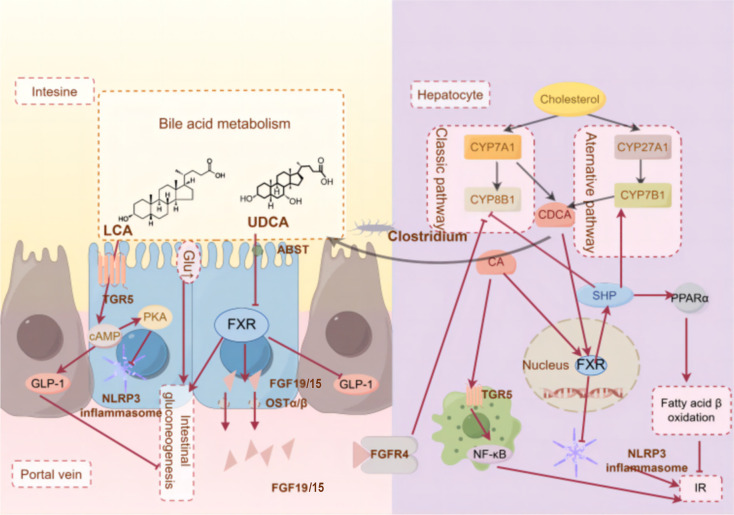
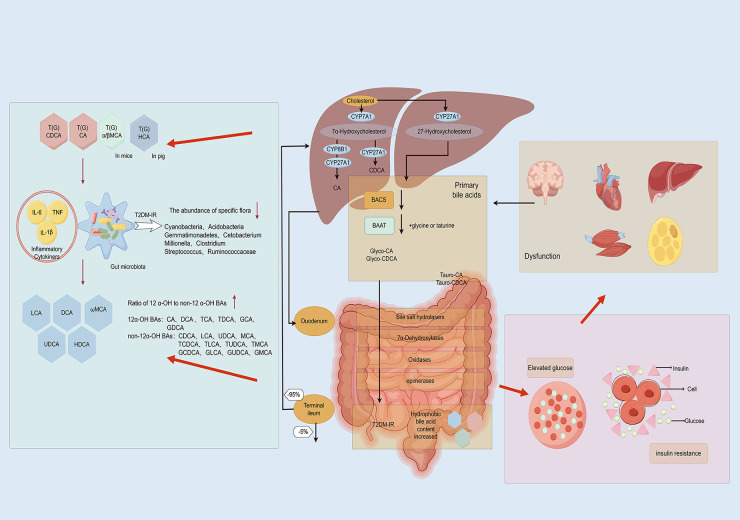
Type 2 diabetes mellitus (T2DM) is a chronic metabolic disease caused by insulin resistance (IR) and insufficient insulin secretion. Its characteristic pathophysiological processes involve the interaction of multiple mechanisms. In recent years, globally, the prevalence of T2DM has shown a sharp rise due to profound changes in socio-economic structure, the persistent influence of environmental factors, and the complex role of genetic background. It is worth noting that most T2DM patients show significant IR, which further exacerbates the difficulty of disease progression and prevention. In the process of extensively exploring the pathogenesis of T2DM, the dynamic equilibrium of gut microbes and its diverse metabolic activities have increasingly emphasized its central role in the pathophysiological process of T2DM. Bile acids (BAs) metabolism, as a crucial link between gut microbes and the development of T2DM, not only precisely regulates lipid absorption and metabolism but also profoundly influences glucose homeostasis and energy balance through intricate signaling pathways, thus playing a pivotal role in IR progression in T2DM. This review aims to delve into the specific mechanism through which BAs contribute to the development of IR in T2DM, especially emphasizing how gut microbes mediate the metabolic transformation of BAs based on current traditional Chinese medicine research. Ultimately, it seeks to offer new insights into the prevention and treatment of T2DM. Diet, genetics, and the environment intricately sculpt the gut microbiota and BAs metabolism, influencing T2DM-IR. The research has illuminated the significant impact of single herbal medicine, TCM formulae, and external therapeutic methods such as electroacupuncture on the BAs pool through perturbations in gut microbiota structure. This interaction affects glucose and lipid metabolism as well as insulin sensitivity. Additionally, multiple pathways including BA-FXR-SHP, BA-FXR-FGFR15/19, BA-FXR-NLRP3, BA-TGR5-GLP-1, BAs-TGR5/FXR signaling pathways have been identified through which the BAs pool significantly alter blood glucose levels and improve IR. These findings offer novel approaches for enhancing IR and managing metabolic disorders among patients with T2DM.
2型糖尿病(T2DM)是一种由胰岛素抵抗(IR)和胰岛素分泌不足引起的慢性代谢性疾病。其特征性病理生理过程涉及多种机制的相互作用。近年来,在全球范围内,由于社会经济结构的深刻变化、环境因素的持续影响以及遗传背景的复杂作用,T2DM的患病率急剧上升。值得注意的是,大多数T2DM患者表现出显著的IR,这进一步加剧了疾病进展和预防的难度。在广泛探索T2DM发病机制的过程中,肠道微生物的动态平衡及其多样的代谢活动越来越凸显其在T2DM病理生理过程中的核心作用。胆汁酸(BAs)代谢作为肠道微生物与T2DM发生发展之间的关键环节,不仅精确调节脂质吸收和代谢,还通过复杂的信号通路深刻影响葡萄糖稳态和能量平衡,从而在T2DM的IR进展中发挥关键作用。本综述旨在深入探讨BAs促进T2DM中IR发生发展的具体机制,尤其基于当前中医药研究强调肠道微生物如何介导BAs的代谢转化。最终,旨在为T2DM的预防和治疗提供新的见解。饮食、遗传和环境错综复杂地塑造了肠道微生物群和BAs代谢,影响T2DM-IR。研究表明,单味中药、中药方剂以及电针等外治疗法通过扰动肠道微生物群结构对BAs池有显著影响。这种相互作用影响葡萄糖和脂质代谢以及胰岛素敏感性。此外,已确定包括BA-FXR-SHP、BA-FXR-FGFR15/19、BA-FXR-NLRP3、BA-TGR5-GLP-1、BAs-TGR5/FXR信号通路在内的多种途径,通过这些途径BAs池可显著改变血糖水平并改善IR。这些发现为增强T2DM患者的IR和管理代谢紊乱提供了新方法。